Day 19 - reflection & refraction concepts
 Call Kai
 Learn
 Practice Test
 Spaced Repetition
 Match
 Flashcards
 Knowt Play
1/148

There's no tags or description
Looks like no tags are added yet.
149 Terms
What is being described?
Light bounces off a surface
reflection
What is being described?
Light changes direction and speed as it crosses into another material
refraction
What is being described?
Light passes through a material
transmission
When light reaches the boundary between two transparent material, some light might…
reflect while some transmits into the second material

What is the normal line/axis?
A imaginary vertical line that is perpendicular to the boundary
The reflected ray’s angle is measured from…
the normal line/axis
Is the reflected ray’s angle measured from the surface?
NO
it is measured from the normal axis/line
A ___________ connects points on a wave that are at the same phase
wavefront
the image depicts wavefronts from two different POVs


What does a wavefront do?
It connects the points of a wave that are at the same phase
example: points that are all at the crest of a wave
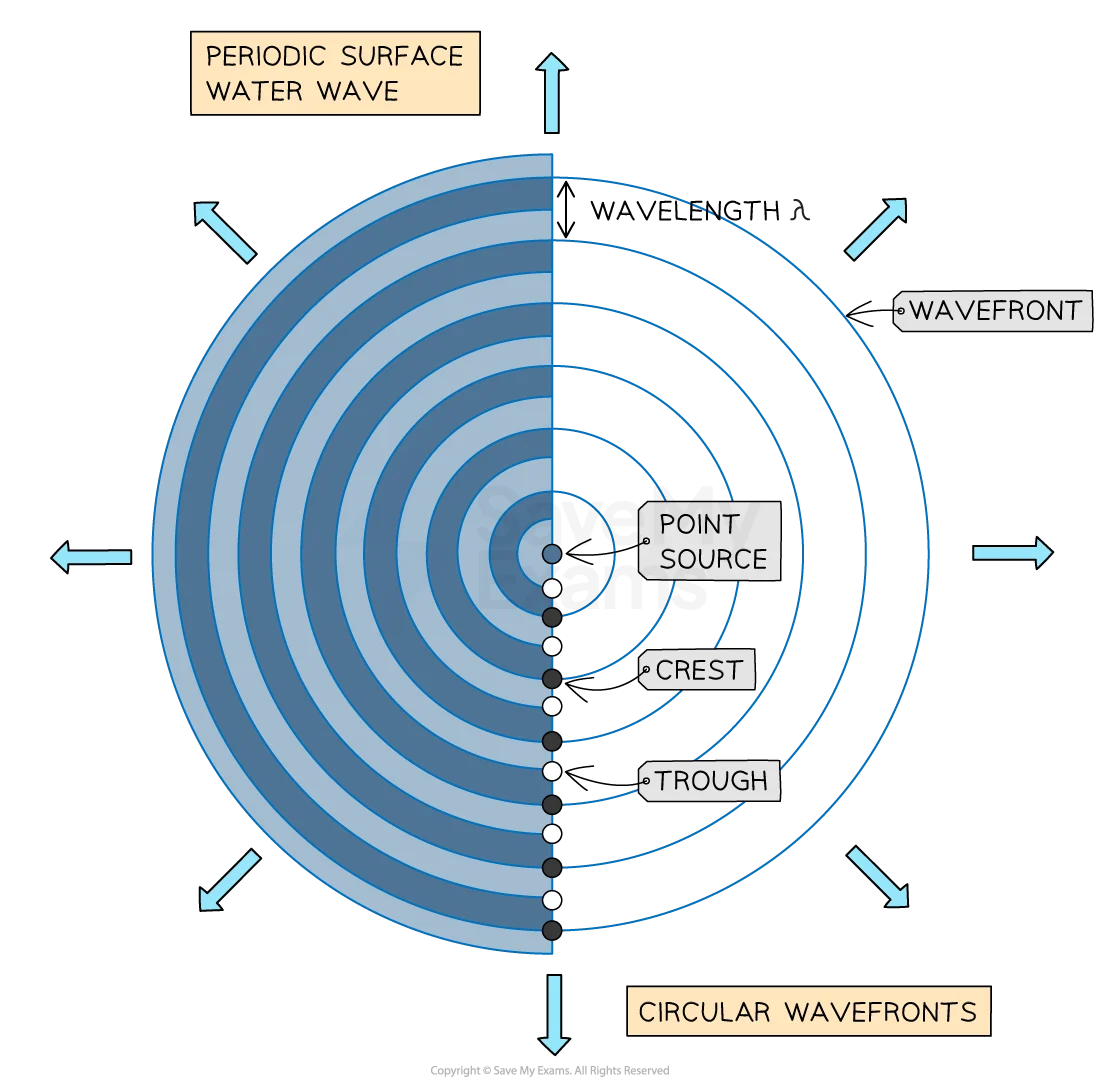
Think of dropping a pebble into a pond, the expanding circles represent ____________
wavefronts
What ways can a wavefront be drawn?
Circle
Line
A _____ is an imaginary line showing the direction in which a wave travels
Ray
A ray does what?
is an imaginary line that shows the direction a wave travels
How can rays be drawn?
an arrowed line
Does a point source (non-uniform material) emit light in MANY directions?
Yes
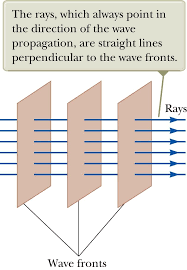
In a ________ material, light rays travel in straight lines and are perpendicular to the wavefronts
Uniform
In uniform material, light rays travel in _________ lines
Straight

In uniform material, wavefronts are __________ to the light rays
Perpendicular

Do light rays travel in the same direction in a uniform material and non-uniform material?
NO
An ______ is the source from which light rays originate or reflect
object
The object is where light rays _______ or reflect
originate
The ______ is the location where the rays converge, or appear to converge when traced backwards
image
The image is the location from which light rays converge, or …
appear to converge from when drawn backwards
On which side of the optical system (lens or mirror) is the object found?
In front/ left side
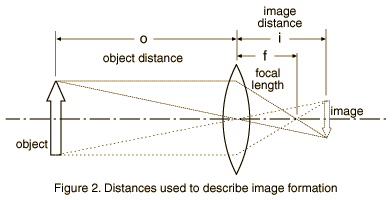
What variable is used for…
Object distance
s
S represents what?
object distance
Measuring from the object to the optical system revels what?
the object distance
On which side of the optical system (lens or mirror) is the image found?
behind the optical system/to the right
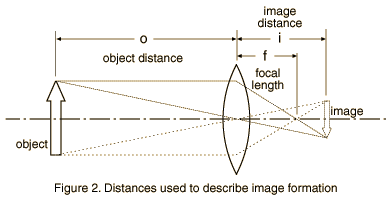
What variable is used for…
Image distance
S’ (s prime)
What does S’ represent?
image distance
Measuring from the optical system to the image reveals what?
the image distance
What variable is used for…
Object height
h
What does h represent?
object height
What variable is used for…
Image height
h’ (h prime)
What does h’ (h prime) represent?
Image height
Which variables are associated with objects?
s and h
Which variables are associated with image?
s’ and h’ (s prime & h prime)
Which variables are associated with distance?
s and s’
Which variables are associated with height?
h and h’
In REAL images, does light converge or diverge?
converge
In REAL images, where do light rays actually converge at?
at the image location
Can REAL images be projected onto a screen?
YES
The image is upside down relative to the object means the image is…
inverted
The image has the same vertical orientation as the object means the image is…
upright
Are images upright or inverted in REAL images?
inverted (upside down)
Can virtual images be projected?
NOOOOOOO
In virtual images, does light converge or diverge?
diverge
Are virtual images upright or inverted?
upright
In virtual images, the rays diverge but tracing them backwards makes them appear to originate from an image location
True or False?
True
In virtual images, does the light actually travel behind the mirror?
NO
the path of the rays are what travels behind the mirror
A place mirror (the ones found in bathrooms) produce what type of image?
Virtual image
diverge
upright
Cannot be projected
When the IMAGE is larger then the object, is it magnified or reduced?
Magnified
When the image is smaller than the object, it is magnified or reduced?
reduced
How is magnification calculated?
m= — (s’ / s)
OR
m= h’ / h
The absolute value of magnification |m| tells you…
the image-to-object size ratio
If the absolute value of magnification is equal to 2, what does that tell us about the image?
|m|= 2
the image is TWICE as tell as the object
If the absolute value of magnification is equal to 0.5, what does that tell us about the image?
|m|=0.5
the image is HALF as tall as the object
The law of reflection states that…
Angle of incidence equals the angle of reflection
Theta i = Theta r
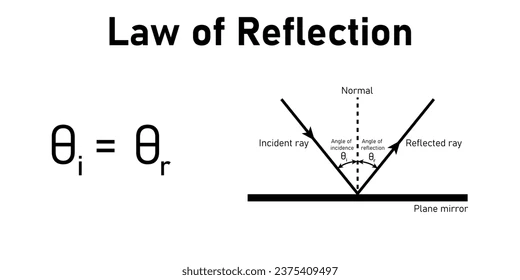
Both the angle of incidence and angle of reflection are measured relative to what/
the normal axis/line
Example:
A ray strikes a mirror at an incidence angle of 35 degrees. What is the reflection angle?
35 degrees
Specular reflection occurs when…
Light reflect is from a smooth surface
Diffuse reflection occurs when…
light reflections from a rough surface
What are examples of specular reflection?
plane mirrors
Polished metal
Smooth water
With specular reflection, parallel incoming rays tend to _______ ________ after reflecting from a flat smooth surface
remain parallel
What are examples of diffuse reflection?
paper
Concrete
Rough water
In diffuse reflection, the surface’s irregularities send rays in _______ ________
different directions
each individual ray does still obey the law of reflection regardless
Why can you see a road without seeing a clear reflection of yourself?
The road reflects light diffusely, sending reflected light in many directions
A smooth mirror produce a more orderly reflection that allows…
an image to form
If it is daytime, do car headlight Mack a noticeable difference?
No, because sunlight already illuminates the road strongly, so the additional diffuse reflection from the headlights is not noticeable
Does diffuse reflection mean the law of reflection stops working?
NOOOOO
it means that the local surface orientations vary, so reflected rays travel in many directions
Describe the image created by an ordinary plane mirror (flat mirror)
virtual
Upright
Same size as object (h = h’)
Same distance behind the mirror as the object is in front (s=s’)
Example: Solve distance between you and your image
d = distance between object & mirror
d = distance between mirror & image
Formula for distance between you and your image is: 2d
You stand 2m in front of a plane mirror, your image is 2m behind it
Now plug in: 2(2) =4 m
technically, you could just add it together to get the same answer lol
Example: walking toward a mirror
You walk toward flat mirror at 2 m/s
Your image approaches the mirror at 2 m/s
You and your image approaches EACH OTHER at what speed?
4 m/s
add velocities together
How tall must a mirror be (minimum) to see your full body?
L= H/2
you plug in your/someone’s height into H to find the minimum mirror length
Example:
How tall must a mirror be if someone is 1.8 m tall?
L = H/2
L = 1.8/2
L = 0.9 m under the ideal plane-mirror conditions
Does a plane-mirror reverse the image left-to-right?
NO
A plane-mirror reverses the image in which direction?
front-to-back
Refraction occurs when what two things occur?
When light (1)crosses a boundary between materials and (2)its speed changes
When refraction occurs, does the velocity of light change?
yes
What are some example of refraction?
a straw appearing bent in a glass of water
A swimming pool appearing shallower (less deep) than it really is
Light bending as it enters glass from air
When light travels through a material, does it interact with atoms and electrons in the material?
Yes, and this interaction results in changes in the speed of light and a change in direction
when light travels from lower refractive index to high refractive index (n1<n2), what happens to the speed of light?
Slows down
when light travels from higher refractive index to lower refractive index (n1>n2), what happens to the speed of light?
speeds up
when light travels into a material with the same refractive index, what happens to the speed of light?
No speed change
when light travels from lower refractive index to high refractive index (n1<n2), what happens to the direction of light?
Bends toward the normal line
when light travels from high refractive index to low refractive index (n1>n2), what happens to the direction of light?
bends away from the normal line
when light travels into a material with the SAME refractive index, what happens to the direction of the light?
It does NOT bend
What variable is used to represent the Index of Refraction?
n
Learn and memorize the index of refraction for vacuum, air, water, ice, glass, and diamond
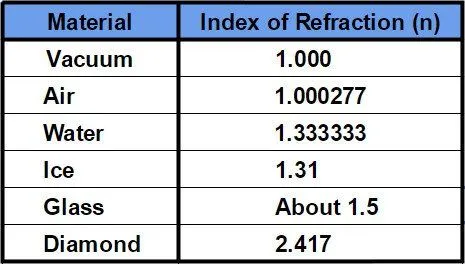
What is the index of refraction in a vacuum?
1.0
What is the index of refraction in air?
1.000277
What is the index of refraction in Water?
1.3
What is the index of refraction in glass?
1.5
What is the index of refraction in diamonds?
2.417
When n1 is greater, does the refracted ray move closer or farther away from the normal line/axis?
AWAY from normal
When n2 is greater, does the refracted ray move closer or farther away from the normal line/axis?
TOWARD the normal
When moving from air into glass, describe the light’s speed & proximity to normal?
Slows down
refracted ray is TOWARD normal
When moving from glass into air, describe the light’s speed & proximity to normal?
speeds up
Refracted ray AWAY from normal
Does light bend at every boundary?
No
True or false?
If light enters along the normal line/axis, the direction remains straight even if it’s speed changes
True