OB exam 2 day 1
 Call Kai
 Learn
 Practice Test
 Spaced Repetition
 Match
 Flashcards
 Knowt Play
1/146

There's no tags or description
Looks like no tags are added yet.
147 Terms
Assessment of uterine contractions
increment
acme
decrement
frequency
intensity
duration
resting tone
increment
“Building up” of a contraction from its onset.
acme
peak
Decrement
The “letting down” of the contraction
frequency
how often contractions occur
the time that elapses from the beginning of one contraction to the beginning of the next contraction
always in minutes and in a range
EX: 2-3 mins
intensity
the strength of a contraction at its peak
intensity: electronic fetal monitor
tells us frequency and duration, not intensity
palpate fundus during contraction to know
intensity: mild feels like
nose
intensity: moderate feels like
chin
intensity: strong feels like
forehead
duration
the time that elapses between the onset and the end of a contraction
always done in seconds
resting tone
the tension in the uterine muscle between contractions
relaxation of the uterus
Palpate fundus to make sure its soft
oral intake during labor
clear liquids
voiding during labor
Encourage voiding every 2 hours
epidural;= at risk for the retention of urine.
why do we want them to void so often during labor
bc a distended distended bladder may:
impede descent of the presenting part
slow or stop uterine contractions
lead to decreased bladder tone (Risk for PPH)
uterine atony after birth
why may you not be able tp advance a cathetor during labor
an obstacle is present and probably at the presenting part
If you cannot advance the catheter, stop the procedure, and notify the primary health care provider of the difficulty.
bowel movements during birth
urge to defecate= perform a vaginal examination to assess cervical dilation and station
When the presenting part is deep in the pelvis, the woman may feel rectal pressure and think she needs to defecate
If a multiparous woman has the urge to defecate= birth will follow quickly.
good positions during labor
Upright positions and mobility during labor may be more pleasant for laboring women
changing positions often (q30-60 min)
side lying
squatting
hands and knees position

good positions during labor: side lying
put a role under her hip
good positions during labor: squatting
great bc gravity helps
can also help OP baby go to OA
good positions during labor: hands and knees
good for babies in OP position and it could turn them to OA position
advantage of upright positions during labor
improved uterine contraction intensity
shorter labors
reduced need for pain medications
reduced risk for caesarean birth
increased maternal autonomy and control.
Labor support by the nurse
Helping the woman conserve her energy.
Protect the woman's privacy and modesty.
Heat or cold applied to the lower back in the event of back labor, a cool cloth applied to the forehead.
Peanut ball also gives support
Second Stage of Labor
Begins with full cervical dilation (10 cm)
Complete effacement (100%)
Ends with baby’s birth.
nulliparous women second stage
without an epidural, upper limits are set at 2 hours
with an epidural 3 hours
multiparous women second stage
the limits are set at 1 hour without an epidural
2 hours with an epidural.
2 phases of 2nd stage of labor
latent
descent
2 phases of 2nd stage of labor: latent
relatively calm with passive descent of baby through birth canal
urge to bear down is not strong or not at all
Delayed pushing is associated with a longer second stage of labor but a decrease in actual pushing time.
2 phases of 2nd stage of labor: descent
active pushing and urges to bear down
The urge to bear down intensifies as descent progresses and the presenting part reaches the perineum.
bearing-down efforts
closed glottis method
open glottis method
bearing-down: closed glottis method
The woman may either push instinctively and spontaneously as she feels the need to do so or be told to hold her breath, closing her glottis, and pushes as the nurse or partner counts to 10
Contraction begins, cleansing breath in and out, bear down and push and redo
bearing-down: open glottis method
When they are not instructed to push in a specific manner, most women will push with an open glottis
Tell her to grunt
Women should be encouraged to use the pushing technique they prefer and believe is more effective for them.
what to do when mom is pushing
preheat babies bed
how to put mom in lithotomy position
bring her buttocks to the edge of the bed or table and place her legs in stirrups
Take care to pad the stirrups, to raise and place both legs simultaneously, and to adjust the shanks of the stirrups so that the calves of the legs are supported.
No pressure should be placed on the popliteal space
Stirrups that are not the same height will strain ligaments in the woman's back as she bears down, leading to considerable discomfort in the postpartum period.
Once the woman is positioned for birth either in a delivery room or in a birthing room, the vulva and perineum are cleansed

how to put mom in lithotomy position: No pressure should be placed on the popliteal space
risk for thrombophlebitis or back pain
Phases of baby coming out
Anteroposterior slit
Oval opening
Circular shape
Crowning
Phases of baby coming out: crowning
Occurs when the widest part of the head (the biparietal diameter) distends the vulva just before birth
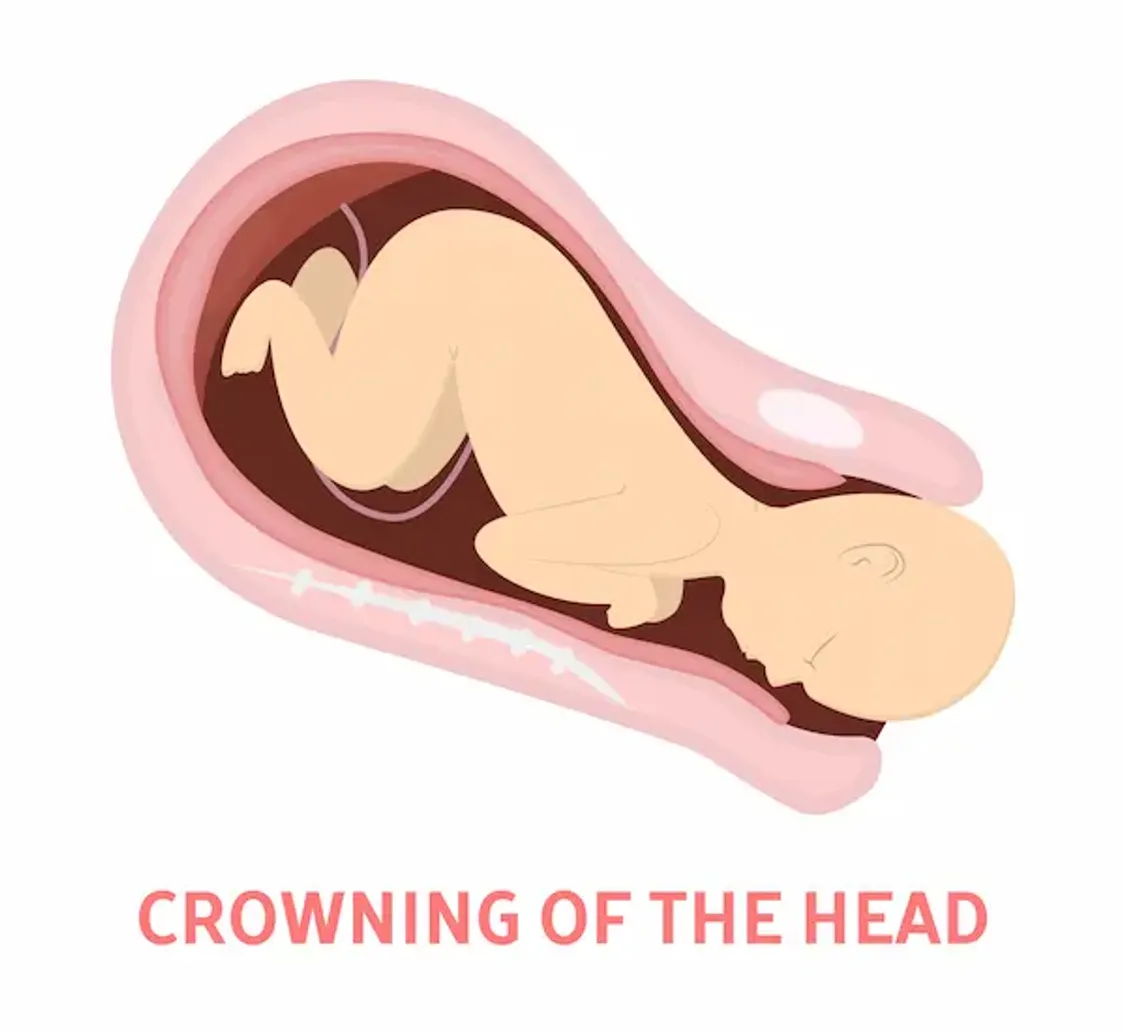
how to get a baby out
Wash your hands and put on sterile gloves.
woman should to pant or pant-blow, thus minimizing the urge to push
Place the flat side of your hand on the exposed fetal head and apply gentle pressure toward the vagina to prevent the head from “popping out.”
After the birth of the head, check for the umbilical cord. If the cord is around the baby's neck, try to slip it over the baby's head or pull it gently to get some slack so that you can slip it over the shoulders.
Then, with one hand on each side of the baby's head, exert gentle pressure downward so that the anterior shoulder emerges under the symphysis pubis and acts as a fulcrum; then, as gentle pressure is exerted in the opposite direction, the posterior shoulder, which has passed over the sacrum and coccyx, emerges.
Cradle the baby's head and back in one hand and the buttocks in the other. Keep the head down to drain away the mucus.
Use a bulb syringe, if needed, to remove mucus from the baby's mouth and nose.
If birth occurs outside a hospital setting, to minimize complications, do not cut the cord without proper clamps and a sterile cutting tool.
Immediate assessments and care of the newborn
Perform a brief assessment of the newborn immediately during skin-to-skin contact
Apgar scores at 1 and 5 minutes after birth
Maintain a patent airway (SUCTION)
prevent cold stress
Immediate assessments and care of the newborn: prevent cold stress
dry the newborn and covering the newborn with a warmed blanket and hat or placing him or her under a radiant warmer
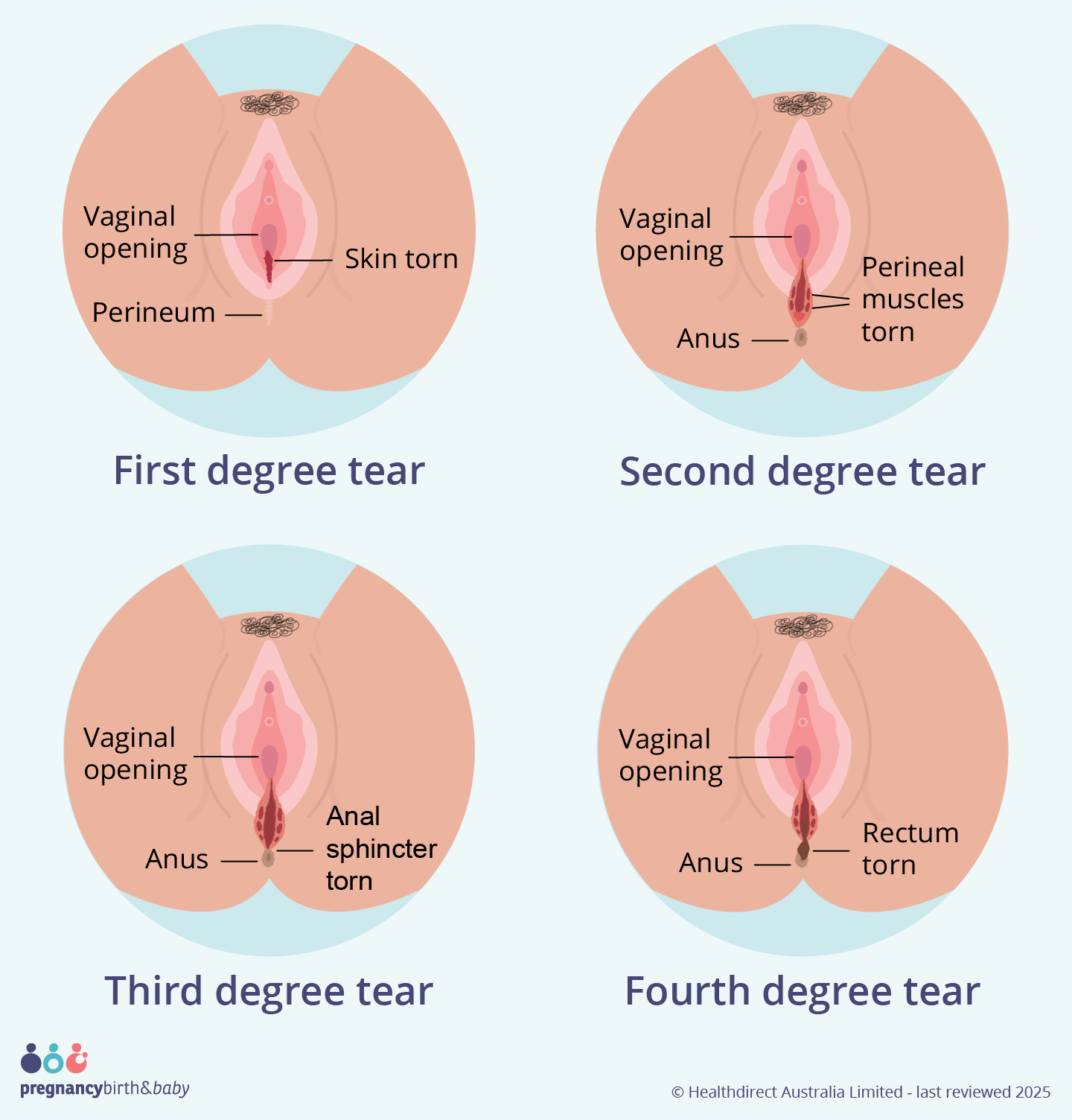
degrees of perineal lacerations: first degree
confined to skin

degrees of perineal lacerations: second degree
Extends into the perineal body (muscle)

degrees of perineal lacerations: third degree
Injury to the external and sphincter muscle

degrees of perineal lacerations: fourth degree
Extends completely through the anal sphincter and the rectal mucosa
episiotomy
an incision made in the perineum to enlarge the vaginal outlet
Midline (median)
mediolateral(45 degree angle)

routine vs indicated episiotomy
routine: no role in modern obstetric care and should be avoided whenever possible
indicated: may still be performed in specific situations, such as the need to hasten birth when FHR abnormalities are present.
third stage of labor
from the birth of the baby until the placenta is expelled
Placental separation and expulsion
The placenta is usually expelled within 15 minutes after the birth of the baby
Provider examines placenta and membranes for intactness.
Signs of placental separation
Uterus changes from discoid to globular shape.
Placenta enters vagina, cord is seen to lengthen, and an increase in bleeding may be seen.
Fourth Stage of Labor
1st hour after delivery of the placenta; up to 1 hour post-partum
postpartum uterus
involution
subinvolution
postpartum uterus: involution
return of uterus to nonpregnant state following birth
Within 12 hours, the fundus can rise to approximately 1 cm above the umbilicus.
Fundus descends 1 to 2 cm every 24 hours
2 weeks after childbirth, uterus should not be palpable abdominally
how to chart uterine involution
FF at U (firm fundus at umbilicus)
FF at U -1) firm fundus at umbilicus minus 1cm
postpartum uterus: subinvolution
failure of uterus to return to nonpregnant state
common causes of subinvolution
retained placental fragments left behind (late PPH)
infection (affects uterus ability to contract)
postpartum uterine contractions
oxytocin, released from pituitary gland, strengthens, and coordinates uterine contractions
she’ll have contractions after birth
afterpains (pains after birth)
Cramps
more noticeable after births in which the uterus was overdistended
Breastfeeding and exogenous oxytocic medication usually intensify these afterpains because both stimulate uterine contractions
breastfeeding releases oxytocin
oxytocin is also put in IV after birth so that can cause it too
in what circumstances would the uterus be over distended
large baby (>8lbs, 15oz)
multifetal gestation
polyhydramnios
placental site after birth
Upward growth of the endometrium causes sloughing of necrotic tissue and prevents the scar formation that is characteristic of normal wound healing.
lochia
Postbirth uterine discharge
Lochia should smell similar to normal menstrual flow; an offensive odor usually indicates infection.
types of lochia
Rubia
serosa
alba
lochia rubia
Bright red
Duration of 1 to 3 days
lochia serosa
Pink or brown
Duration of 4 to 10 days
lochia alba
Yellow to white
10 to 14 days; can last 3-6 weeks
If someone is at alba and goes back to rubra, it’s a sign of late PPH
flow of lochia
If the woman receives an oxytocic medication, the flow of lochia is often scant until the effects of the medication wear off.
The amount of lochia is typically smaller after cesarean births (bc they suction the uterus).
Flow of lochia usually increases with ambulation and breastfeeding.
Lochia tends to pool in the vagina when the woman is lying in bed; on standing the woman may experience a gush of blood. This gush should not be confused with hemorrhage.
cervix after birth
Ectocervix pap smear appears bruised and has small lacerations (risk for infection)
Cervical os (dilated to 10 cm during labor)
closes gradually
Cervix looks like fish mouth after birth

ovulation after birth
6 months until they ovulate again
Because of the uncertainty about the return of ovulation and menstruation, discussion of contraceptive options should be discussed early in the puerperium (discussed at discharge).
anovulation
influenced by the frequency and duration of breastfeeding and supplements
(no supplements for baby)
menstruation after birth
resumes by 12 weeks after childbirth if you’re bottlefeeding
will ovulate at 3 months PP.
vaginal mucosa after birth
Estrogen deprivation responsible for thinness of vaginal mucosa and absence of rugae – return within 3 weeks.
vagina after birth
Dryness and coital discomfort, dyspareunia (painful sex) may persist until return of ovarian function.
The use of a water-soluble lubricant during sexual intercourse is usually recommended. (KY jelly)
perineum after birth
Introitus is erythematous and edematous,
Signs of infection (pain, redness, warmth, swelling, or discharge) or loss of approximation (separation of the incision edges) may occur.
assess incision for REEDA

REEDA
redness
edema
ecchymosis
drainage
approximate
healing of episiotomies
heal within 2 to 3 weeks
can not have sex until it heals
hemorrhoids after birth
decrease within 6 weeks of childbirth.
Documentation: Count hemorrhoids, size, and if they’re painful
pelvic muscular support
Supportive tissues of pelvic floor torn or stretched during childbirth.
Require up to 6 months to regain tone.
Kegel exercises encourage healing
Later in life women can experience pelvic relaxation (prolapse)
pelvic muscular support: Kegel exercises encourage healing
bc they’re at risk for stress incontinence within 6mo
breastfeeding mothers
Before lactation a yellowish fluid, colostrum, can be expressed from nipples.
Some women experience engorgement
Breasts are swollen and hard bc they’re not feeding baby as frequently as they should
breastfeeding mothers: how to help engorgement
frequent breastfeeding and proper care
typically lasts only 24 to 48 hours.
nonbreastfeeding moms: engorgement
Engorgement resolves spontaneously, and discomfort decreases within 24 to 36 hours
need to wear a bra
moms temp after birth
during first 24 hours may rise to 38° C (100.4° F)
After 24 hours the woman should be afebrile
if >100.4, call HCP
what to do when moms temp is a bit elevated in the first 24 hours
drink water
Normal bc she’s dehydrated
pulse after birth
postpartum bradycardia is common, with heart rate decreasing to 40 to 50 bpm
Bc of blood loss, sweating during delivery, and peeing
RR after birth
rapidly returns to nonpregnancy levels after birth
BP after birth
increase of approximately 5% over the first few days after birth, returning to prepregnancy levels over weeks or months.
orthostatic hypotension may occur
BP after birth: orthostatic hypotension
all moms are at risk within 48 hrs and an RN needs to be the one to get her up
indicated by feelings of faintness or dizziness immediately after standing up
cause: splanchnic engorgement
blood loss for vaginal birth
300 to 500 ml (10% of blood volume)
blood loss for c-section
500 to 1000 ml (15% to 30% of blood volume)
cardiac output after birth
Remains increased for 1 hour postpartum because of an increase in stroke volume.
Cardiac output generally returns to normal by 6 to 8 weeks after birth
If mom has cardiovascular disease, this will put her at risk for pulmonary distress syndrome
Varicosities after birth
Total or nearly total regression of varicosities is expected after childbirth
Varicosities of the legs and around the anus (hemorrhoids) are common during pregnancy
blood components after birth
H&H: eaches nonpregnant levels by 4 to 8 weeks postpartum
WBC: during and after labor, the WBC may rise to 30,000/mm3(bc it’s a protective mechanism to prevent PP infection)
coags: normally increased during pregnancy and remain elevated in the immediate puerperium
normal WBC count
Normal is 5,000 to 15,000
blood components after birth: coags
risk for thromboembolism
all women are at risk for pulmonary embolism for up to 12 weeks after birth
placental hormones after birth
Expulsion of the placenta results in dramatic decreases of hcg, estrogen, and progesterone, human Placental Lactogen
pituitary hormones after birth (breastfeeding)
Prolactin levels in blood rise remain elevated
pituitary hormones after birth (bottle feeding)
Prolactin levels decline after birth and reach the prepregnant range by the third postpartum week
renal function after birth
Risk of UTI may be increased bc of tissue trauma from labor and birth, effects of epidural analgesia or anesthesia, or perineal/vaginal discomfort.
Ketonuria may occur in women with an uncomplicated birth or after a prolonged labor with dehydration.
fluid loss after birth
Within 12 hours women begin to diurese (pee a lot)
Profuse diaphoresis often occurs at night for first 2 to 3 days
This is how the get rid of extra blood volume from pregnancy
fluid loss after birth: Within 12 hours women begin to diurese (pee a lot)
May void 3000 ml/day
Check foley of c-section mom frequently
urethra and bladder after birth
Excessive bleeding can occur because of displacement of the uterus if bladder is full
if Bladder wont be able to clamp down—> risk for PPH
Fundus will be deviated to side (needs to empty)