Chem chapter 5
 Call Kai
 Learn
Learn Practice Test
 Spaced Repetition
 Match
Match Flashcards
 Knowt Play
1/56

There's no tags or description
Looks like no tags are added yet.
Name | Mastery | Learn | Test | Matching | Spaced | Call with Kai | Chat |
|---|
No analytics yet
Send a link to your students to track their progress
57 Terms
bond polarity
electrons are not shared equally between atoms in a covalent bond, resulting in a partial positive charge and a partial negative charge
electronegativity
ability of an atom to attract bonding electrons to itself
bond polarity and electronegativity connection
larger EN difference = higher bond polarity
negative end of bond polarity goes towards the more EN atom
electronegativity trend
increases across a period and decreases down a group
Fluorine is highest, francium is lowest
noble gases not assigned EN values
opposite of atomic size trend
pure covalent bond
difference in EN is 0- equal sharing of atoms in a bond
nonpolar covalent
EN difference between 0.1-0.4
polar covalent
EN difference is between 0.5-1.9 - unequal sharing of electrons between atoms in a bond
ionic bond EN
EN difference greater than 2
dipole moment
measure of bond polarity
a material with a positive and negative end
directly proportional to the size of partial charges and the distance between them
dipole moment equation

percent ionic character
the percentage of a bond’s measured dipole moment compared to what it would be if electrons were completely transferred
indicates the degree to which the electron is transferred
percent ionic character formula
measured dipole/dipole if e- was transferred *100%
resonance purpose
used when 2+ valid Lewis structures can be drawn for the same compound
formal charge definition
an electron bookkeeping system that allows us to discriminate between alternative Lewis structure
atoms may end up with more or fewer electrons than the valence electrons they brought in order to fill octets, resulting in a charge
resonance theory
suggests that there is some degree of delocalization of the electrons
delocalization of charge helps stabilize the molecule
resonance structures
when there is more than 1 Lewis structure for a molecule that only differ in the position of electrons

formal charge rules
sum of all formal charges in a neutral molecule must equal 0
sum of formal charges in an ion must = the charge of the ion
small (or zero) formal charges on individual atoms are better than large ones
when formal charge cannot be avoided, negative formal charge should lie on the most electronegative atom
formal charge formula
# of valence electrons - [# of nonbonding electrons + 1/2(# of bonding electrons)]
SHORTCUT: how many valence electrons atom should have - how many it actually has
group number - (number of lines + number of dots)
exceptions to octet rule
odd electron species (free radicals), incomplete octets, and expanded octets
odd electron species (free radicals)
molecules or ions with an odd number of electrons- incomplete octets, molecules, or ions with fewer than 8 electrons
incomplete octets
elements (specifically metalloids and hydrogen) whose tendency is not to have a complete octet
expanded octets
molecules with more than 8 electrons around an atom - 3rd row nonmetals and below can do this
expanded octets and Lewis structures
when a high charge separation is detected, like a high positive charge (ex. +2) on a central atom sitting next to negative charges on terminal atoms
take lone pair from the negative atom and double bond it to the central atom, reducing positive charge by 1 on the central atom and increasing negative charge by 1 on terminal atom
bond energy
the amount of energy in gas state it takes to break one mole of a bond in a compound
greater bond energy = stronger/more stable bond
trends in bond energy
in general, more electrons shared = stronger bond
must compare bonds between like atoms (i.e triple bonded carbon, double bonded carbon, and single bonded carbon)
in general, the shorter the bond, the stronger the bond
must compare similar types of bonds (Br-F > Br-Cl > Br-Br)
bonds get weaker down a column and stronger across a period
larger atomic radius = weaker bonds + vice versa
bond length
the distance between the nuclei of bonded atoms
we use the average bond length for similar bonds across many compounds
trends in bond length
in general, more electrons shared = shorter bond
must be compared between like atoms (c triple bond greater than c double bond greater than c single bond)
generally decreased across a period and increases down a column
as bonds get longer, they get weaker
structure of compounds depends on
skeletal arrangement of atoms
kind of bonding between atoms (ionic, polar covalent, or covalent)
shape of molecule
molecular geometries
describe the shape of a molecule with terms that relate to geometric figures
have characteristic “corners” that indicate the positions of the surrounding atoms around a central atom in the center of the geometric figure
have characteristic angles called bond angles
valence shell electron pair repulsion theory
electron groups around the central atom will be most stable when they are as far apart as possible- the resulting geometric arrangement will allow us to predict shapes and bond angles in the molecule
electron groups
each lone pair of electrons constitutes one electron group, and each bond constitutes one electron group regardless of single, double, or triple status
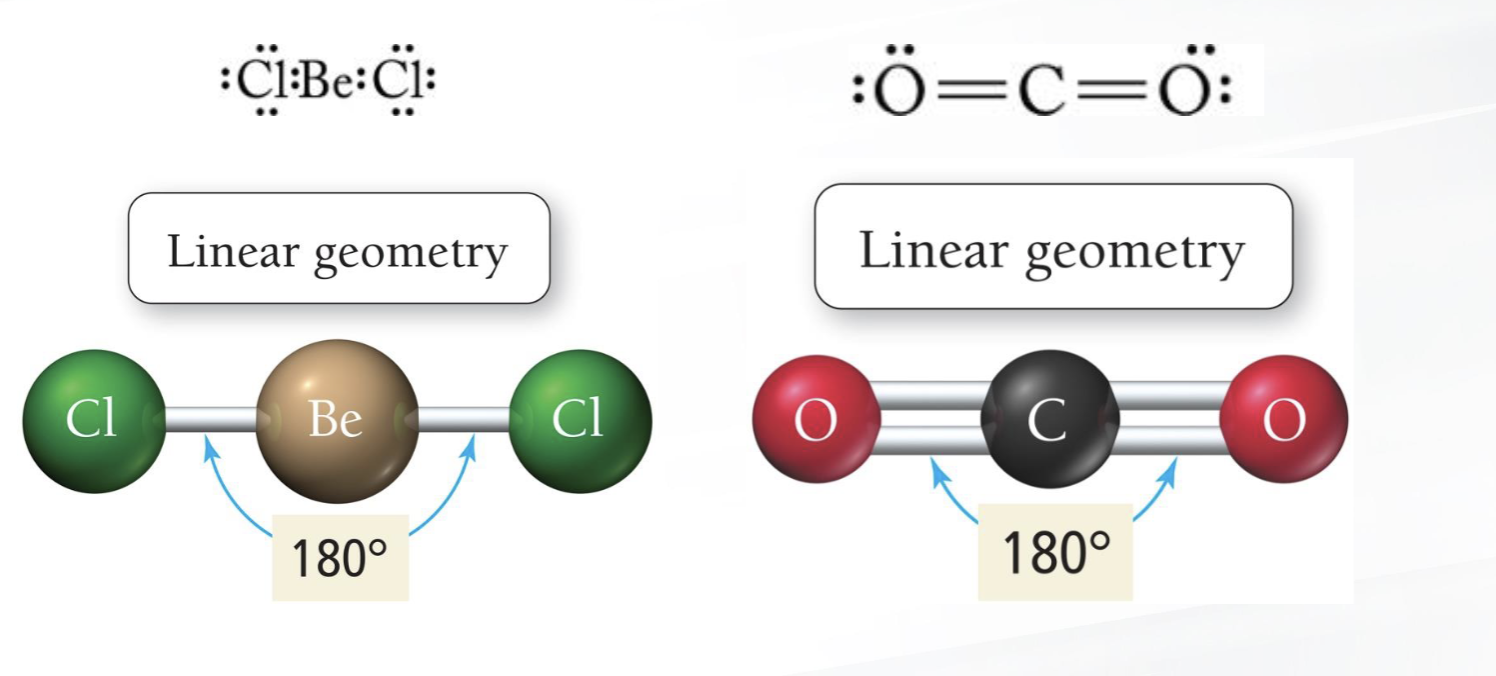
linear geometry
two electron groups
bond angle 180 degrees
trigonal planar geometry
three electron groups
bond angle 120 degrees

tetrahedral geometry
four electron groups
bond angle 109.5 degrees

trigonal bipyramidal geometry
5 electron groups
positions above and below central atom are axial positions
bond angle between axial and equatorial positions is 90
positions in the same base plane as the central atom are equatorial positions
bond angle between equatorial positions is 120

octahedral geometry
six electron groups
figure has 8 sides- explains octa- prefix
all positions are equivalent
bond angle 90 degrees

lone pair groups
occupy space on central atom but not “seen” as points on molecular geometry
take up more space on central atom because their electron density is exclusively on central atom
affects bond angles and makes bonding-pair angles smaller than expected
relative sizes of repulsive force interactions
lone pair to lone pair > lone pair to bonding pair > bonding pair to bonding pair
two types of tetrahedral electron geometry
trigonal pyramidal and bent
trigonal pyramidal molecular geometry
4 electron groups around the central atom, one of which is a lone pair
bond angle of 107 degrees

bent molecular geometry
4 electron groups and 2 are lone pairs
bond angle of 104.5 degrees

bond angle distortion
as more lone pairs are added, bond angles get progressively smaller
3 types of trigonal bipyramidal geometry
seesaw, t-shaped, linear
seesaw molecular geometry
5 electron groups, 1 of which is a lone pair
90 and 120 degree bond angles

t-shaped molecular geometry
5 electron groups, 2 of which are lone pairs

linear molecular geometry
5 electron groups, 3 of which are lone pairs

2 types of octahedral geometry
square pyramidal and square planar
square pyramidal molecular geometry
6 electron groups, 1 of which is a lone pair
bond angles between axial and equatorial positions are less than 90 degrees

square planar molecular geometry
6 electron groups, 2 of which are lone pairs
bond angles between equatorial positions are 90 degrees

representing 3D shapes on paper
the central atom is put in the plane of the paper
use a straight line for atoms in the same plane of central atom
use a solid wedge for atoms in front of the plane
use a hatched wedge for atoms behind the plane
illustrations of molecular geometries using 3D

geometries with multiple central atoms
for multi-center molecules, each central atom has a designated shape

determining molecular polarity
draw Lewis structure for molecule and determine its molecular geometry
determine if the molecule contains polar bonds
determine if polar bonds add together to form a net dipole moment
molecular polarity and water solubility
water is a polar molecule, so other polar molecules and ionic compounds will dissolve in water
nonpolar molecular geometries
linear, trigonal planar, tetrahedral, trigonal bipyramidal, octahedral
polar molecular geometries
bent, trigonal pyramidal, seesaw, t-shaped, square pyramidal
dipole moment trend
generally, the more electrons two atoms share and the larger the atoms are, the larger the dipole moment