Microbiology Chapter 20
 Call Kai
 Learn
 Practice Test
 Spaced Repetition
 Match
 Flashcards
 Knowt Play
1/62

Earn XP
Description and Tags
Flashcard set to review for Exam 3
63 Terms

Define antimicrobial drug
Substances that, in small amounts, kill or inhibit the growth of microbes.
What type of microbes does antimicrobial drugs kill/inhibit?
Bacteria
Fungi
Viruses
Parasites
Difference between antibiotic and antimicrobial drug?
Antibiotics are a specific type of antimicrobial drug that targets bacteria.
What is selective toxicity?
Selectively finding and destroying pathogens without damaging the host.

Broad-spectrum vs narrow-spectrum drugs
Narrow-spectrum drugs affect a narrow range of microbes; broad-spectrum drugs affect a broad range of Gram-positive or Gram-negative bacteria.
What is a superinfection?
Overgrowth of an opportunistic pathogen when normal microbiota is disrupted by antibiotic use.
Examples of superinfection organisms?
Candida albicans (cause yeast infections)
Clostridioides difficile (cause GI infections)

Bactericidal drugs
Drugs that directly kill bacteria.
Examples of bactericidal drugs?
Penicillin
Cephalosporins

Bacteriostatic drugs
Prevent bacterial growth but do not directly kill bacteria.
Example of a bacteriostatic drug?
Tetracyclines
What are the 5 major modes of action that antibiotics have on bacterial cells?
Mode 1: Inhibit Cell wall synthesis
Mode 2: Inhibit Protein synthesis
Mode 3: Injure Plasma Membrane
Mode 4: Inhibit Nucleic Acid synthesis
Mode 5: Inhibit Synthesis of essential metabolites
Drugs associated with Mode 1: Inhibit Cell Wall Synthesis?
Natural Penicillins - Penicillin G & V
Semisynthetic Penicillins - Oxacillin, Ampicillin, Amoxicillin
Carbapenems
Cephalosporins
Polypeptide Antibiotics - Bacitracin, Vancomycin
Antimycobacterial Antibiotics - Isoniazid
Drugs associated with Mode 2: Inhibit Protein Synthesis?
Chloramphenicol
Aminoglycosides - Streptomycin, Neomycin, Gentamicin
Macrolides - Erythromycin
Tetracyclines - Tetracyclines
Drugs associated with Mode 3: Injure Plasma Membrane?
Polymyxin B
Drugs associated with Mode 4: Inhibit Nucleic Acid Synthesis?
Quinolones and Fluoroquinolones - Nalidixic acid, Ciprofloxacin
Rifamycin - Rifampin
Drugs associated with Mode 5: Inhibit Synthesis of Essential Metabolites?
Sulfonamides - Sulfamethoxazole-trimethoprim
How does penicillin work?
Prevents cross-linking of peptidoglycan, interfering with cell wall construction.
How do protein synthesis inhibitors work?
Target bacterial 70S ribosomes.

What does polymyxin B do?
Damages bacterial plasma membranes by changing membrane permeability.
What does ciprofloxacin inhibit?
Topoisomerase
What does rifampin inhibit?
the synthesis of mRNA; RNA polymerase, preventing transcription.

How does sulfanilamide work?
Competes with PABA and stops folic acid synthesis.
Neosporin components?
Polymyxin B (damages membrane)
Neomycin (blocks protein synthesis)
Bacitracin (damages cell wall)
Natural penicillins (β-lactam antibiotics)
Penicillin G
Penicillin V
Semisynthetic penicillins (β-lactam antibiotics)
Oxacillin
Ampicillin
Amoxicillin
Carbapenem Example?
Imipenem → β-lactam antibiotic reserved for severe multidrug-resistant infections.
Cephalosporin examples? (β-lactam antibiotics)
Cephalothin (1st generation)
Ceftaroline (5th generation, active against MRSA).
Polypeptide antibiotics
Bacitracin
Vancomycin
Antimycobacterial antibiotics
Isoniazid
Ethambutol

Aminoglycosides
Streptomycin
Neomycin
Gentamicin
Macrolide example?
Erythromycin
Nucleic acid synthesis inhibitor examples?
Rifampin
Nalidixic acid
Ciprofloxacin
Widely used sulfonamide combination?
Sulfamethoxazole-trimethoprim (Bactrim, TMP-SMX)
Why are fungal infections difficult to treat?
Fungi are eukaryotic and selective toxicity is harder to achieve.
Fungal membrane sterol?
Ergosterol; human membranes use cholesterol.
Fungal cell wall component highlighted?
β-glucan
Important antifungal drug example?
Ketoconazole
Why are viral infections difficult to treat?
Viruses reside inside host cells.

What is AZT?
Zidovudine (AZT); inhibits HIV reverse transcriptase.
Important antiviral against herpesviruses?
Acyclovir

What are interferons?
Produced by virus-infected cells to inhibit further spread of infection.
How does the Kirby-Bauer test work?
Antibiotic disks are placed on inoculated agar. Zone of inhibition indicates susceptibility.
What determines susceptibility in Kirby-Bauer?
The size of the zone of inhibition around the disk.

What is the E-test?
A gradient diffusion method that determines antibiotic sensitivity and estimates MIC.
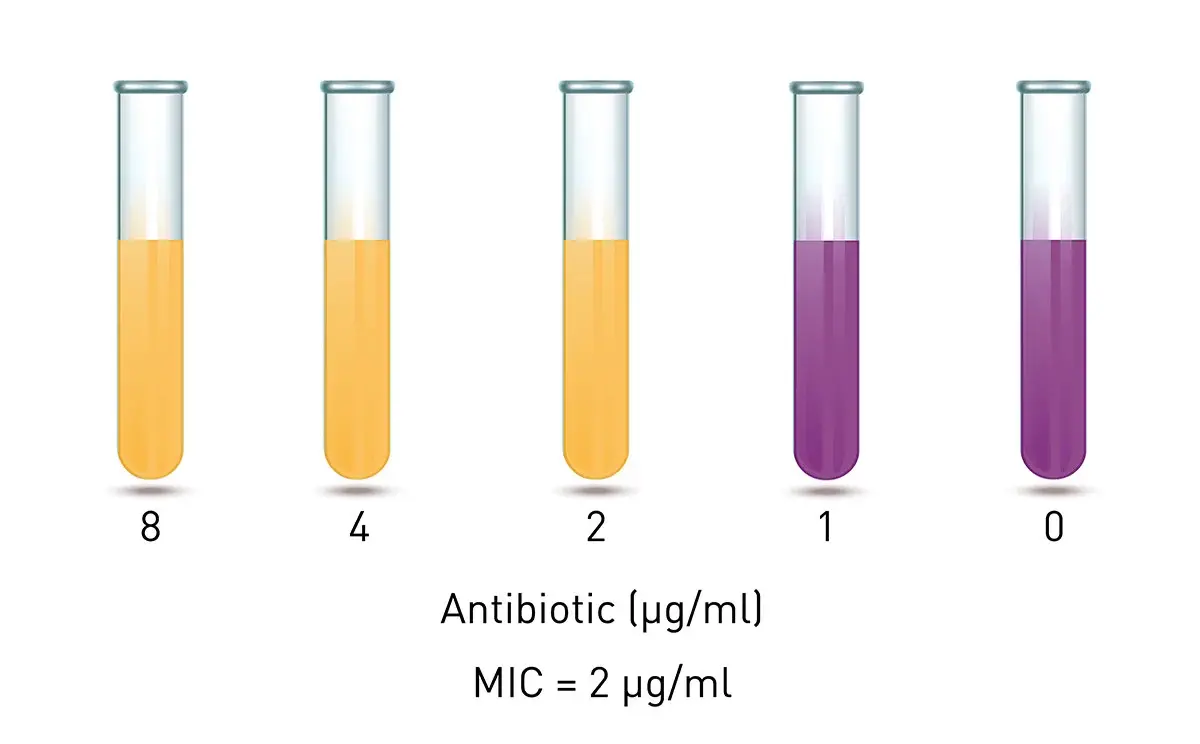
Define MIC.
Lowest antibiotic concentration preventing bacterial growth.
How is MIC observed on the E-test?
At the tip of the zone of inhibition.
How is MIC determined by dilution testing?
Lowest drug concentration that prevents visible growth in broth.
How is MBC determined?
Subculture onto antibiotic-free agar and find the lowest concentration that kills bacteria.

Define acquired antibiotic resistance.
An acquired ability of bacteria to survive and multiply in the presence of a previously effective antibiotic.

Define intrinsic resistance.
Natural lack of susceptibility due to the organism’s structure.
Five mechanisms of resistance?
Enzymatic inactivation
Prevention of penetration
Target alteration
Efflux pumps
Variations/overproduction strategies
How do β-lactamases cause resistance?
They enzymatically inactivate β-lactam antibiotics.
How does penicillinase inactivate penicillin?
It cleaves the β-lactam ring, converting penicillin into inactive penicilloic acid.
Example of target alteration?
MRSA with mecA gene/PBP2a

What are efflux pumps?
Active transport systems that eject antibiotics from the cell.
Examples of antibiotic misuse?
Using antibiotics without a prescription.
Taking outdated antibiotics.
Treating viral colds.
Using them in animal feed.
Not finishing prescriptions.
Using leftover prescriptions.
What can happen if a patient does not finish antibiotics?
Selects for resistant bacteria and promotes antibiotic resistance.
General antibiotic safety concerns
Therapeutic index
Drug interactions
Organ damage
Fetal risk during pregnancy
Define synergism
Two drugs together have a greater effect than either one alone.
Example of synergism?
Penicillin and streptomycin.

Define antagonism
Two drugs together have a less effective result than either one alone.
Example of antagonism?
Tetracycline interfering with penicillin activity.