Climate Change and Its Effects
 Note
Note Call Kai
 Learn
Learn Practice Test
 Spaced Repetition
 Match
Match Flashcards
 Knowt Play
1/19

Earn XP
Description and Tags
Flashcards covering key vocabulary and concepts related to climate change and its impacts, based on the lecture notes.
Name | Mastery | Learn | Test | Matching | Spaced | Call with Kai | Chat |
|---|
No analytics yet
Send a link to your students to track their progress
20 Terms
Greenhouse Gas Effect
The process by which certain gases in the atmosphere trap heat from the sun, maintaining the Earth's temperature and permitting life.
Climate vs. Weather
Climate refers to long-term patterns of weather in an area, while weather denotes short-term atmospheric conditions.
Albedo
The reflectivity of a surface; higher albedo means more sunlight is reflected, which can lead to cooling.
Hadley Cells
Large-scale wind patterns characterized by rising warm air at the equator which cools and descends at around 30 degrees latitude, influencing trade winds.
Photosynthesis
The process by which plants convert carbon dioxide from the atmosphere into organic compounds using sunlight, reducing atmospheric CO2 levels.
Ocean Acidification
The decrease in pH levels in the ocean due to absorption of excess atmospheric CO2, which can harm marine life.
El Niño
A climate pattern characterized by warmer-than-average sea surface temperatures in the central and eastern tropical Pacific Ocean, affecting global weather patterns.
Fast Carbon Cycle
The rapid cycling of carbon through living organisms via photosynthesis and respiration, occurring on a timescale of years.
Slow Carbon Cycle
The long-term carbon cycle involving geological processes such as rock weathering and the formation of fossil fuels, occurring over millions of years.
Thermal Haline Circulation
A global pattern of oceanic circulation driven by temperature and salinity differences, influencing climate and weather.
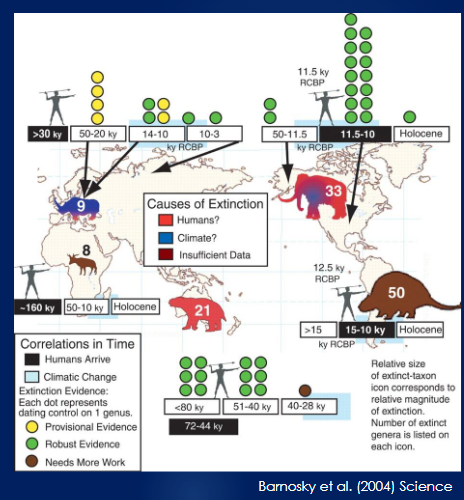
Pleistocene Mega Faunal extinctions
Large scale extinctions (4%of big mammals species) at the end of the last “Ice Age”
Potential causes: hunting by spreading humans, climate change
Extinctions were spatially and temporally heterogeneous
Lack of global synchrony makes it an unideal marker
Dawn of agriculture
Dramatic change in species composition
Evidence: increased fossil pollen from domestic plants
Not an ideal boundary because of:
multiple independent, asynchronous origins
secondary markers (e.g. ceramics) not consistently associated with agriculture
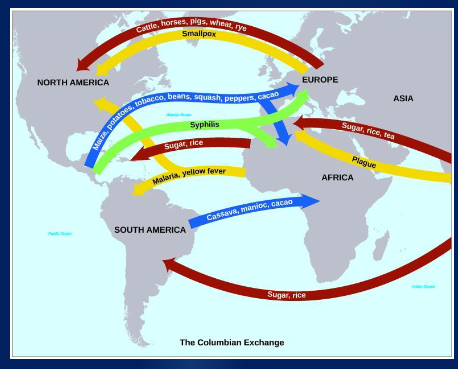
Columbian exchange
Cross-Atlantic exchange of human-associated species (crops, farm animals, diseases)
Potatoes, corn, tobacco, cocoa: New to Old World
Sugar cane, wheat, horse, smallpox: Old to New world
Pollen from crops widespread
Potential good marker – global, time constrained, secondary
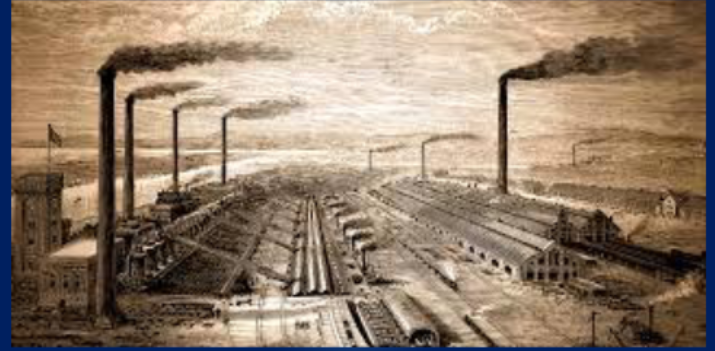
Industrial Revolution
Rise of capitalism
Land ownership = greater agricultural productivity
Technological innovation
Greater productivity → more food access
Improved medicine → rapid human population growth
Rise of factories → urbanization
Rapid increase in fossil fuel use → rise in atmospheric CO2
Industrialization: spatial and temporal asynchrony
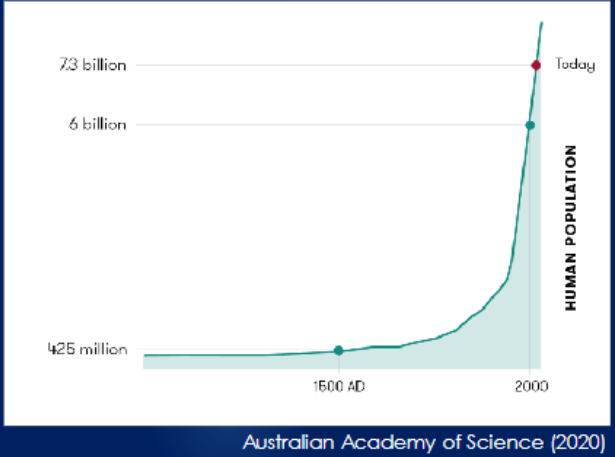
The Great Acceleration
Major expansion in human population
Medical advances
Green revolution in agriculture = better nutrition
Major changes in biogeochemical cycles
Industrialized farming = widespread use of N and P fertilizers
Large increase in fossil fuel use = increased atmospheric CO2
Novel products
Nuclear testing (visible in sediments)
Plastics, concrete, pure Aluminium
Summary
▪ Major shifts during human history in energy use and organization may mark the start of a new geological time, the Anthropocene.
▪ Human society has modified many elements of the Earth’s critical systems.
▪ Changes of such magnitude have only rarely occurred in the Earth’s history.
▪ Environmental change drivers are highly interconnected.
▪ Tipping points, where systems shift into different states, pose a considerable risk to humanity’s future.
The Start of the Anthropocene coincides with major shifts in energy use and organization
Two energy transitions:
• Agriculture
• Fossil fuel use and industrializationTwo organizational transitions:
• Globalization and the trans-Atlantic interchange
• The Great Acceleration
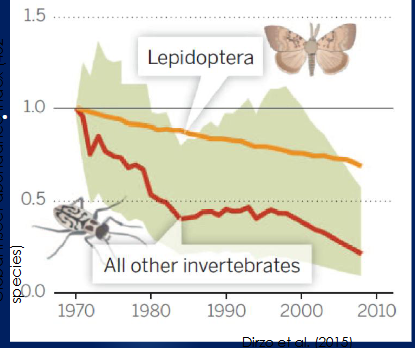
3.Decay & homogenization of biodiversity
• Humans have raised extinction rates to levels only comparable to the five mass extinctions. Is this the 6th mass extinction?
• Extinction rate is 100-1000 times the background rate.
▪ Yearly Loss of 11,000 – 58,000 species
▪ Widespread decreases in insect biomass (20-75%)
• Mixing of biota across oceans is unprecedented (e.g. 20% of plant species are exotic in many regions).
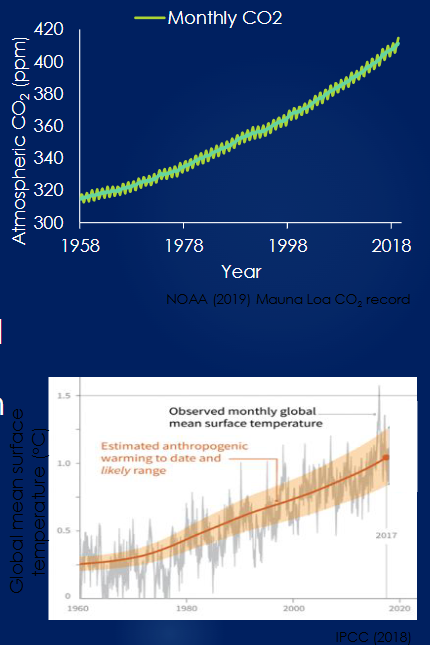
1.Major changes in biogeochemical cycles
• Atmospheric CO2 increased from 280 ppm in 1800 to 413 ppm today, mostly due to burning of fossil fuel. Causes warming.
• Ocean pH is more acidic due to CO2 uptake, with a decrease of 0.1 units or 26%. Affects marine organisms.
• Nitrogen cycling is highly affected by industrial processes and fertilizers. Causes eutrophication in aquatic environments
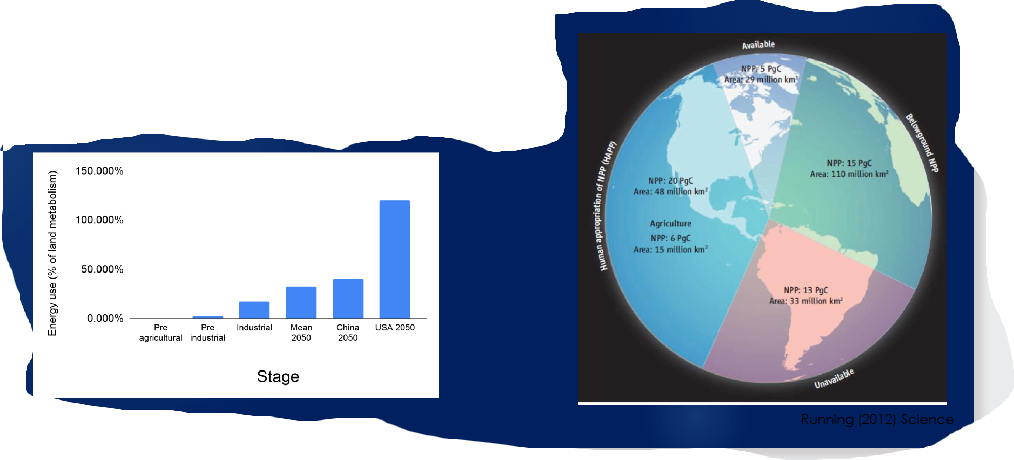
2.Exploitation of energy and resources
• About 97% of large mammal biomass is human (30%) or domestic animals (67%).
• Humans appropriate ~38% of Global Net Primary Productivity.
• Humans use 50% of available fresh water (70% of this for agriculture). Only 37% of rivers globally (2% in the US!) are unimpeded by dams.