Lesson 2 : Electricity
 Call Kai
 Learn
 Practice Test
 Spaced Repetition
 Match
 Flashcards
 Knowt Play
1/65

There's no tags or description
Looks like no tags are added yet.
66 Terms
Ohms law
voltage = current x resistance
(The voltage across a conductor is directly proportional to the current flowing through it, provided all physical conditions, such temperature, stay constant
Current
A flow of electric charge.
Unit of current
Ampere (A)
In which direction does current flow?
From the positive terminal to the negative terminal
Charge flow, current and time equation
Charge flow = current x time
Unit of charge flow
Coulombs (C)
Potential difference
energy used between two points in a circuit
Unit of potential difference
Volts (V)
Resistance
A measure of a materials opposition to the flow of electric charge in a circuit
Unit of resistance
Ohm (Ω)
Circuit symbol for open switch

CS for closed switch

CS for cell

CS for battery

CS for diode

CS for resistor

CS for variable resistor

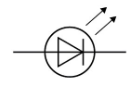
Circuit symbol for LED
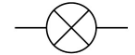
CS for lamp
Circuit symbol for fuse

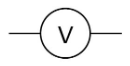
Circuit symbol for voltmeter
Circuit symbol for ammeter

Circuit symbol for thermistor

CS for LDR

What is an ohmic conductor?
A resistor in which the current is directly proportional to the potential difference at a constant temperature
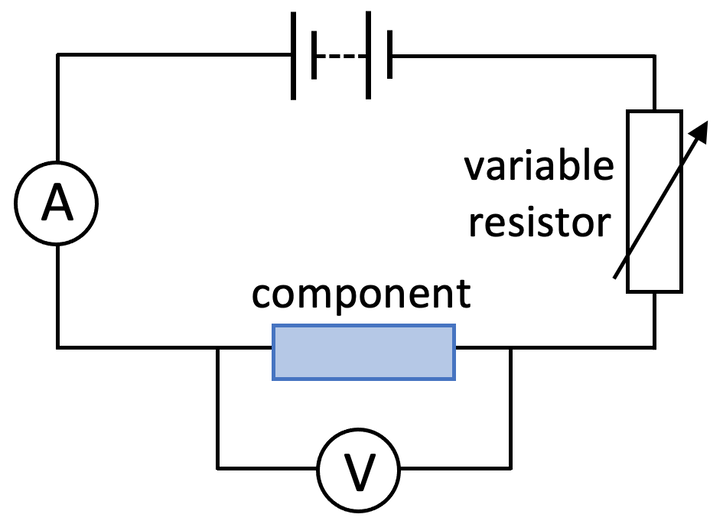
Draw the circuit used to test the IV characteristics of a compnent
Explain the I-V characteristic of a filament lamp
When current increases, the temperature of the filament increases, therfore increasing the resistance
Explain the I-V characteristic of a diode.
The current only flows in one direction, as there is a very high resistance in the reverse direction
Explain the I-V characteristics of a thermistor
Resistance of a thermistor increases and temperature decreases
What are the applications of thermistors irl?
Thermistors are used as temperature sensors to switch devices on or off.
When the temp increases, the resistance if the thermistor decreases, decreasing the potential difference across it, which can be used to send a signal to a switch, relay etc to activate a motor, heater or alarm
Explain the I-V characteristics of a LDR
When light intensity increases, resistance decreases
What are the applications of LDRs irl?
When light intensity drops, the resistance of the LDR increases, which increase the pd across it, turning the light on. In high light intensity, the resistance of it decreases, turning it off
Ammeter are connected in...
Series
voltmeters are connected in...
Parallel
Circuit rules for series circuits
1. Current is the same throughout circuit
I(total) = I(1) = I(2) =...
2. Total P.D. of power supply is shared between components
V(total) = V(1) + V(2) +...
3. Total resistance is sub of resistances if each component
Circuit rules for parallel circuits
1. Total P.D. across each component is the same
V(total) = V(1) = V(2) =...
2. Total current throughout the circuit is sum of currents through individual components
I(total) = I(1) + I(2) +...
3. Total resistance of two resistors in parallel is less than the resistance of a smaller individual resistor
Why does adding resistors in series increase total resistance?
Adding resistors in series increases total resistance as charge must flow through every single resistor along a single path
Why does adding resistors in parallel decrease the total resistance?
Adding resistors in parallel decreases total resistance as it provides extra pathways for current to flow (resistance is less than smaller individual resistor)
What is direct potential difference?
A potential difference that always stays in the same direction (has same polarity)
What is alternating potential difference?
A potential difference that continuously changes direction (switched polarity) regularly over time
What type of current is mains electricity?
Alternating current
Frequency of UK mains supply
50Hz
Pd of the UK mains supply
230V
What colour is the live wire?
Brown
Function of the live wire
Supplying alternating pd from mains supply to appliance
PD of live wire
230V
Why is a live wire dangerous even when a switch in the mains circuit is open?
1. The live wire is still connected to the mains supply, meaning it remains at a high pd of 230V.
2. A person has a potential difference of 0V. (Same as the ground/Earth)
3. Therefore, if a person touches the live wire, a large pd is created across their body.
4. This causes current to flow through the person to the ground resulting in a dangerous electric shock.
What colour is the neutral wire?
Blue
Function of neutral wire
Completes the circuit and carries away current
pd of neutral wire
At (or close to) 0 V (close to earth/ ground potential)
What colour is the earth wire?
Green and yellow stripes
Function of earth wire
Stops the appliance from becoming live
The pd of the earth wire
0V (only carries current if there is a fault with the appliance)
What are the dangers of providing any connection between the live wire and the earth?
1. Overheating
2. Melting components
3. Causing electrical fire
Equations for power transfer of circuit device
power = pd * current
Power = current^2 * resistance
P = VI or P = I^2V
Equation for amount of energy transferred by electrical work
Energy transferred (J) = power (W) *time (s)
Energy transferred = charge flow(C) * potential difference
Why is the national grid an efficient way to transfer energy?
It uses step up transformers to increase potential difference (voltage) and drastically decrease current in the transmission cables, decreasing resistance and therefore reducing heat loss to the surroundings
What is the function of a step-up transformer?
- increase p.d from power stations to transmission cables.
- this reduces current, and therefore cools down the wires from the current flowing.
- reducing the heating effect reduces energy loss, so makes the transmissions more efficient.
What is the function of a step down transformer?
- potential difference of the electricity is far too high to go into homes
- step-down transformers reduce the p.d to ~230V before the electricity passes to homes
How does static charge build up on an object?
1. Two objects must be rubbed together do there is friction
2. This causes electrons to transfer from one object to the other
3. Electrons are negatively charged
4. The object with excess electrons is negatively charged overall
5. The object with excess protons is positively charged overall
What is an electric field?
a region around a charged particle or object where another charged particle or object will experience a force
Field lines are drawn in terms of...
Positive charge
Electric field lines point away from...
Positive charge
Electric field lines point towards...
Negative charge
Explain how the electrostatic phenomena sparking happens
1. As an object builds up static charge, the pd between it and the earth increases.
2. This high pd creates a very strong electric field in the gap between the charged object and the earthed object.
3. The strong electric field exerts a force on the electrons in the air molecules, ripping them away from their atoms (Ionisation) - turns air from electrical insulator into conductor)
4. Due to the air now being conductive, a current flows rapidly through the air to discharge the object, creating a visible spark and a mini shock
Simple form
1. High pd creates strong electric field
2. This causes the ionisation of air
3. Air becomes conductive, allowing current to flow
4. This causes a visible spark and mini shock