W5: Elements of Logic
 Call Kai
 Learn
 Practice Test
 Spaced Repetition
 Match
 Flashcards
 Knowt Play
1/40

There's no tags or description
Looks like no tags are added yet.
41 Terms
What is propositional logic?
The logic of a few “logical” words or expressions, called “propositional connectives”
What does a propositional argument consist of?
Propositional variables (true or false statements)
Logical connectors
What are the 5 connective formulas/operators?

What are the rules to constructing a well-formed formula (WFF)?
*Symbols:
Φ Phi
Ψ = Psi

What is the purpose of parenthesis? (brackets)
To group propositions together (like math)
How do we translate this sentence into propositional logic (PL): If Mary does not go to the party, then either Bob or Jasmine will go
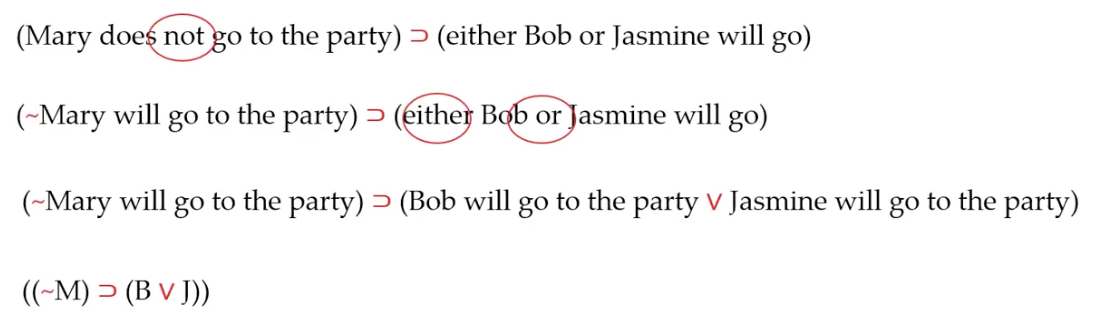
What are the steps of PL translating?
Find the main connective (this may require paraphrasing
Replace the connective with the appropriate symbol
Examine each of the sentences the main connective applies to
What is the job of semantics?
To assign meaning and truth values to formal symbols and formulas
What do we use to summarise the semantics of our logical connectives?
Using truth tables
How do truth tables work?
It takes some truth values as inputs and produces another truth value as outputs
What is the truth table like for conjunction (“&”)?

What is the truth table like for negation (“~”)

What does doubly-negated formulas have the same truth value as (~~Φ)?
Equivalent to unnegated formula (Φ)
What is the truth table like for disjunction (“V”)?
Φ V Ψ will be true if at least one of them is true, and false otherwise

What is disjunction interdefinable with?
Combination of conjunction and negation

What are the notations for 'necessary and sufficient conditions?
X is sufficient for Y: X ⊃ Y. X guarantees Y.
X is necessary for Y: Y ⊃ X. You can’t have Y without X.
How do we interpret the truth table for horseshoe (“⊃")?
For Φ⊃Ψ, think of it as “did my prediction come true?”
What is the truth table like for horseshoe (“⊃")? (using the example “Bob studies ⊃ Bob passes the exam”)
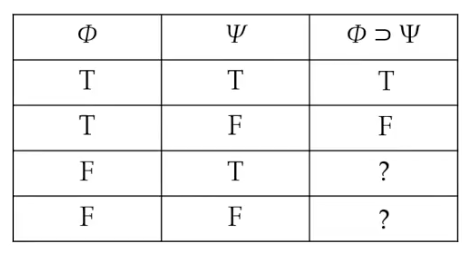
Since “if…then…” is not a truth function, for the bottom two uncertainties (the case where Bob does not study), what can we interpret them to be?
We simplify it and treat the condition as true

What is the tip/rule of thumb?
Whenever the antecedent of ⊃ is false, the conditional (output) is true
What about: “Bob will pass the exam, if he studies”?
Saying the same thing, the antecedent is still “If Bob studies”
*Note the order of the sentence does not auto define the antecedent
What about: “Bob will pass the exam, only if he studies”?
Since studying is a necessary condition for him to pass, this swaps the configuration to: “Bob passes the exam ⊃ Bob studies” (= if Bob passed, that means he studied)
What is the truth table like for the triple bar (“≡”)?
Φ≡Ψ is true if and only if Φ and Ψ are either both true or both false

What can the triple bar replace?
Both necessary and sufficient
What is the rule for the triple bar?
A ≡ B is the same as B ≡ A
What can you replace ‘unless’ with? (using the example “unless you water the flowers, they will die”)
“If you do not water the flowers (negation), then they will die (horseshoe)
aka Unless Φ, Ψ = (~Φ⊃Ψ)
How do we approach truth-tables for complex formulas?
Decide on the number of columns and rows
Create table with the all T/F possibilities for the propositional variables and the outcomes for the complex formula
Work from the “inside out”, starting with the simplest sub-formulas, which is copying over the T/F values of the variables itself
Apply the rules for connectives (everything within parenthesis > conjunction > negation > disjunction > horseshoe)
Step1: How do we decide on the no. of columns and rows?
Rows: 2n (n = number of variables)
Columns: total no. of variables & connectors
Given ~(~A V ~B), how would step 2 look like?

What would we deal with first in step 4?
Negation of A and B

What would we deal with second in step 4?
Disjunction of the two new columns we just formed
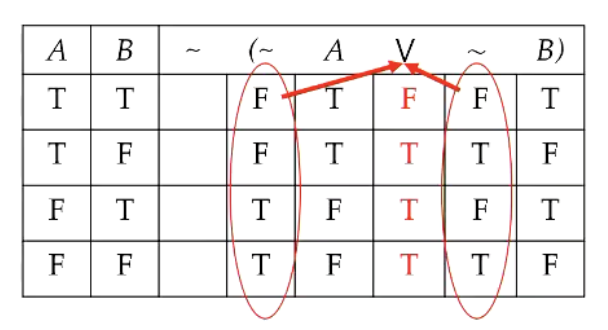
What do we deal with last in step 4?
Negation of the previous column we formed
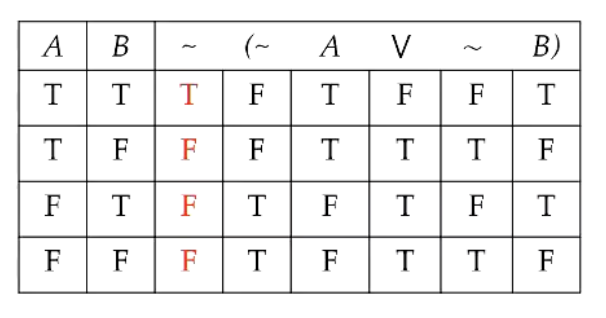
How can multiple formulas be represented?
In a joint truth table

In the above example, what do you call two formulas that have the same truth values all the time?
They are logically equivalent
What is a tautology and the propositional representation for it?
A formula that is true in every row
(A V ~A)
E.g. “the blue is either made out of blue cheese, or it is not”

If Φ and Ψ are logically equivalent, then what would Φ≡Ψ be?
A tautology
Φ is T, Ψ is T → Φ≡Ψ is T
Φ is F, Ψ is F → Φ≡Ψ is T
What is a contradiction and the propositional representation for it??
A formula that is false in every row
(A & ~A)
E.g. “the grass is green, and the grass is not green”
What is the requirement for a set of formulas to be consistent?
If and only if it is possible for all of them to be true together
i.e., if and only if there is at least one row in their joint truth-table where they are all true
How do we test for validity using truth tables?
Relate back to the definition: it is impossible for all its premises to be true while its conclusion false
E.g. modus ponens

What is a general rule/combination for a valid argument (using consistency)?
(premises + ~conclusion) is inconsistent.