Kap. 3 - Perception and Mental Imagery
 Call Kai
 Learn
Learn Practice Test
 Spaced Repetition
 Match
Match Flashcards
 Knowt Play
1/14

There's no tags or description
Looks like no tags are added yet.
15 Terms
What does it mean to say that perception is a “construction of the mind”?
What is the distinction between top-down and bottom-up processing?
Perception
“The ability to recognize and interpret information from the senses“
.
Construction of the mind
“The very act of perceiving involves making sense of the raw stimulation conveyed by our senses“
Making sense by:
piecing together a coherent, stable, mental representation


The mind fills in missing pieces
Like perceiving the whole picture with only a few puzzle pieces
E.g.
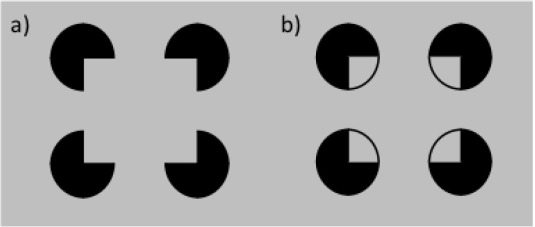
Modal completion
Where view of the illusory object is not obstructed, and there is no objective boundary between the illusory object and the background
a)
Amodal completion
See/to perceive an object despite an apparently obstructed view
b)
.
Top-down processing
Knowledge and expectations influence and enhance our interpretation of sensory input
Feedback
Memories, expectations and experiences modulate/bias the activity in the early sensory areas
E.g. - interpreting ambiguous images
Context shapes perception
Experience shapes perception
Unconscious inference —> Educated guesses based on visual cues
(top-down guesses bases on bottom-up information)
E.g. - making predictions
Predictive coding
Visual brain makes predictions about what input the eyes are about to receive
Ongoing comparison of expectations with bottom-up information
.
Bottom-up processing
Sensory input (“raw data”) influences perception
Feedforward
How fast can an object be recognized?
Within 150 ms!

Give examples that illustrate the challenges of object segmentation, occlusion, and inverse projections in everyday vision
Object segmentation
“Visually assigning the elements of a scene to separate objects and backgrounds”
To recognize objects and their location, you need to separate them from the background
Figure-ground organization
“The perceptual segmentation of a visual scene into objects (“figure“) and backgrounds (“ground”)
Problem: - not always evident what boundary belongs to object vs background
E.g.
Rubin vase

Camouflaged animals

Rules to solve the problem:
Enclosure
The region completely surrounded by the other is perceived as the figure
Symmetry
The more symmetrical region is perceived as the figure
Convexity
The side that is convex (bulges out) is perceived as the figure, and the concave (caves) as the background
Meaningfulness
The meaningful side (determined by experience) is perceived as the figure
.
Object occlusion
“Our views of objects are often partially blocked by other objects“
Amodal completion
Brain fills in/infer the missing information during object occlusion
Infering the missing information can be easier with the occlusion than without but with the same amount of information
E.g
Seeing a truck behind a tree
“Amodal nudity“
Related phenomenon: boundary extention
Tendensy to remember pictures as having extended beyond their actual edges
.
Inverse projection
The fact that we live in 3D, but input to the eyes are 2D
Problem: Different 3D objects can produce the same 2D image - bottom-up information is incomplete
E.g.
Different objects producing the same shadow
3D objects producing 2D image on the retina
.
Solving the problem:
Top-down information completes the image - disambiguating the multiple possibilities:
Binocular depth cues
(result of binocular disparity —> disparity/difference between what the different eyes see)
i.e. binocular depth cues require both eyes
Greater disparity = object is closer to you
Monocular depth cues

Linear perspective
Parallell lines converge on single point when receding into distance
Texture gradient
Textual elements that are of same size get smaller and densely packed when receding into distance
Constancy - to perceive the world as stable
Constancy mechanisms require binocular and/or monocular depth cues
The distance/depth cues activate the constance in size mechanism
i.e. - If no distance/depth cues (monocular or binocular), we won't activate the constance in size mechanism

Object constancy
Recognizing objects despite orientation/ despite the image on the retina changing dramatically

Size constancy
Perceives sizes of objects are stable despite radical differences in their image size on retina -
Smaller retinal image often infer distance and not size

What are the different types of visual constancy that perception achieves?
Lightness/brightness Constancy
Ability to factor in illumination conditions - in order to perceive a lightness as constant

The brain compensates for the squares in the shadow
Making the perception of the squares in the brain seem brighter than the ones outside of the shadow, even if they actually are the same brightness
.
Color Constancy
Ability to factor in differences in illumination - in order to perceive a color as constant
i.e. - So, the shadow information/cues influences how we perceive the brightness of colors!
e.g.:
We are used to colors in the shadow being darker than in the light:
and so even if the color at the top/in the light in reality is the same (see picture under) as the color in the bottom/shadow, we compensate for the shadow, - ending up thinking that the bottom color is a brighter color and therefore another color than the one on the top

What is object recognition? - explain in terms of Riddoch and Humphreys (2001) hierarchical model of object recognition
What is the distinction between apperceptive and associative agnosia? At which steps in the hierarchical model do they disturb the process of object recognition?
Object recognition
Ability to match perceptual images with stored representations
.
Riddoch and Humphreys (2001) hierarchical model of object recognition
Recognizing an object is not a single process - different stages transform visual information into increasingly meaningful representations:

1. Early visual processing
Basic visual information is extracted - e.g. edges, orientation, color, size, shape
Processes what the visual impact looks like
2. Viewpoint-dependent object descriptions
The visual features are combined into a more structured description of the object as it appears from a particular viewpoint
Processes what the object’s parts and spacial arrangements are
3. Perceptual classification
The perceptual description is compared with stored structural knowledge to determine what kind of object is being seen
Processes whether the visual pattern corresponds with a familiar object shape
4. Semantic classification
The recognized object is linked to stored knowledge about what the object is/means and what it is used for
Processes what the object is and what to do about it
5. Naming
The appropriate verbal label is retrieved once the object has been identified and its meaning accessed
Labels the object
.
Agnosia
Inability to recognize objects
Can occur in different modalities:
e.g. visual agnosia, tactile or auditory
Often caused by lesions/damage in brain, but functioning eyes and ability to see in general
i.e. not explained by sensory deficits or memory loss
i.e. also not loss of the knowledge about the objects - the semantic system is intact
Visual agnosia
Indicates that object recognition involves both early perceptual stages (low-level) and late perceptual stages (high-stages)
e.g. visual agnosia: matching images to their correct categories/lables
.
Apperceptive (visual) agnosia
Impaired early vision - cannot perform even simples visual feature tasks (e.g. copying images)
Cannot recognize objects’ shape and say if it is familiar or not,
This inability can interfere with different levels of the object recognition process
Often involves prosopagnosia
Brain lesion impacting the early visual stage
Associative (visual) agnosia
Intact early vision - can (ish) copy images
Impaired late vision (stage of recognition and categorization) - inability to name objects
i.e. Cannot say what the object is used for, but can recognize the object as familiar or not
They can copy it, describe it, but don't know what the object actually is - cannot assign meaning to object
Brain lesion impacting later visual stages
i.e. disturbing the connection between the perceptual and semantic system
.


Define and contrast view-based approaches and structural description approaches to object and face recognition
View-based - approaches to object recognition
Claims: “we match images to representations that are like 2D pictures / “templates””
“Template” - representation that fully describes the shape of an object
Critique of this approach:
How much noise or deviation can a matching process tolerate?
.
Structural description - approaches to object recognition
Structural descriptions: “models that represent objects as sets of 3D parts standing in spatial relationships to each other“
The “models” - have have volumetric parts that can be analyzed quickly regardless of orientation
Recognition by components / analysis by parts
Essential for reading and object recognition
.
Holistic perception
Claims: “process a whole object at once - including the relations of the individual parts to each other“
Evidence:
Visual expertise is linked with holistic processing across a range of visual stimuli
Face recognition is dependent on holistic analysis

What area of the brain is associated with face recognition?
Fusiform Gyrus
Fusiform face area (FFA)
ERP N170:
Show increased negativity for faces compared to objects

.
Prosopagnosia
Visual agnosia specific for faces
Can be caused by lesion in FFA
What is the evidence distinguishing what and where pathways for object processing?
What evidence suggests that the what/where distinction might be better thought of as a perception/action distinction?

What and where pathways - evidence
What pathway
Ventral path
From V1 and 2 —> through V4 in inferial temporal lobe
More active when focusing on distinguishing objects
e.g. by color, texture, shape, detail
Where pathway
Dorsal path
From V1 and 2 —> through V3 and V5 in parietal lobe
More active when performing location task (even with same objects as in the object task)
e.g. location, movement, spatial relation
.
Dissociating the ventral and dorsal streams
E.g. discrimination tasks and lesion
Object discrimination
Task: to pick the correct shape
Lesion in temporal lobe —> makes the task difficult

Landmark discrimination
Task: pick the food tray closer to the cone
Lesion in parietal lobe —> makes the task difficult

.
E.g. object and position task and fMRI

Object task:
Task: Participants need to say if the two displays (a and b) contained the same objects
Associated with activity in the ventral pathway (temporal lobe) - (red color)
Position task:
Task: Participants need to say if the objects in the two displays are presented in the same location
Associated with activity in the dorsal pathway (parietal lobe) - (green color)
.
E.g. Ebbinghaus illusion

Even if the ventral pathway can be tricked by sizes of surrounding circles (see picture for reference), the dorsal pathway (action pathway) is not
.
Perception / action pathway
Evidence for this way of thinking about the two paths:
Perception and action use information differently:
Case D.F. —> Agnosia with lesion in lateral occipital cortex (ventral/what path):
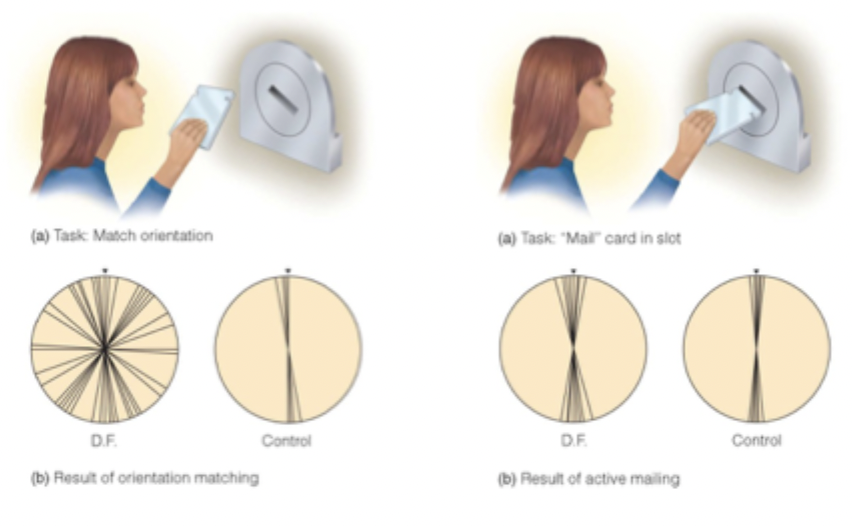
Unable to report the orientation of a slot, but could place a card in the slot
So, from the findings you can infer that visual information may influence action (dorsal stream) directly, independent of the recognition pathway (ventral stream)
Frogs hunt without recognizing the shape of the prey - only by detecting flylike movement
Perception pathway
Allows us to determine what is located where
Action pathway
Uses perceptual information to guide ongoing actions
How does the brain build complex visual perception from simple features over time?
Stage 1 (Features): Lower-level neurons detect basic orientations
Feature detectors:
Neurons that respond best to specific types of stimuli (e.g. a certain orientation)
Hubel & Wiesel
recorded electrical activity from a single neuron in the primary visual cortex of an anesthetized cat

.
Stage 2 (Hierarchy): Information moves from lower to higher cortices
Hierarchical processing
Information progresses sequentially from lower to higher brain regions
Gross et al., 1972
Recorded single-neuron activity in the temporal lobe while presenting different visual images to the subject

Findings:
A specific neuron fired strongly when looking at a shape resembling a hand
This response was invariant (i.e. it didn't matter if it was a real hand, a drawing, or tilted).
However, the neuron became inactive or fired weakly when shown abstract rectangles or shapes that did not look like a hand
Disproven Hypothesis:
If a visual stimulus is more complex, then more total neurons should fire to process it.
The Reality:
The visual system uses a structural hierarchy where specialized neurons along the ventral stream recognize whole configured objects rather than individual parts.
.
Stage 3 (Coding): Higher-level neurons recognize complex objects like tables
Sensory coding
The way neurons represent the environment
Specificity coding
Suggests that highly complex stimuli are recognized by dedicated, single neurons "grandmother neurons"
However! the grandmother neuron hypothesis is not true!:
The brain relies on a neural network (population coding/distributed representation) rather than isolated cells
If we relied on single grandmother neurons, the visual system would be too sensitive and exposed to damage.
So, instead: A distributed network ensures resilience; if a few cells are damaged, the rest of the network can still accurately reconstruct and recognize the object.

.
Stage 4 (Dynamics): Successive images propagate simultaneously through the network
(King & Wyart)
Experimental Setup:
The experiment uses very simple visual stimuli that differ just slightly by tilting their orientation. These are flashed rapidly one after the other

The flux of visual information propagate across time

Visual representations propagate continuously across a timeline from early sensory to late associative cortices, tracking cumulative processing scores
i.e. Network Propagation = Information does not stay isolated; it propagates through the whole brain like a network to help us make sense of the complete image/event

The 2-Second Window: The colorful graph tracks about 2 seconds of information processing. At any given second, the brain is actively processing the current stimulus while simultaneously processing what was presented just before
i.e. What was experienced just a moment ago still lingers in the brain and is actively integrated with what we are currently seeing.
Implications:
Proves that we process things over time to create a whole combined world.
Instead of experiencing fragmented, free-floating stimulations, our brain merges these slightly different stimuli into a single, continuous perception.
What is mental imagery?
The act of forming a percept in mind without sensory input
.
Aphantasia
Inability to engage in mental imagery
What is the mental rotation test, and how does performance change as a function of the angle of rotation?
Mental rotation
Comparing and matching rotated images
Performance changes as a function of the angle of rotation:
The time it takes to mentally rotate and match two objects is directly proportional to the amount of rotation that separates the objects
Like turning the object at a fixed speed in the mind
Define and contrast the depictive view and the propositional view of mental imagery
Depictive view of mental imagery
Suggests: “the brain represents mental images like it represents real images coming through the eyes“
.
Propositional view of mental imagery
Suggests: “mental images are held in a post-perceptual, abstract way, more like a linguistic description than a picture“
What is the neuropsychological patient evidence supporting a tight relation between mental imagery and perception? - i.e. supporting a depictive view of mental imagery
Evidence for relationship between mental imagery and perception
“Machinery” (in brain) used for perception is also used in mental imagery
Brain scans showing similar activity in both conditions
e.g. Subtraction method in fMRI Ganis et al. (2004)
Findings:
Visual imagery and visual perception draw on mostly the same neural machinery, showing massive spatial overlap.
In frontal and parietal regions, the subtraction (Perception − Imagery) leaves almost no difference, proving cognitive control processes function comparably
In temporal and occipital (sensory) regions, differences appear, indicating that actual sensory inputs are engaged differently than purely mental ones.
Lesions:
Hypothesis: impairments in visual perception should have similiar impairments in mental imagery
E.g.
Color-vision impairments
Impairments in reporting colors from memory of common objects
Select regions of occipital lobe damage in one hemisphere
Impaired in visual perceiving & mental imagining in select region
Occipital lobe is topographic
Items in visual space is represented by adjacent close-together-neurons in cortex (like a map)
Spatial neglect
Fails to visually attend to objects on one side of their visual field
Test: asked to report a famous building from perception and then from memory —> showing similar patterns
“The minds eye turn”: Then asked to turn their body a bit in their minds eye —> now able to report parts of the building they weren’t able to before
Conclusion: Mental imagery uses the exact same coordinate system and attentional brain networks as physical vision
What/where pathways
Visual imagery performance correspond with visual perception performance
So, poor ability on what tasks visually correspond with poor ability on what tasks imaginary (and vice versa)
Why does mental imagery have a profound impact on mental illness compared to verbal thought?
Mental imagery elicits stronger emotions than verbal thinking does
PTSD & Anxiety:
Patients rate mental images as feeling "more real" than healthy controls do
Depression Risk:
Imagining suicidal acts is heavily linked to an increased risk of actual suicide
Therapeutic Interventions:
Learning to intentionally imagine positive future events acts as a treatment for depression
Playing visuospatial video games (like Tetris) distracts the brain's visual working memory, blocking the rehearsal of trauma and leading to weaker, less vivid emotional memories
What is the brain imaging evidence supporting a tight relation between mental imagery and perception?
Imagining specific things activates areas in brain corresponding to areas activated when actually seeing the same things:
Faces
Scenes
Motion
Topographic areas show larger activity for mental imagery of large objects
As if the images were stimulating larger areas of the cortex
Using TMS on visual area in brain also disrupts visual imagery