Digestive system lecture 18 A
 Call Kai
 Learn
 Practice Test
 Spaced Repetition
 Match
 Flashcards
 Knowt Play
1/11

There's no tags or description
Looks like no tags are added yet.
12 Terms
Properties of the rugae
Extensions that have various types of cells that secrete HCl/enzymes
Also contain folding which increases surface area
Basics of stomach anatomy
pH is 1-3
Secretes a peptin enzyme that helps digest proteins
Proteins are more difficult to digest in comparison to other thingies
Basics of intestine anatomy
There are folds!
Increasing surface area because we wanna maximize the extraction of carbs because we make a lot of ATP
Folds are mostly made of villi
Highly vascularized because we’re taking in a lot of nutrients
Peyers patch
Immune cells
Myenteric Plexus
Contains NS cells
Remember: parasympathetic, rest and digest!
pH is 7-9
Bicarbonate!
This is where most of digestion and nutrient absorption occurs
Microvilli / basic intestine anatomy cont
Part of villi
Increase SA even more
Found on surface of enterocytes
they line the intestine
Often replaced!
Made in the crypt and move up as other ones kinda die off as we digest shit
These are how we can get away with eating bad things
Endocrine cells on the bottom of the crypt that secrete hormones that regulate digestive tract
Small intestine - Duodenum
Proximal small intestine
First 25 to 40 cm
Has ligaments of treitz
Supports and anchors small intestine, made of skeletal/smooth muscle
Contains a pocket shape where enzymes are secreted, bicarb, and overall majority of digestion occurs here
Ok guys basically bicarb is there to neutralize the acidic tummy acid
This is why the intestine is more basic than the stomach
Digestion of polymers into dimers/trimers
Small intestine - jejunum
Mid small intestine
The middle 250 cm
Primary site of more digestion and absportion
Digestions of Dimers, trimers into monomers
Once they’re monomers, they’re absorbed into enterocytes in apical side then sent to basal side of cells and out into blood stream
Small intestine - illeum
Distal small intestine
Final 400 cm
Rich in peyer’s patches
immune system upregulated here
Reabsorption of bile salts
Important for fat digestion, vitamins, and other tingles
Ileo-Cecal valves that help things only go in one direction
M-Cells
In illum
Line the epithelial layer of the digestive tract
Gut associated lymphoid tissue (GALT)
Taking in antigens and up regulate an immune response to them
Sections of large intestine
ascending colon
runs up right side
Includes cecum and appendix
Note that appendix contains bacteria, or just pouches in general! Bacteria helps us by digesting things we can’t and essenciakky spitting the nutrients back to the intestine for us to absorb
Transverse colon
Runs under diaphragm
Descending colon
Runs down left side
Sigmoid colon
The final bend!
Rectum
Functions of large intestine
Reabsorb water and beneficial things, such as electrolytes
Primary site of microbial community and fermentation
Hypoxia environment, so makes sense that you have bacterias that are fermentators
Whatever bacteria gives back (vitamins, AA) that’s beneficial gets reabsorbed here
Pancreas is endocrine and exocrine!
Has ducts that are aligned with cells that secrete bicarbonate
Bicarbonate sent to ducts and then to the duodenum
example: like so when we eat a meal with lots of protein, HCl gets sent to te pocket thingy in the duodenum to digest, and so we have to neutralize the HCl with the bicarb
Acinar cells
synthesizes digestive enzymes, sends them through the duct which is again connected to the duodenum
Rememvber!!! digestion of polymers occurs in the duodenum
islet cells release insulin and glucagon but this comes up later
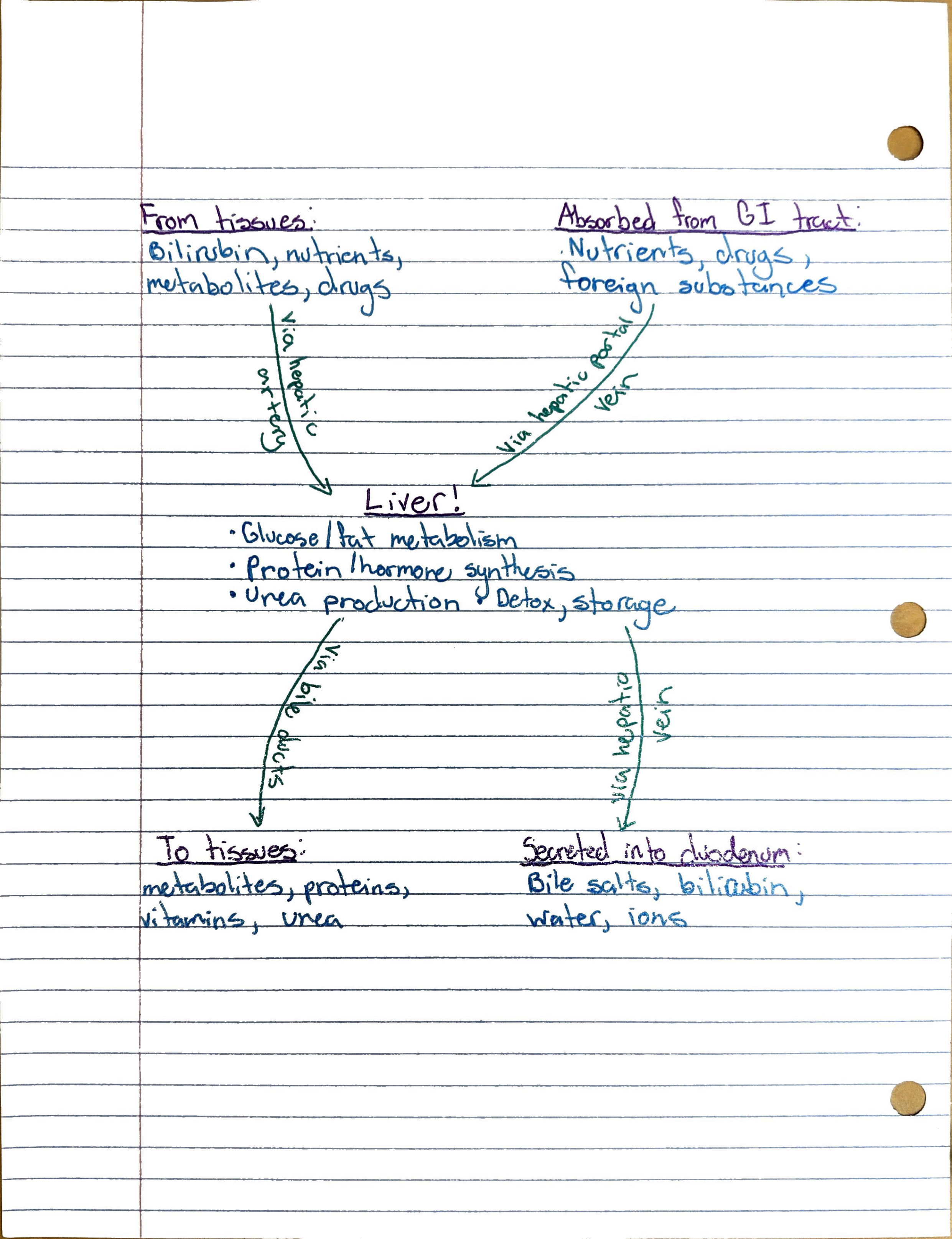
Liver!! is the central distribution center
guys. listen very carefully: