Chapter 10.3: The Rules for Translation of RNA into Amino Acids Are Contained in the Genetic Code
 Call Kai
 Learn
 Practice Test
 Spaced Repetition
 Match
 Flashcards
 Knowt Play
1/9

10 Terms

Codons
Three nucleotides in mRNA that direct amino acid placement in polypeptide chains, related to amino acids by the genetic code
First types decoded by Marshall Nirenberg and Heinrich Matthaei utilizing an artificial known mRNA to trigger the production of radioactively-marked proteins
These are generally the same across species
Sense codons
Codons that encode amino acids, including high levels of redundancy to mitigate DNA mutations
Synonymous mutations
Mutations in a DNA sequence that, after being translated into RNA, do not alter the phenotype
Occur because of the degeneracy of the genetic code
Stop codons (nonsense codons)
Codons that do not encode amino acid information and cause termination of translation
These cause the release of the polypeptide into the cell
Start codon
The codon that initiates translation, AUG; this also codes for the amino acid methionine

Transgenic organisms
Organisms engineered to express a gene from another organism, made possible through the presence of the universal genetic code

Missense mutations
Mutations that occur when a DNA substitution encodes a different amino acid, which can cause a change in function or lose a start codon
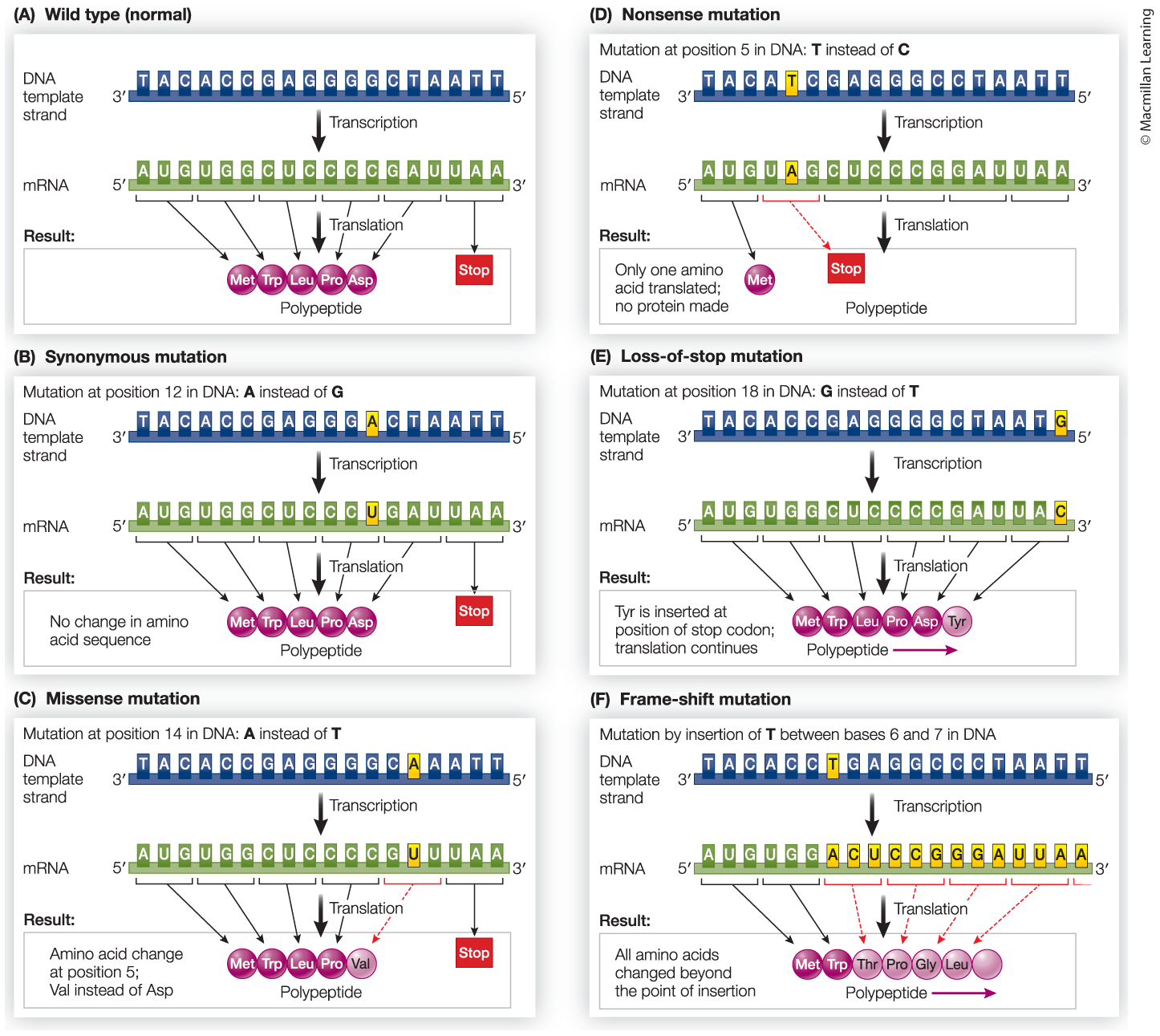
Nonsense mutations
Mutations that result in a change from a sense to a stop codon, causing a premature termination of translation and shortened protein

Loss-of-stop mutations
Mutations that result in a change from a stop to a sense codon, resulting in additional amino acids being added
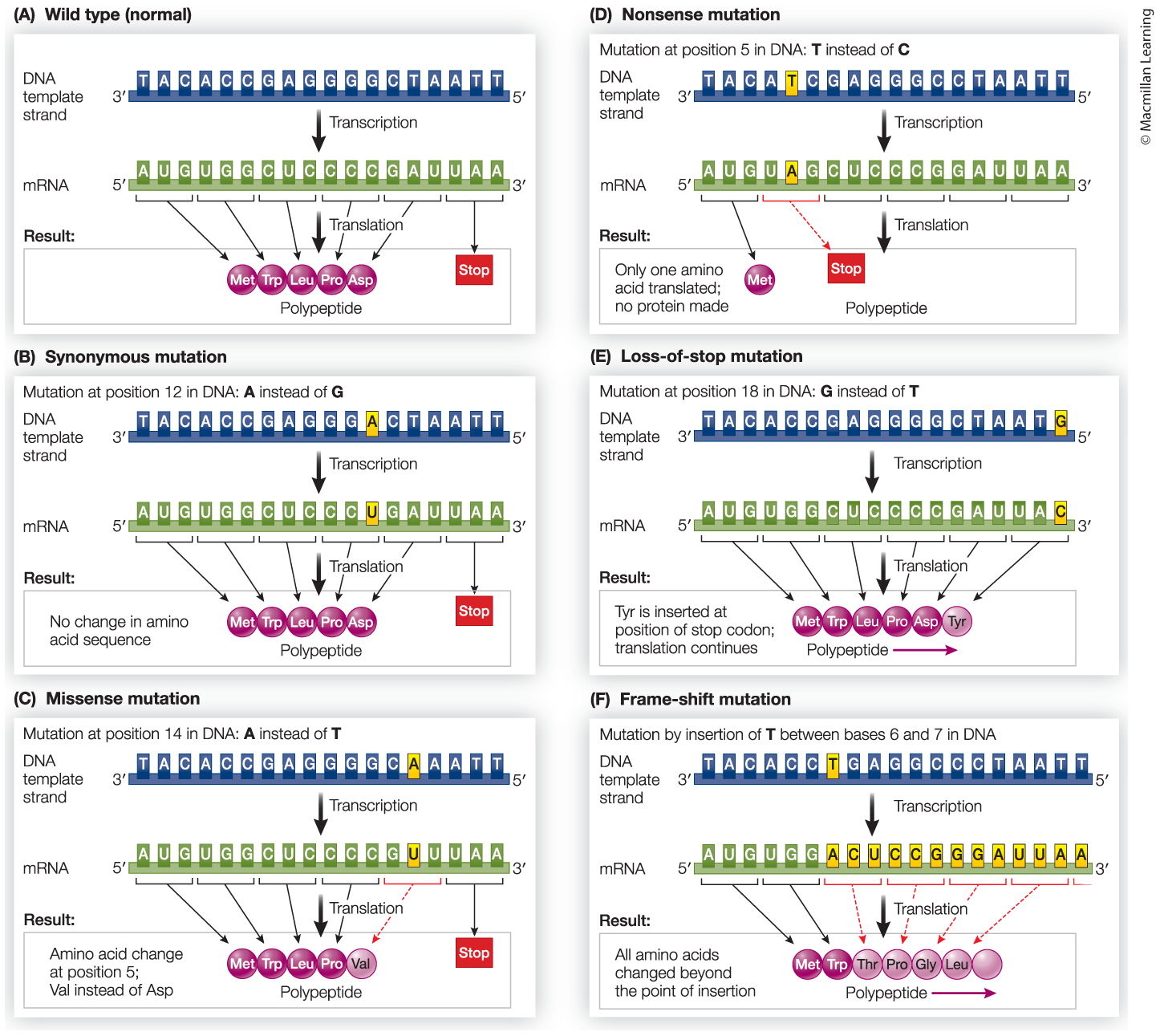
Frame-shift mutations
Mutations that result in the insertion or deletion of one or more (but not a multiple of three) base pairs in the coding sequence, leading to an altered sequence being read and a typical loss of function