Introduction to Muscle Tissues
 Call Kai
 Learn
 Practice Test
 Spaced Repetition
 Match
 Flashcards
 Knowt Play
1/20

Earn XP
Description and Tags
Chapter 23
21 Terms
What are the three types of muscle tissues?
Skeletal
Cardiac
Smooth
List the characteristics of skeletal muscle
Attached to bone
Moves bone
Long and skinny fibers
Striated
Multinucleate
Voluntary
List the characteristics of Cardiac muscle
Within the heart wall
Pumps blood
Short and branching cells
Striated
1-2 nuclei
Intercalated discs
Involuntary
List the characteristics of smooth muscles
Primarily within the wall of hollow organs
Moves material through hollow organs
Fusiform cells
Skeletal muscle


What does 1 represent?
Striations. These are due to the overlap of contractile proteins called actin and myosin
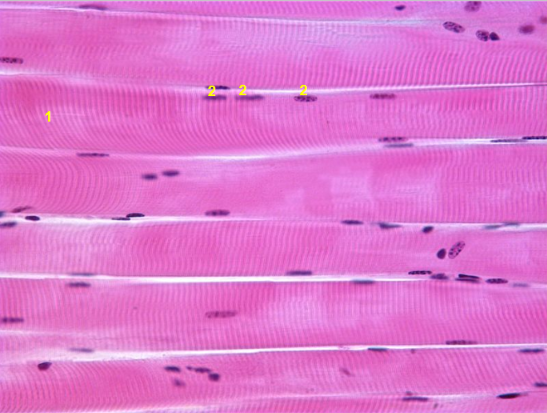
What does 2 represent?
Nuclei. Skeletal muscle are multinucleate
Cardiac muscles
Within the heart wall

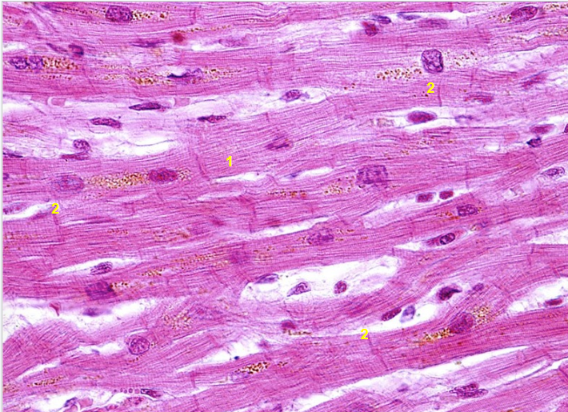
What does 1 represent
Striations. Most cardiac muscles are uninucleate

What does 2 represent
Intercalated disks. Join cardiac muscles electrically through gap junctions and mechanically through desmosomes
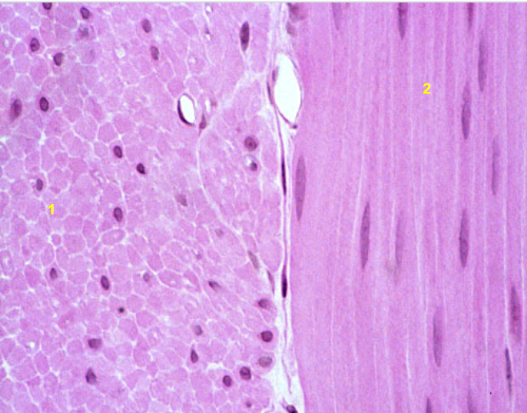
Smooth muscles
These muscles lack striations

What does 1 represent?
The plasma membrane of the skeletal muscle fiber. Called the sarcolemma
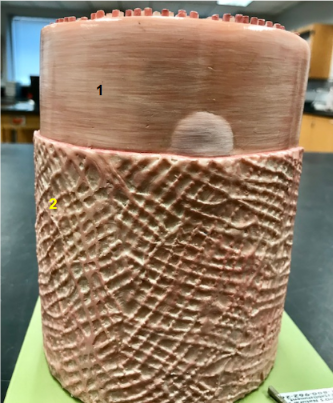
What does 2 represent?
Loose connective tissue that wraps around the fiber and binds neighboring muscle fibers together. Called the endomysium

What does 3 represent
The motor end plate. This is the part of the muscle fiber that receives a synaptic knob.

What does 4 represent
The synaptic knob

What does 5 represent
Telodendrion

What does 6 represent?
Myofibrils. They take up majority of the muscle fiber interior. They are bundles of proteins that include actin and myosin that allow for them to contract
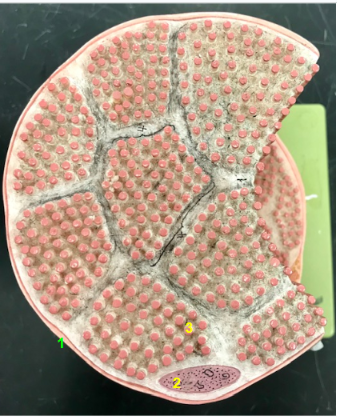
What does 1 represent
The sarcolemma

What does 2 represent
The Nucleus
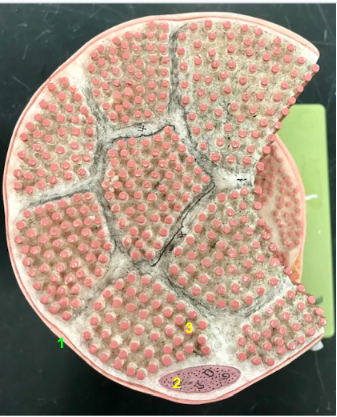
What does 3 represent
Myofibrils

What does 2 represent
Neuromuscular junction. This is a synapse between a motor neuron and the motor end plate of a muscle fiber