BMOL30090 L8 B cells and Abs
 Call Kai
 Learn
Learn Practice Test
 Spaced Repetition
 Match
Match Flashcards
 Knowt Play
1/38

Earn XP
Description and Tags
watch YT video: slide 7
Name | Mastery | Learn | Test | Matching | Spaced | Call with Kai | Chat |
|---|
No analytics yet
Send a link to your students to track their progress
39 Terms
B cells
secrete Abs - many key roles in IR
vital for protection against many pathogens
antiserum

antiserum
Antibody cocktail
Ab isotypes image

Ab isotypes
IgA - mucosal surface (lung, gut, genitourinary), tend to be dimers
IgE - allergy, basophil activation
IgD - signal B cells to activate
IgM - produced earliest in Ab response
IgG - plasma cells: high affinity
IgA
mucosal surface (lung, gut, genitourinary), tend to be dimers
IgE
allergy, basophil activation
IgD
signal B cells to activate
IgM
produced earliest in Ab response
IgG
plasma cells - high affinity
Abs of different classes have distinct effector functions

overall Ab structure
tip of red is hypervariable region
all IgAs have same type of constant region, etc..
light chain in yellow

Ab diversity
each individual has > 1 × 10¹¹ different Abs
diversity at the variable region
hypervariable region & framework regions

B cell variation
similar to TCR genetic variation
V(D)J recombination - any V D J can combine
2 types of light chains: lamda (120,000 possibilities), kappa (150,000 possibilities)
total of 265 (? thousand) light chain combos
total of 81,000 heavy chain combos
B cell variation - VDJ image

VDJ
200 different V genes
27 different D (Diversity) genes
15 different J (Joining) genes
combos of these contib to diversity

B cell development
As the B cell develops into a plasma cell, the B cell receptor gets secreted as an antibody with the exact same antigen specificity. (from google)
B cell receptor prods the same Ab that it reacts w/ the Ag of?
cellular level of B cell development image

B cell receptor image

Part 1. B cell activation
Ag binds to the B-cell receptor (BCR)
triggers a signal-transduction cascade
the BCR is internalised
Ag processed
newly synthesised MHC molecules & Ag peptides bound to the BCR form complexes
the peptide-MHC complexes are transported to cell surface
Part 1. B cell activation image
d: B cell receptor internalised
e: newly syn. MHC molecules & Ag peptides bound to BCR form complexes

Part 2. B cell activation
peptide-MHC complexes are recognised by the T-cell receptor (TCR) of T-helper cells, leading to T-cell activation
activated T-cells provide ‘help’ to the B cell, by both secreted cytokines (IL-4) and cell-cell interactions mediated by CD40 (B cell)-CD20L (T cell)
leads to activation of B cells
Part 2. B cell activation image

T-B cooperation

activation of B cells by Ag involves signals from the BCR and TFH cells or microbial Ags
reside in lymph nodes

pathway to B cell activation image
FDC - follicular dendritic cell

second phase of a primary B-cell IR
germinal centre: a B-cell nursery, nutrient rich, dense cell contact
all signals needed for intense cell proliferation
gene rearrangement and Ab maturation occurs here
plasma cells - leave via lymphatics
germinal centre image

human tonsillar germinal centre
B cells found in the dark zone, light zone and mantle zone
proliferating B cells = green
rapidly proliferating B cells are present in the dark zone
FDCs = red
small recirculating B cells - in mantle zone
large masses of CD4+ T cells are in the T cell zone = blue

tonsils
a type of lymph node
isotype switching
naiive mature B cells prod both IgM and IgD
encounter Ag → B cells proliferate & receive CD40 signal
undergo Ab class switching to prod IgG, IgA or IgE Abs
cytokine signals from T cells contrib to decision of which isotype
parasite infection: large amount of IL-4 = IgE
IFN-gamma: IgG
mucosal infection: IL-5 = IgA

affinity maturation by somatic hypermutation
affinity maturation: process by which B cells respond to an Ag → Ab with better affinity
acts randomly on rearranged V region genes
clustered in the 3 hypervariable regions that make contact w/ the Ag
activation induced cytidine deaminase (AID) introduces mutations into genes transcribed in B cells - somatic hypermutation
(watch YT)
if it encounters Ag, recognises it and activates B cell to change the sequence of V region (?)
on nucleotide level
affinity maturation by somatic hypermutation image

primary vs secondary humoral responses


humoral response of covid infections image
secretory IgA at the epithelial surface
polymeric immunoglobulin receptor (pIgR) binds to the Fc regions of IgA and IgM
transports them across epithelial barriers

high affinity IgG and IgA Abs can neutralise toxins table

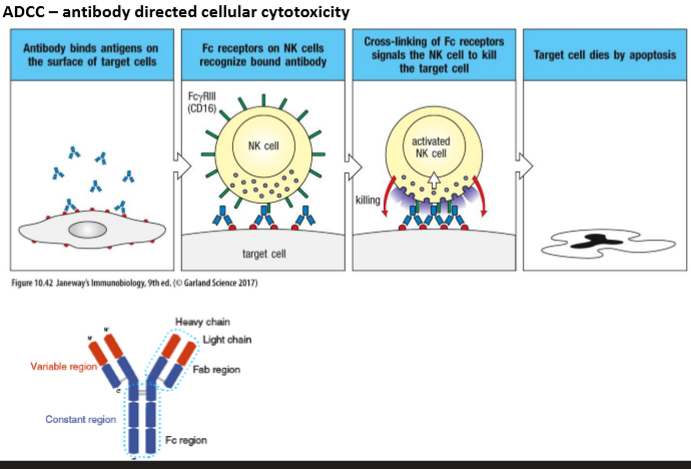
Fc receptors activate NK cells to destroy Ab-coated targets image
recap/summary
