Visual Sources
 Note
Note Call Kai
 Learn
Learn Practice Test
 Spaced Repetition
 Match
Match Flashcards
 Knowt Play
1/42

There's no tags or description
Looks like no tags are added yet.
Name | Mastery | Learn | Test | Matching | Spaced | Call with Kai | Chat |
|---|
No analytics yet
Send a link to your students to track their progress
43 Terms
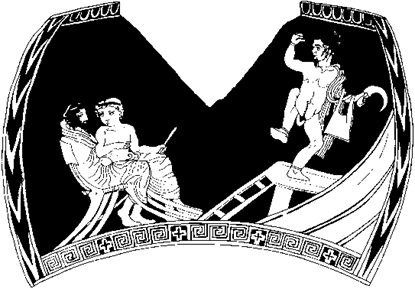
Perseus Dance Vase - 420-410 BC
Artist and Vase Type
Red-figure vase fragment
Where was the Perseus Dance Vase made?
Athens
What does it depict?
Comic actor Perseus depicted on stage, brandishing a sickle used to behead Medusa (whose head is in a bag)
Actor shown dancing or mimicking flight akin to Perseus' actions from the myth
Two audience members are present at the stage's foot; one is an older bearded man and the other a younger man
Audience members are seated on wooden chairs called klismoi, similar to those in the Theatre of Dionysus
What makes it useful as evidence?
Illustrates how mythical scenes might be portrayed in theatre
Demonstrates use of costume, emphasizing the actor's skin-tight outfit visible at the wrists and ankles
Indicates that actors sometimes performed shoeless
Highlights the use of a raised wooden platform for performances
Shows the significance of facial hair in determining perceived age
Implicates the elite status of audience members seated in prohedria due to the special chairs
Limitations
Vase contains reconstructed features due to damage
Absence of the chorus in the depiction; role and significance unrepresented
Identity of the two seated figures is ambiguous; they could be:
Two judges
Priest of Dionysus and another priest
Dionysus paired with his consort Ariadne
Choregos and a playwright
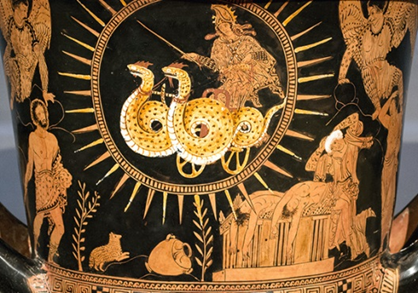
Medea’s Escape - 400 BC
Artist and Vase Type
Red-figure calyx krater = mixing bowl
Where was Medea’s Escape made?
Southern Italy
Artist and Vase Type
Policoro Painter
What does it depict?
Story of Madea’s escape
Her 2 sons lying dead on an altar with Furies flying above
Her Chariot (given by her grandfather/sun god) is being pulled by dragons and she is encircled by the sun.
She is escaping punishment for killing her sons because her husband, Jason, had divorced her to marry someone else.
What makes it useful as evidence?
Shows use of stagecraft/props - Medea would have been suspended above the stage with a crane [deus ex machina']
Medea in stock costume of foreigners and Jason in heroic nakedness giving insights into costume choices depending on character type.
Artistic Interpretation - The artist has heightened the intensity by having Medea and Jason lock eyes with one another.
Found in South Italy showing the widespread influence of plays.
Limitations
Furies were not present in Medea’s escape and Medea’s sons were taken with her to be buried, not left on the altar.
Changes show painting is a possible exaggeration of the true play’s scene (obviously not going to be real dragons).
Made 30yrs after Medea written by Euripides (doesn’t follow exact story)
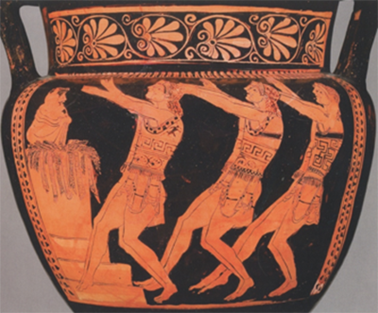
Basel Dancers Vase - 500-490 BC
Artist and Vase Type
Unknown Artist (Mannerist style) - Red figure Column Krater = Mixing Bowl
Where was the Basel Dancers Vase made?
Athens
What does it depict?
Tragic chorus in action. Notable that it dates to the early years of the fifth century, where tragedy was still in its early forms
A figure seems to rise from the altar
interpretation is that the figure represents an icon of Dionysus which has been placed on the altar to witness the performance.
Indecipherable letters coming out of their mouths to indicate singing
What makes it useful as evidence?
Chorus members with same masks, costumes and dance moves in lines tells us how the chorus worked as equal, indistinguishable individuals.
They appear to be wearing military costumes, although on their heads are diadems rather than helmets as may be expected
They also go barefoot, which seems to be the norm for choruses.
Limitations
Don't know what play it is; can't recognise figure on the altar (is it Dionysus, or ghost from Persians/similar play?)
Static; no sense of the actual atmosphere of play, only one scene with one dance move and a limited amount of characters.
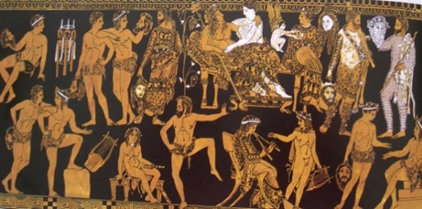
Pronomos Vase - 400 BC
Where was Pronomos Vase made?
Athens
Artist and Vase Type
Pronomos painter - Volute Krater = Mixing Bowl
What does it depict?
Shows a depiction of tragic actors and chorus members off stage
There is an aulos player in the centre of the scene
how costume phallus' used for comedic effect, giving sense of a satirical performance.
Famous figures; e.g. Aulos player is Pronomos + Demetrios the playwright shows who was important at that time.
Aulos + music references shows importance of music in plays.
Dionysus and Ariadne oversee the performance shows theatre was part of religion; was an act of worship to Dionysus.
What makes it useful as evidence?
Shows chorus members offstage but still in costume
Shows the masks
Many of the actors have their real life names inscribed beside them
Shows how there were females in roles in the play (but men in masks)
Picture of Dionysus – shows how gods were in the play
Limitations
Only a vase – does not show very much colour (not as much as there would have been)
Lots of actors/chorus members makes it hard to distinguish between different participants.
Nothing about how plays are performed onstage - only shows what happens offstage.
no sense of the actual atmosphere of play
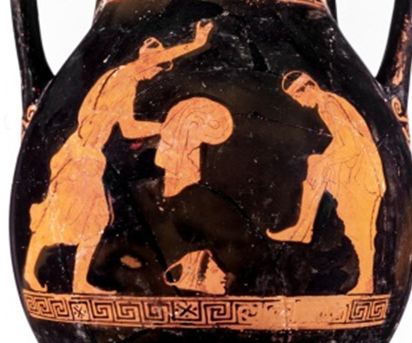
Tragic actors dressing - 450 BC
Artist and Vase Type
Phiale Painter - Red figure Pelike = Storage Jar
Where was Tragic actors dressing made?
Athens
What does it depict?
You can see two tragic actors or chorus members who are getting into costume, including his masks which is indicated by the gasping mouth
Playing Women
The actor on the right puts on his high boots, while his life-like mask lies on the floor beside him
What makes it useful as evidence?
The boots of tragic actors had thin soles and turned up toes that allowed them to move around easily.
Show what happened backstage
Depictions of Masks/Costumes
Limitations
Only shows two actors/chorus members
No skene shown so we can guess this is backstage but not sure. This doesn't tell us about the layout of the theatre
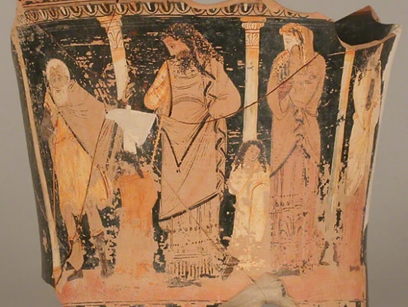
Oedipus vase - 330-320 BC
Artist and Vase Type
Capodarso Painter - Calyx Krater = Mixing bowl
Where was Oedipus vase made?
Sicily
What does it depict?
Depicting a performance of Oedipus Rex.
The scene is believed to be the one in which the messenger relays the information on the death of Polybus to Oedipus. And how Oedipus was a Theban, not a Corinthian.
It is the exact moment Jocasta realises the truth, hence her reaction.
It includes Antigone and Ismene despite them not being present in the text at that time
What makes it useful as evidence?
This helps us observe costumes, masks and stage structure.
Pillars show use of skene to depict palace
It is also allows us to see what liberties artists took with plays, as Antigone, Ismene and Jocasta never appear on stage at the same time. This allows us to be more cautious when analysing other sources.
Jocasta in shock, and Oedipus looks deep in thought giving insights into stock poses for different emotions.
Shows us all characters involved in play - gives us more insight into how characters interacted with one another.
Use of three-(speaking) actor rule by Sophocles
In Sicily, not Greece proving the influence these plays held
Limitations
The vases depiction is inaccurate, thus we cannot draw evidence from it as we have no way of knowing if it just artistic interpretation
Broken vase, so other areas of theatre (e.g. Theatron) may be missing.
Parts of play don't correlate w/ Sophocles' play - i.e. His daughters (Antigone and Iphigenia) are present, unlike in play.
Not completely clear what scene being shown
Limited colour usage; red figures w/ some yellow doesn't show us what costumes were like colour-wise (E.g. Oedipus could be wearing purple, but we don't know).
Found in South Italy, so may not be the same interpretation as one held in Greece.
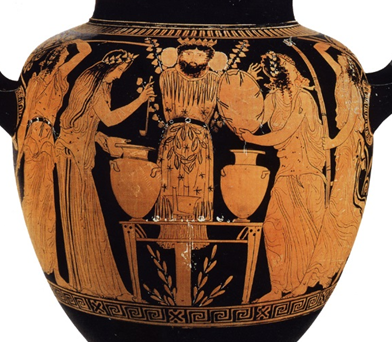
Maenad vase (Stamnos) - 430-420 BC
Artist and Vase Type
Dinos Painter - Red Figure Stamnos = wine vessel
Where was Maenad vase made?
Athens
What does it depict?
image of the god fastened to pillar suggests a festival of Dionysos
Women or maenads with thyrsi and tambourines dance around a pillar idol of Dionysus
holding two large stamnoi from which one maenad ladles wine into a skyphos.
What makes it useful as evidence?
Shows typical worship of Dionysus, as well as garb of Bacchants and Maenads.
Also allows us to look at typical vases used to hold drink, and how it was served. Ladles etc
Allows us to see what typical Dionysian idols looked like
Maenads have their hair down, which wouldn't have been appropriate to other Greeks; Maenads were separate to others in Greek society due to their cult-likeness, meaning societal rules didn't really apply to them.
Limitations
Not a real image. Likely an artistic depiction of a festival.
Doesn't show any of their other rituals (e.g. Dancing).
Don't know what they're actually celebrating; festival or private event?