ne102 4/13 lecture: cell-to-cell comms + signal transduction

0.0(0)
Studied by 0 people
call kaiCall Kai
learnLearn
examPractice Test
spaced repetitionSpaced Repetition
heart puzzleMatch
flashcardsFlashcards
GameKnowt Play
Card Sorting

1/11

encourage image

There's no tags or description

Looks like no tags are added yet.

12 Terms

1
New cards

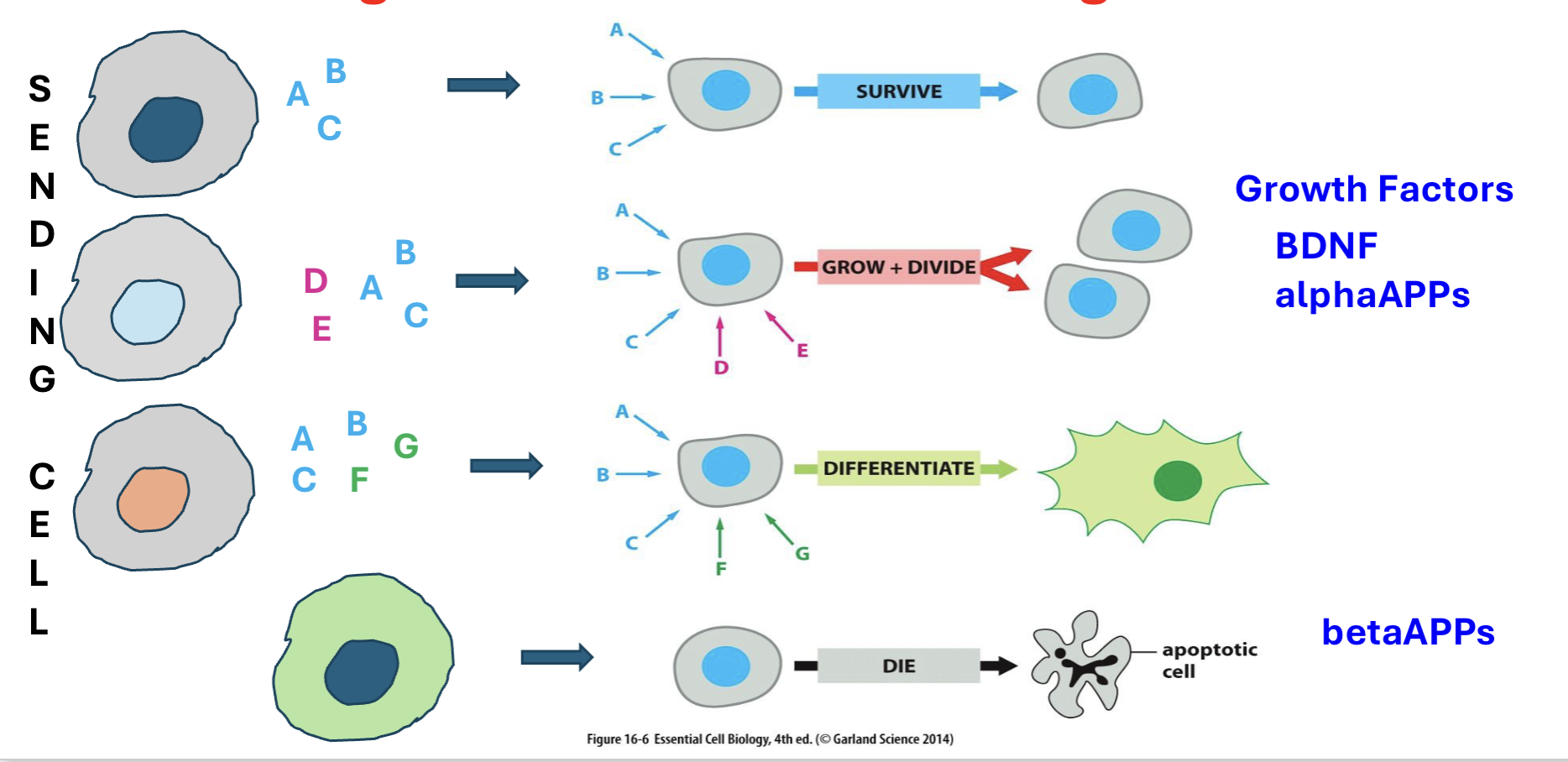
what determines which specific response a receiving cell will carry out?

signal transduction is SPECIFIC based on signal molecule used, receptor involved, + the molecules/proteins that are activated

2
New cards
<p>by signal transductions, diff stages of the life of the receiving cell are</p>

by signal transductions, diff stages of the life of the receiving cell are

  1. survive

  2. grow and divide (growth factors like BDNF, alphaAPPs)

  3. differentiate

  4. die (betaAPPs)


<ol><li><p>survive</p></li><li><p>grow and divide (growth factors like BDNF, alphaAPPs)</p></li><li><p>differentiate</p></li><li><p>die (betaAPPs)</p></li></ol><p></p>
3
New cards

signal transduction specificity pipeline

specific signaling molecules → receptors → initiate defined pathway that determines cell’s response (survival, movement, growth, etc)
4
New cards
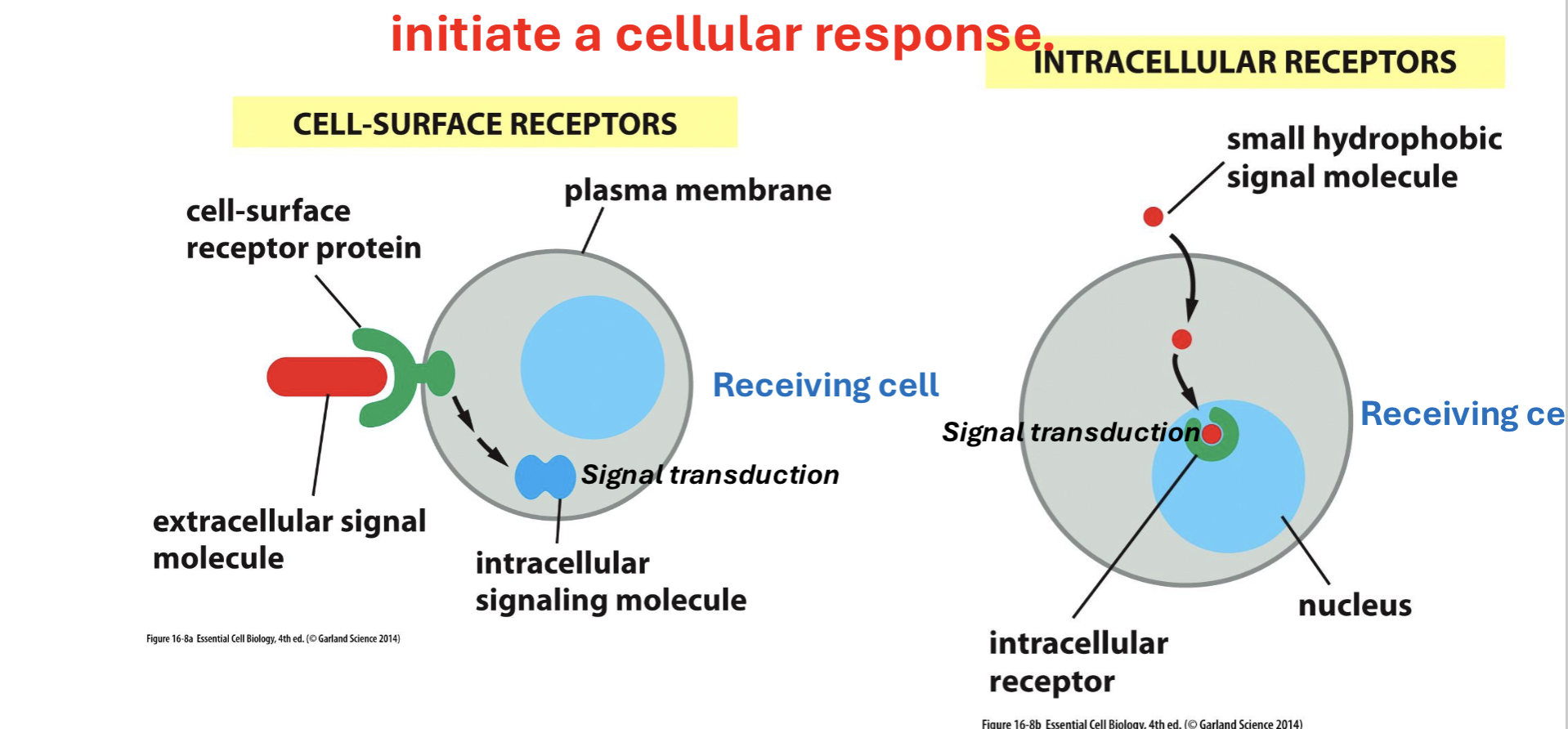
<p>how is signal transduction mediated? (cell-surface) </p>

how is signal transduction mediated? (cell-surface)

by specific receptor proteins that interact with signaling molecules to initiate a cellular response

<p>by specific receptor proteins that interact with signaling molecules to initiate a cellular response</p>
5
New cards
<p>cell-surface receptors process</p>

cell-surface receptors process

  1. signal molecule needs to be close to the receiving cell

  2. chemical interaction between signal molecule + receptor in receiving cell

  3. conformational changes in receptor, that lead to activate other proteins in the receiving cell

  4. regulation of a specific step of the life of a cell


<ol><li><p>signal molecule needs to be close to the receiving cell</p></li><li><p>chemical interaction between signal molecule + receptor in receiving cell</p></li><li><p>conformational changes in receptor, that lead to activate other proteins in the receiving cell</p></li><li><p>regulation of a specific step of the life of a cell</p></li></ol><p></p>
6
New cards
<p>intracellular receptors process</p>

intracellular receptors process

  1. signal molecule needs to be close to receiving cell

  2. SM crosses membrane bilayer

  3. chemical interaction between signal molecule + intracellular receptor

  4. SM is transported to nucleus

  5. SM may directly control specific gene transcription


<ol><li><p>signal molecule needs to be close to receiving cell</p></li><li><p>SM crosses membrane bilayer</p></li><li><p>chemical interaction between signal molecule + intracellular receptor</p></li><li><p>SM is transported to nucleus</p></li><li><p>SM may directly control specific gene transcription</p></li></ol><p></p>
7
New cards
<p>steroid hormones can pass through plasma membrane + can interact with intracellular receptors</p>

steroid hormones can pass through plasma membrane + can interact with intracellular receptors

cortisol hydrophobic SM → pass through membrane → bind to nuclear receptor protein + conformational change activates it → complex moves into nucleus → binds to element of target gene SRE → gene transcription activated

<p>cortisol hydrophobic SM → pass through membrane → bind to nuclear receptor protein + conformational change activates it → complex moves into nucleus → binds to element of target gene SRE → gene transcription activated</p>
8
New cards
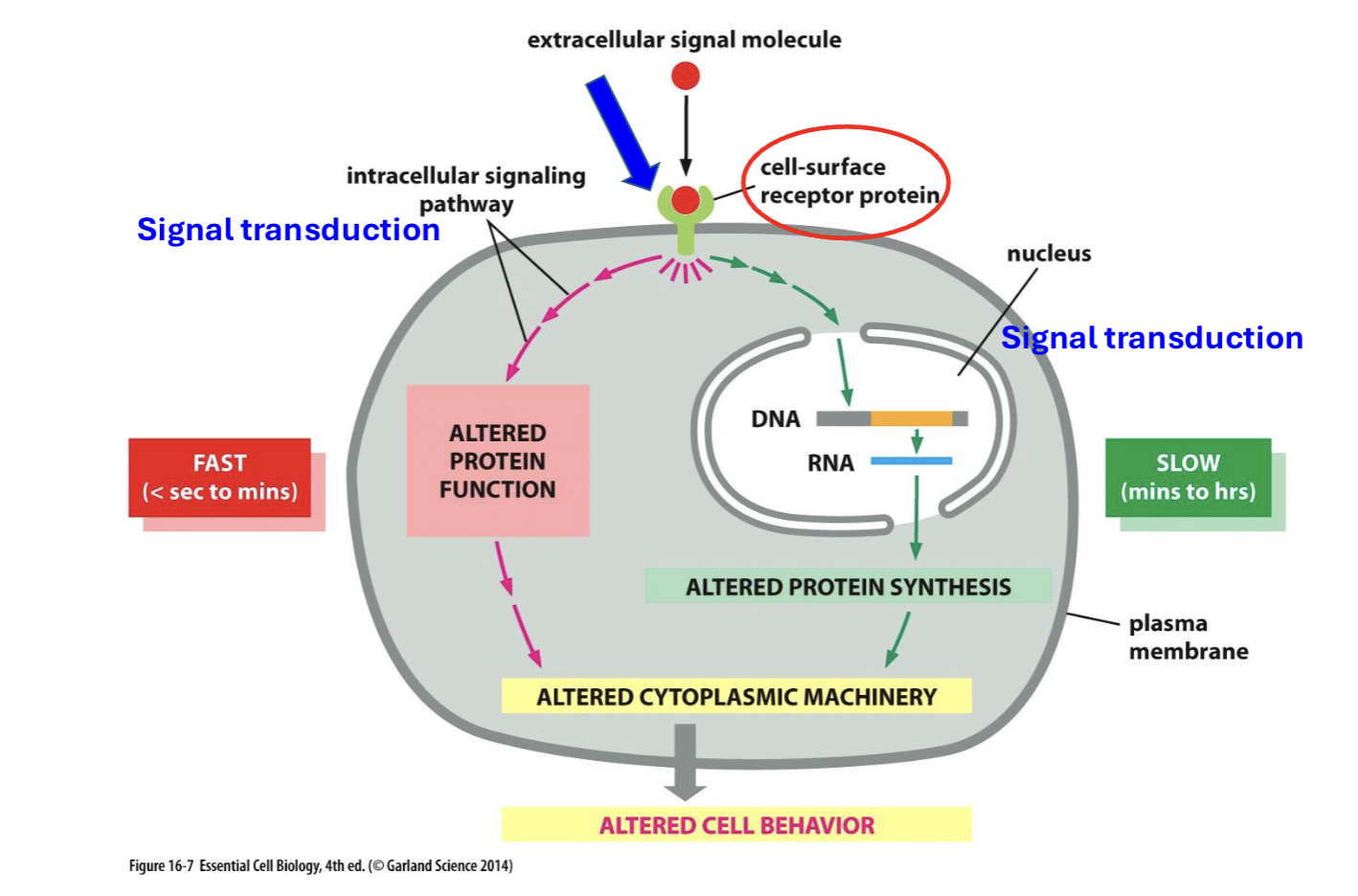
<p>how fast is the signal transduced by the receiving cell? (fast)  </p>

how fast is the signal transduced by the receiving cell? (fast)

SMs can act slowly or rapidly

fast (sec to mins): extracellular SM binds to cell-surface receptor protein → intracellular signaling path → altered protein function → altered cytoplasmic machinery → altered cell behavior
<p>SMs can act slowly or rapidly</p><p>fast (sec to mins): extracellular SM binds to cell-surface receptor protein → intracellular signaling path → altered protein function → altered cytoplasmic machinery → altered cell behavior</p>
9
New cards
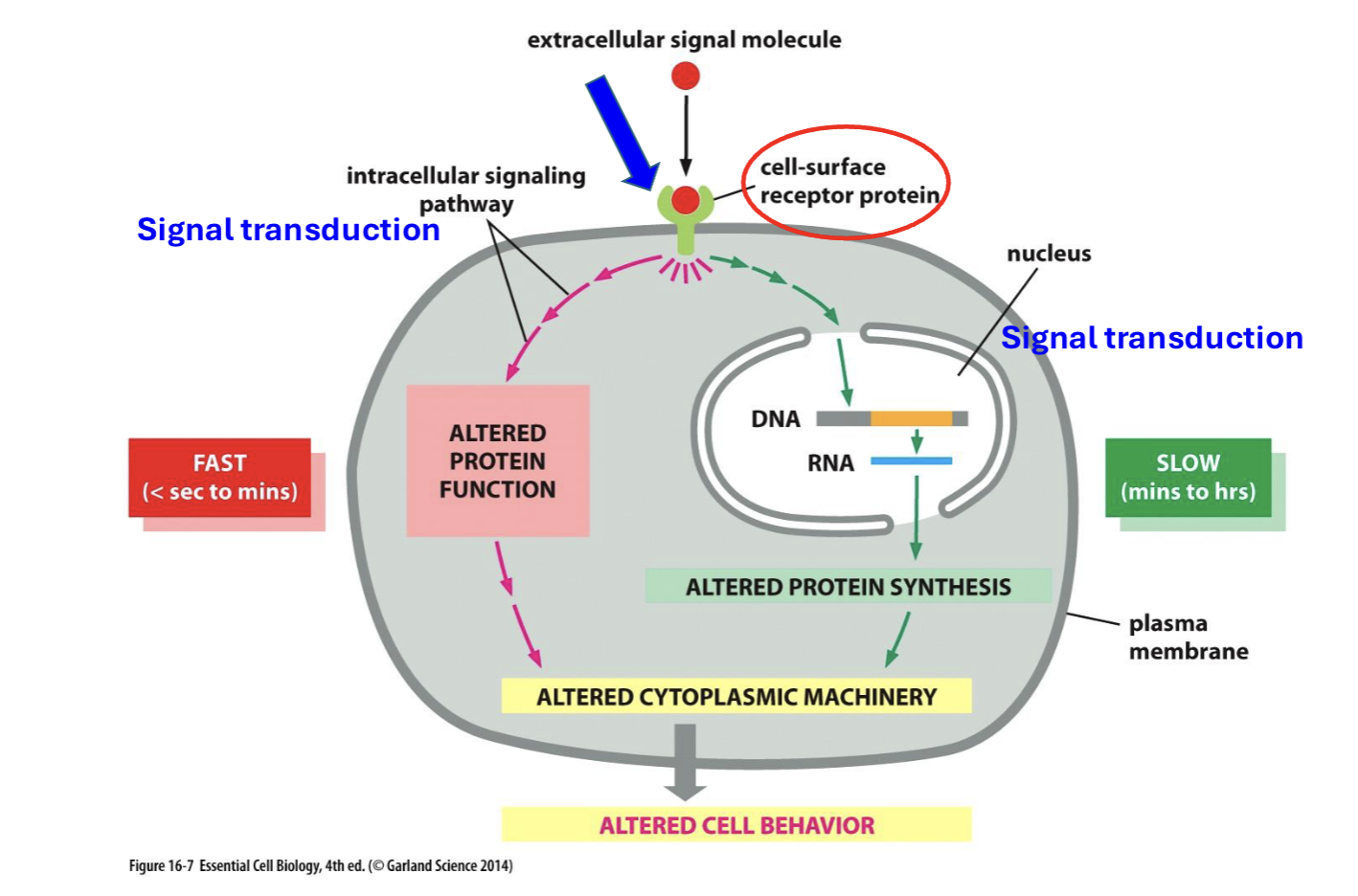
<p>slow pathway (mins to hours) </p>

slow pathway (mins to hours)

extracellular SM binds to cell-surface receptor protein → cell-surface signaling path → need to transcribe/translate → altered protein synthesis → altered cytoplasmic machinery → altered cell behavior
<p>extracellular SM binds to cell-surface receptor protein → cell-surface signaling path → need to transcribe/translate → altered protein synthesis → altered cytoplasmic machinery → altered cell behavior</p>
10
New cards
<p>how is it possible for signal transduction to control receiving cell responses?</p>

how is it possible for signal transduction to control receiving cell responses?

activation/transcription of specific proteins via interactions + conformational changes at extracellular + intracellular domains of receptor

<p>activation/transcription of specific proteins via interactions + conformational changes at extracellular + intracellular domains of receptor</p>
11
New cards
<p>molecular activation in signal transduction</p>

molecular activation in signal transduction

changes in protein conformation at intracellular domain of receptor → activation of effector proteins inside cell (metabolic enzyme → altered met; cytoskeletal protein → altered cell shape/movement; TR → altered gene expression)

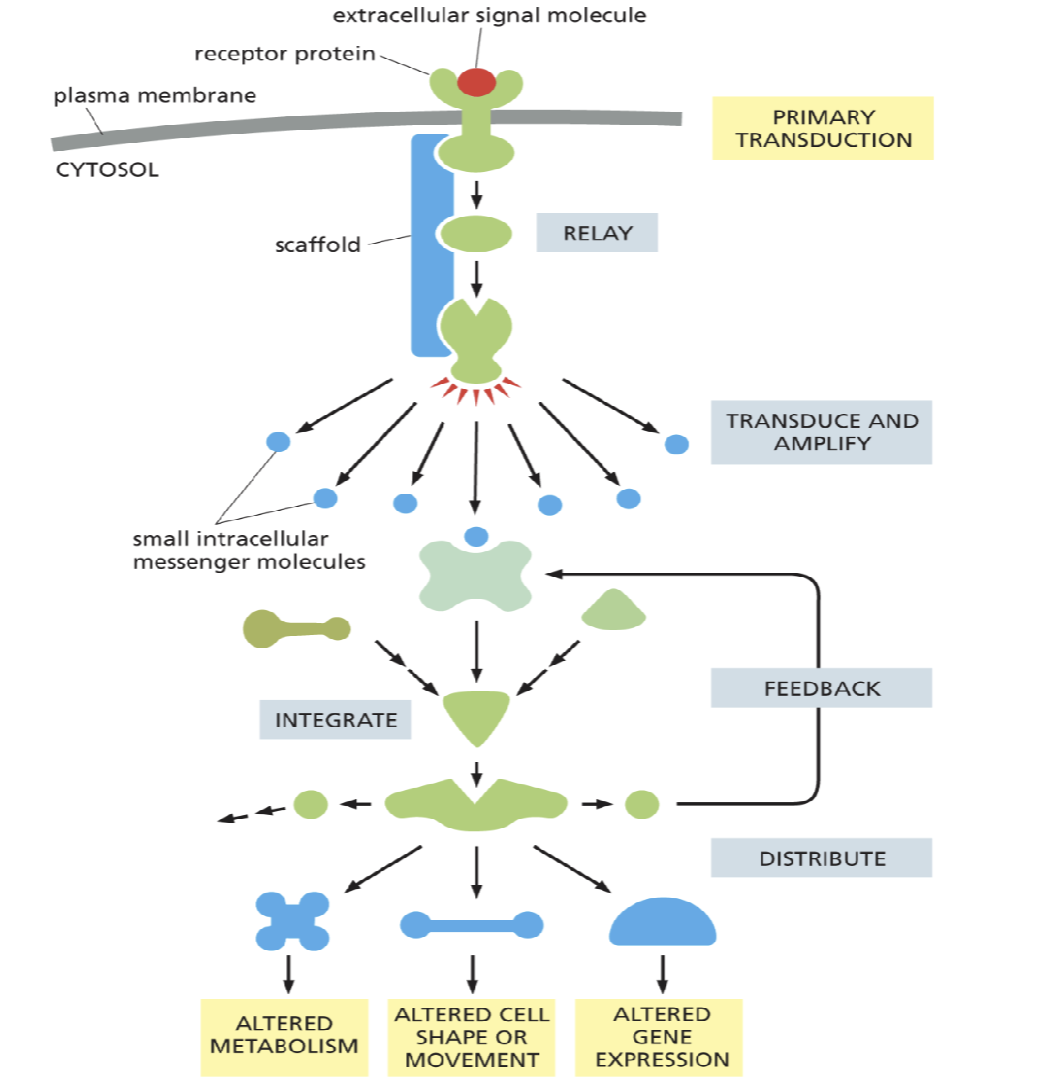
<p>changes in protein conformation at intracellular domain of receptor → activation of effector proteins inside cell (metabolic enzyme → altered met; cytoskeletal protein → altered cell shape/movement; TR → altered gene expression)</p>
12
New cards
<p>intracellular effectors can do what?</p>

intracellular effectors can do what?

relay → amplify → integrate incoming signal

<p>relay → amplify → integrate incoming signal</p>