Lesson 10: Vertical Motion
 Call Kai
 Learn
Learn Practice Test
 Spaced Repetition
 Match
Match Flashcards
 Knowt Play
1/38

There's no tags or description
Looks like no tags are added yet.
Name | Mastery | Learn | Test | Matching | Spaced | Call with Kai | Chat |
|---|
No analytics yet
Send a link to your students to track their progress
39 Terms
vertical motions are usually much () than horizontal motions
horizontal air flow ranges from () to ()+ kt
vertical air flow is usually a () ft per minute, but may exceed () ft/min in strong (), mountain (), or () turbulence
vertical motions are usually much (weaker) than horizontal motions
horizontal air flow ranges from (0) to (100)+ kt
vertical air flow is usually a (few) ft per minute, but may exceed (5000) ft/min in strong (TS), mountain (waves), or (clear-air) turbulence
air can change temperature without exchanging heat with its surroundings, what is this type of temperature change called?
adiabatic
what does a rising motion mean in terms of air?
air () and () since the air molecules (…) to spread out which leaves them with () heat
() and () may form if the air is sufficiently humid
air expands and cools since the air molecules use their own energy to spread out which leaves them with less heat
clouds and precipitation may form if the air is sufficiently humid
what does a sinking motion mean in terms of air?
air is () and () since there is more () which compresses the air molecules, increasing () which () them
() skies
air is compressed and warms since there is more weight which compresses the air molecules, increasing pressure which warms them
clearing skies
what are the four sources of vertical motion that may generate precipitation because they last longer than 15 mins?
con…/div…
oro…
fro…
conv…
convergence/divergence
ororaphy (topography)
fronts
convection
what are the two sources that generally do not lead to precipitation because they are short lived?
wave…
turb…
wave motion
turbulence
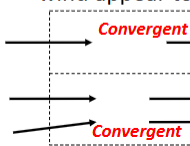
what is convergence?
occurs when there is more () to than () from a region
when looking at the box, there will be a larger portion of the arrow pointing () the box rather than ()
also arrows will be moving () to each other
occurs when there is more inflow to than outflow from a region
when looking at the box, there will be a larger portion of the arrow pointing INSIDE the box rather than out
also arrows will be moving closer to each other
what is divergence?
occurs when there is more () from than () to a region
when looking at the box, there will be a larger portion of the arrow pointing () the box rather than ()
also arrows will be () (far apart) or moving () from each other
occurs when there is more outflow from than inflow to a region
when looking at the box, there will be a larger portion of the arrow pointing OUTSIDE the box rather than in
also arrows will be parallel (far apart) or moving away from each other
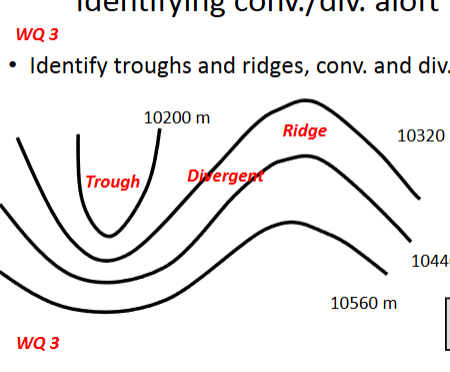
how do you identify a trough, ridge, conv, and div?
a trough is a () area of pressure that looks like a ()
a ridge is a () area of pressure that looks like a ()
a convergent is () of a trough (going () to the trough)
a divergent is () of a trough (going () from the trough)
a trough is a low area of pressure that looks like a U
a ridge is a high area of pressure that looks like a hill
a convergent is upwind of a trough (going down to the trough)
a divergent is downwind of a trough (going up from the trough)
what happens in upper-level convergence?
() skies and () pressure
over time weight of column (), air high up piles up and weighs ()
the heavy air () towards the ground
at the surface, the air spreads () which creates fair, (), and () weather
clear skies and high pressure
over time weight of column increases, air high up piles up and weighs down
the heavy air sinks towards the ground
at the surface, the air spreads outward which creates fair, stable, and clear weather
what happens in upper-level divergence?
() and () pressure
air () up spreads and () away
this acts like a (), pulling air () from the surface (weight of column () )
surface air rushes () and (), creating clouds, storms, and low pressure systems
storms (clouds/rain) and low pressure
air high up spreads and moves away
this acts like a vacuum, pulling air up from the surface (weight of column decreases)
surface air rushes inward and rises, creating clouds, storms, and low pressure systems
what does this lead to and what does the tropopause resist?
leads to pressure…
tropopause resists () motion, thus air () below convergence and () below divergence
leads to pressure surface changes
tropopause resists vertical motion, thus air sinks below convergence and rises below divergence
what are the 3 effects of convergence/divergence
Leads to surface…
() in the jet stream
Surface () and () are weakened by ()
leads to surface pressure changes
troughs in the jet stream
surface highs and lows are weakened by friction
explain “leads to pressure changes”
convergence → () pressure
divergence → () pressure
convergence → increases pressure
divergence → decreases pressure
explain “troughs in the jet stream”
downwind side: strong () (surface pressure () )
upwind side: strong () (surface pressure () )
downwind side: strong divergence (surface pressure drops)
upwind side: strong convergence (surface pressure rises)
explain “surface highs and lows are weakened by friction
highs: surface (), () motion, pressure () - air moves () away from the center of high pressure as it () toward the Earth's surface.
lows: surface (), () motion, pressure () -
lows: surface convergence, rising motion, pressure rises - air naturally rushes () toward the lowest pressure to fill the atmospheric deficit at the center.
highs: surface divergence, sinking motion, pressure drops
air moves outward (diverges) away from the center of high pressure as it sinks toward the Earth's surface.
lows: surface convergence, rising motion, pressure rises
air naturally rushes inward toward the lowest pressure to fill the atmospheric deficit at the center.
how does surface high pressure strengthen?
when upper level () exceeds surface ()
mass () in the atmospheric column faster than it leaves at the ground, causing surface pressure to () and build the high
when upper level convergence exceeds surface divergence
mass accumulates in the atmospheric column faster than it leaves at the ground, causing surface pressure to rise and build the high
how does surface low pressure strengthen?
when upper level () exceeds surface ()
mass is () from the atmospheric column faster than the surface can () it, causing surface pressure to drop and () the storm
when upper level divergence exceeds surface convergence
mass is removed from the atmospheric column faster than the surface can replace it, causing surface pressure to drop and intensify the storm
sinking motion develops when there is () aloft with () at the surface; () of the upper level trough
sinking motion develops when there is convergence aloft with divergence at the surface; upwind of the upper level trough
rising motion develops when there is () aloft with surface (); () of the upper level trough
rising motion develops when there is divergence aloft with surface convergence; downwind of the upper level trough
what are the four kinds of orographic (topographic) lifting?
() lifting
() lifting
() lifting: caused by ()
() of thermal circulations
upstream lifting
upslope lifting
lee lifting: caused by convergence
convergence of thermal circulations
what is upstream lifting?
caused by () upstream from mountains
air () down and () up before it even hits the mountain since the (…) acts like a traffic jam and the air () behind it, since it has nowhere else to go, the air is forced () before reaching the actual slopes
caused by convergence upstream from mountains
air slows down and piles up before it even hits the mountain since the physical barrier acts like a traffic jam and the air crashes behind it, since it has nowhere else to go, the air is forced upward before reaching the actual slopes
what is upslope lifting?
caused by air being () up a mountain slope
strong () blows against a mountain slope and since the air cannot go () the rock, it is forced to () the terrain and straight up the mountain
caused by air being forced up a mountain slope
strong wind blows against a mountain slope and since the air cannot go thru the rock, it is forced to follow the terrain and straight up the mountain
what is lee lifting?
caused by () on the () side
air () together and () on the backside of the mountain since as the winds blow over the top of a mountain and come down the other side, they encounter different ()/() which causes the air to slam on the () side and force some of that air back ()
caused by convergence on the downwind side
air crashes together and rises on the backside of the mountain since as the winds blow over the top of a mountain and come down the other side, they encounter different winds/obstacles which causes the air to slam on the downwind side and force some of that air back up
what is convergence of thermal circulations?
sun-heated air () the mountain from both sides and () at the peak
during the day, the sun () the mountain slopes quickly and then the warm air () which pulls () air up from the valley on both sides of the mountain and when the two currents meet at the very top, they () into each other and are forced () up into the atmosphere, forming () and/or ()
sun-heated air climbs the mountain from both sides and collides at the peak
during the day, the sun warms the mountain slopes quickly and then the warm air rises which pools cool air up from the valley on both sides of the mountain and when the two currents meet at the very top, they smash into each other and are forced straight up into the atmosphere, forming clouds and/or TS
what are fronts
() boundary between two air masses (i.e ()/() )
resulting in () air rising (), ()
surface boundary between two air masses (i.e. warm/cold)
resulting in warm air rising (clouds, precip)
what is a cold front?
when (), () air mass moves forward and pushes underneath a () air mass
it moves () and it is ()
it forces () air up quickly which creates () clouds, () drops, ()/TS
after it passes, sky () up and air feels () and ()
when cold, dense air mass moves forward and pushes underneath a warmer air mass
it moves fast and it is steeper
it forces warm air up quickly which creates tall clouds, temperature drops, storms/TS
after it passes, sky clears up and air feels cooler and drier
what is a warm front?
when a () air mass slides up and over a retreating () air mass
it moves () and is more dragged out
it creates a () slope of rising air, bringing layer-type () and long periods of light to moderate () or ()
after it passes, the weather becomes () and more ()
when a warm air mass slides up and over a retreating cooler air mass
it moves slow and is more dragged out
it creates a gentle slope of rising air, bringing layer-type clouds and long periods of light to moderate rain or snow
after it passes, the weather becomes warmer and more humid
what is convection?
caused by (), a lifting force () to differences in (…) (occurs in () air)
() air in warm plumes (bubbles) called ()
thunderstorms form when () and () enough
caused by buoyancy, a lifting force proportional to differences in air density (occurs in unstable air)
rising air in warm plumes (bubbles) called thermals
thunderstorms form when humid and unstable enough
what is the structure of a thermal?
() acceleration in the core, decelerates when reaches () air aloft
() compensating () motion on the sides
with sufficient moisture, () form atop the thermal
momentum of () may be sufficient to extend through an upper stable layer
upward acceleration in the core, decelerates when reaches stable air aloft
weaker compensating downward motion on the sides
with sufficient moisture, clouds form atop the thermal
momentum of updraft may be sufficient to extend through an upper stable layer
what are wave motions?
observed () from () or () systems
called (g) waves, (l) waves, (m) waves
observed downwind from mountains or thunderstorm systems
called gravity waves, lee waves, mountain waves
what is turbulence?
() air motions often caused by ()
overturning air motions often caused by wind shear
what is wind shear?
when the wind () ( () and/or () ) changes with ()
when the wind velocity (speed and/or direction) changes with distance
what are the 5 types of turbulence?
(c)-(a) turbulence
(m) turbulence
(t) turbulence
turbulence near () ()
() wave turbulence
clear-air turbulence
mechanical turbulence
thermal turbulence
turbulence near thunderstorms (TNT)
mountain wave turbulence
what is clear-air turbulence?
occurs () and () jet streams
(), caused by ()
there are no () or () to warn pilots
occurs above and below jet streams
invisible, caused by wind shear
there are no clouds or storms to warn pilots
what is mechanical turbulence?
occurs on () days, over () terrain
directly caused by ()
occurs on windy days, over rough terrain
directly caused by friction
what is thermal turbulence?
occurs from () air near ground
caused when the sun () the ground (), making warm air () and mix with cooler air () so the airplane flies through upward and downward currents, creating the turbulence
occurs from unstable air near ground
caused when the sun heats the ground unevenly, making warm air rise and mix with cooler air above so the airplane flies through upward and downward currents, creating the turbulence
what is turbulence near thunderstorms (TNT)?
occurs from ()
violent, () air caused by powerful () and () air currents that roll and clash outside the storm cloud
occurs from thunderstorms
violent, rough air caused by powerful upward and downward air currents that roll and clash outside the storm cloud
what is mountain wave turbulence?
occurs from breaking (…)
forms when strong () blow across a mountain range and create bouncing, () patterns on the () side
occurs from breaking mountain waves
forms when strong winds blow across a mountain range and create bouncing, wave-like patterns on the downwind side