BIOL 2041 Exam 2
 Call Kai
 Learn
 Practice Test
 Spaced Repetition
 Match
 Flashcards
 Knowt Play
1/187

There's no tags or description
Looks like no tags are added yet.
188 Terms
physical requirements for growth
temperature, pH, osmotic pressure
Chemical requirements for growth
Carbon
Nitrogen, sulfur, and phosphorous
Trace elements
Oxygen
Organic growth factor
Carbon
backbone of organic molecules
- chemoheterotrophs use organic molecules as both carbon and energy sources
Nitrogen
component of proteins, DNA, and ATP
Psychrophiles
cold-loving microbes
(0-15 C)
Psychrotrophs
Can grow at 0C, optimum growth between 20-30C
Mesophiles
moderate temperature loving microbes
(optimum at 25-40C)
Thermophiles
heat loving microbes
(Optimum growth at 50-60C)
Hyperthermophiles
Extreme Thermophiles
Optimum growth temperature >80C
Most bacteria grow best between a pH of
6.5-7.5
Mold and yeast grow between a pH of
5-6
Buffers may be added to
minimize pH changes
Acidophiles
grow in acidic environments
osmotic pressure
pressure that must be applied to prevent osmotic movement across a selectively permeable membrane
Plasmolysis
shrinkage of the cells cytoplasm as water moves out of the cell by osmosis
extreme/obligate halophiles
Require high salt concentrations for growth.
facultative halophiles
those that do not require, but can tolerate high salt concentrations, tolerate high osmotic pressure
Sulfur
Used in amino acids, thiamine, and biotin
Phosphorus
Use in DNA, RNA, ATP
Found in membranes (phospholipids)
Trace elements
Inorganic elements required in small amounts
enzyme cofactors
Fe, Cu, Zn, and molybdenum?
Planktonic
freely existing bacteria, single cell rather than attached to a biofilm
Deep-freezing bacteria
-50C and -95C, the low temperature slows bacterial metabolism - growth
Lyophilization (freeze-drying)
Frozen (-54° to -72°C) and dehydrated in a vacuum
Binary fission
cell division process used by most bacteria
Budding
used by a few bacterial and fungal species
2^generation number
Lag phase
intense activity preparing for population growth, but no increase in population
Log phase
The period of exponential growth of bacterial population.
Stationary phase
period of equilibrium; microbial deaths balance production of new cells
Death Phase
as limiting factors intensify, cells die exponentially
sterilization
removing and destroying ALL microbial life
Commercial sterilization
Killing Clostridium botulinum endospores in canned goods.
botulinium toxin
Clostridium botulinum
rod shaped and produce resilient endospores
Botulism
food borne disease botulism via contaminated food
disinfection
destroying harmful microorganisms on INANIMATE surfaces/ environments
Antisepsis
destroying harmful microorganisms from living issue
Degerming
the mechanical removal of microbes from a limited area (washing your hands)
Sanitization
lowering microbial counts on eating utensils to safe levels
biocide/germicide
treatments that kill microbes
Bacteriostasis
inhibit growth, not killing microbes
effectiveness of treatment is dependent on...
number of microbes
environment
time of exposure
microbial characteristics
number of microbes
the more microbes there are to begin with, the longer it takes to eliminate the entire population
Actions of Microbial Control Agents
damage to plasma membrane
damage to proteins
damage to nucleic acids
Thermal death point (TDP)
lowest temperature at which all cells in a liquid culture are killed in 10 min
Thermal death time (TDT)
minimal time for all bacteria in a liquid culture to be killed at a particular temperature
Decimal Reduction Time (DRT)
minutes to kill 90% of a population at a given temp
Autoclave
sterilization, moist heat coagulates/denatures proteins, relies on steam under pressure
Autoclave conditions
121C at 15 psi for 15 mins
- kills all organisms (not prions lol) and endospores
Pasteurization
reduces spoilage organisms and pathogens
High-temperature short-time (HTST) pasteurization
72 C for 15 sec - reduces spoilage organisms and pathogens to safe levels
thermoduric bacteria (pasteurization)
organisms survive, but are unlikely to cause disease or to spoil refrigerated milk
Ultra-high temperature (UHT) pasteurization
140C for 4 seconds, then rapid cooling heat - sterilizes product
dry heat sterilization
Kills by oxidation
Flaming
Incineration
Hot-air sterilization
Filtration
used for heat sensitive materials (heat would destory the substance)
High-efficency particulate air (HEPA) filtration
remove microbes > 0.3 micrometers in diameter
membrane filtration
removes microbes >0.05 µm (can remove viruses)
Low temperatures are bacteriostatic
slow metabolism and reproduction
Desiccation (drying)
absence of water prevents metabolism (no water, no reporduction)
microwaves kill by
Heat (not very antimicrobial)
ionizing radiation
sterilization method that works by generating high energy particles that damage microbial DNA
nonionizing radiation
mainly UV light, not a enough energy to remove electrons, but does damage DNA - thymine dimers
Thymine Dimers
block DNA replication and transcription
phenols
injure lipids of plasma membranes, causing leakage
- remain active in the presence of organic matter (blood, dirt, ect...)
O-phenylphenol is an ingredient in
Lysol
Bisphenols
two phenol groups, disrupt plasma membranes
Examples of bisphenols
hexachlorophene- skin infections
triclosan - antimicrobial hygiene
what do biguanides attack?
plasma membranes
biguanide
effective against gram-positive bacteria, gram negative, and enveloped viruses
Essential oils
mixtures of hydrocarbons extracted from plants
microbial action of essential oils is primarily due to
(phenolics) and terpenes
which microbes do essential oils harm?
gram-positive bacteria
halogens
impairs protien synthesis and alters membranes
examples of halogen disinfectants
tincture
Iodophor - skin antisepsis
chlorine (halogen)
is an oxidizing agent that shuts down cellular enzyme systems
Alcohols
denature proteins and dissolve lipids
Alcohols have no effect on
endospores and nonenveloped viruses (Clostridium difficile or Norovirus)
oligodynamic action
very small amounts (of heavy metals) exert antimicrobial activity
- denature proteins
Surface active agents
decrease surface tension among molecules of a liquid
soap
degerming, emusification
Quaternary Ammonium Compounds (Quats)
Cations are bactericidal, denature
proteins, disrupt plasma membrane.
Acid-anionic sanitizers
Anions react with plasma membrane
Use for cleaning food processing
facilities
Sulfur dioxide prevents
wine spoilage
Organic acids
Inhibit metabolism
Sorbic acid, benzoic acid, and calcium propionate
Control molds and bacteria in foods and cosmetics
Nitriles and nitrates
prevent endospore germination (clostridium botulinum) mainly used for meat
Aldehydes
Inactivate proteins by cross-linking with functional groups
Aldehydes can be
Used on respiratory therapy equipment, endoscopes, other
medical/dental equipment that can't be autoclaved
Morticians use glutaraldehyde and formalin for embalming (liquid)
Sporicidal in 3-10 hours
plasma
free radicals destroy microbes
- tubular instruments
Peroxygens: oxidizing agents
good disinfectant
not great for living surfaces
H2O2
Gaseous Chemosterilants
Proteins are alkylated
Principles of Effective Disinfection
Concentration of disinfectant
• Organic matter—often interferes with disinfection
• pH
• Temperature
• Time
Fungi
Decompose dead plants, recycle elements
Chemoheterotrophs
Decompose organic matter - aerobic or facultative anaerobic
molds and fleshy fungi
The fungal thallus (body) consists of hyphae filaments; a mass of hyphae is a mycelium
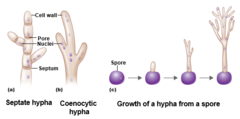
Vegetative hyphae
Straight into the substraite, obtain nutrients
Aerial hyphae
Extends into the air, involved with reproduction
Yeasts
Nonfilamentous and unicellular
Budding yeasts divide unevenly
Fission yeasts divide evenly
Dimorphic fungi
yeastlike at 37°C and moldlike at 25°C -
Fungi reporduction
Reporduce sexually and asexually via the formation of spores