Lecture 1: Dynamic variation in genome + mechanisms
 Call Kai
 Learn
 Practice Test
 Spaced Repetition
 Match
 Flashcards
 Knowt Play
1/51

There's no tags or description
Looks like no tags are added yet.
52 Terms

*******Define Dynamic Mutations
The process by which certain naturally occurring polymorphic DNA repeat sequences EXPAND and result in fragile sites on chromosomes and/ or in human diseases
What are dynamic repeats also known as?
Unstable repeats
Or by their repeat number eg. Trinucleotide repeats
***What are the 5 categories of Repetitive elements? Which of these repetitive elements make up Dynamic Repeats
Tandem Repeats + satellite DNA = DYNAMIC REPEATS
Simple repeats
Processed pseudogenes
Segmental duplications
Transposable elements

Not sure of importance
*******COMMON CHARACTERISTICS OF DYNAMIC REPEAT DISEASES
What types of tissue are typically associated with Dynamic repeat diseases
Associated with NEURAL + MUSCULAR systems
“Anticipation” is a common phenomena
Imperfect Mendelian segregation = do not follow classical, predictable Mendelian inheritance laws (like simple dominant or recessive patterns).
Correlation between repeat size and disease presentation
Founder effects, certain populations show higher rates/susceptible genetic background
Almost exclusively human disorders (result of our own success - longer life span + brain volume)
*****What does it mean by “Anticipation” is a common phenomena in Dynamic repeat diseases?
The disease tends to become more severe, manifest at an earlier age, or occur more frequently as it is passed down through successive generations.
Microsatellites account for approx. ___% of human genome?
3%
Aka. Short tandem repeats
********True or False: REPEATS of all types are difficult to study.
Why or why not?
TRUE
difficult to study because structure interferes with
sequencing and mapping.
So called “dark” regions of the human genome
******Are all Microsatellites sequences unstable?
NO (most = stable across generations + and somatic tissue but some are not and can cause instability + disease)
Can be polymorphic = Diff # repeats
Can have some influence if in and around genes
Disease-associated microsatellites are diverse in terms of the nucleotides they are composed of and their length and location in and around human genes
****Does repeat length alone explain disease expression + age of onset?
If No, What other things have an impact?
NO
Many other things also contribute to instability
Gene expression
stability
Chromatin configuration
DNA repair
****Discovery of Disease associated Microsatellites/Dynamic repeats
What 3 diseases are associated with micro satellites?
How were they discovered/ What method was used?
Fragile X (1991)
Myotonic Dystrophy (1992)
Huntington’s (1993)
Discovered using POSTITIONAL CLONING
******What is Positional cloning
Why was it used to discover Dynamic repeat /microsatellite associated diseases
Reverse genetics = extremely useful for at time for discovery as there was Nothing to grab hold of + could not determine what was wrong despite lots of clinical cases
Historically, if scientists wanted to find a disease gene, they had to know what the faulty protein did first (e.g., "this protein carries oxygen, so let's find the oxygen-carrying gene").
Positional cloning flipped this entirely. It allows scientists to find a disease-causing gene based purely on its physical location in the genome, even if they have absolutely no idea what the gene actually does or what protein it makes.
*******HUNTINGTON’s is the repeat of what seq.?
CAG
*********What size of repeat is considered affected range for HUNTINGTON’s?
39+ repeats

*****Method for Detecting Huntington’s?
PCR = primary and most accurate molecular method used to diagnose Huntington disease (taken from AI overview)
******Hallmark of results for Huntington’s PCR?
Resulting PCR products are separated and sized (often via capillary electrophoresis or repeat-primed PCR) to calculate the exact number of CAG repeats on both inherited alleles
Hallmark = STUTTERING → polymerase is having trouble going through the highly repetitive sequence slipping backwards or forwards while trying to replicate the highly repetitive sequence. = reflecting what is happening in the cell
NOTE: stuttering loss of intensity of larger repeats = PCR bias → preferentially amplify shorter DNA strands.
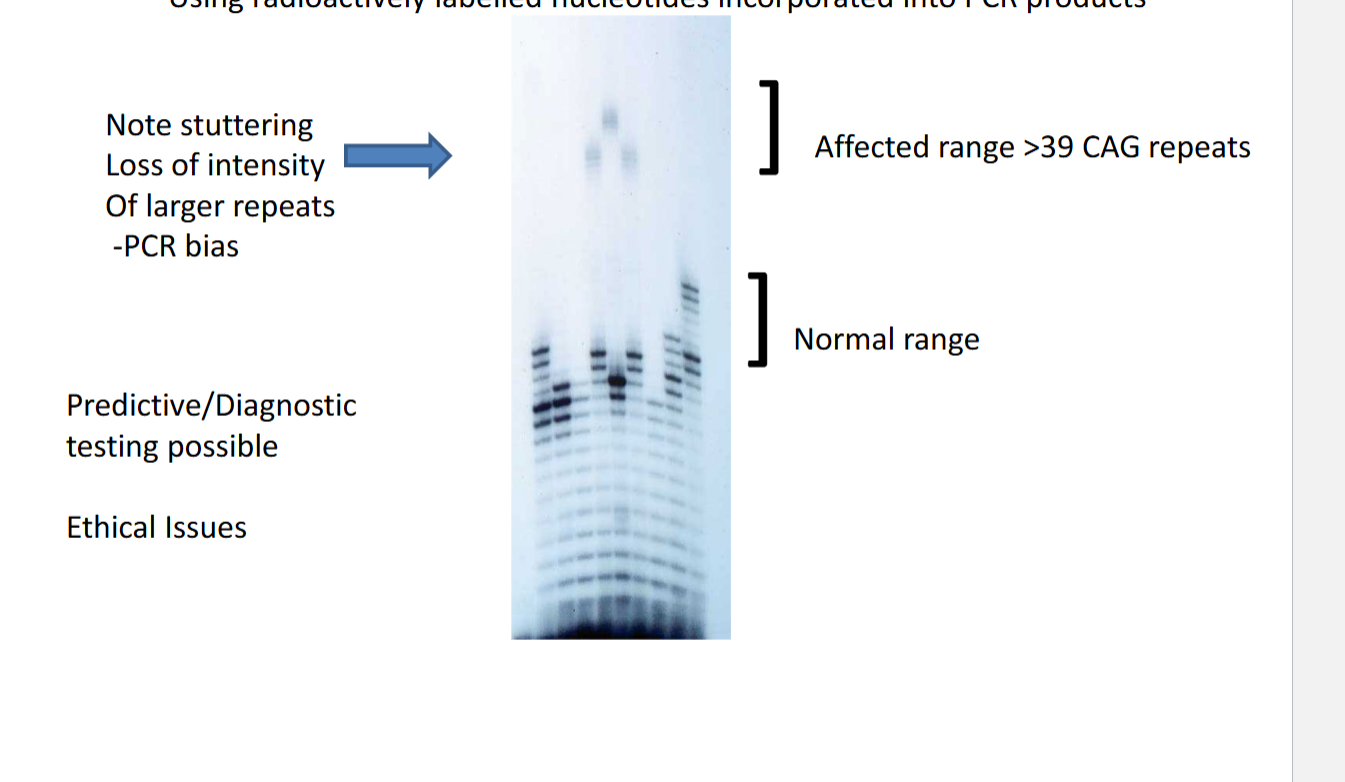
*****Issues with predictive/Diagnostic testing of Hungtington’s?
A completely healthy young adult can find out decades in advance if they will inevitably develop an untreatable neurodegenerative condition.
Raises ETHICAL issues
******What are the 4 size ranges for Repeat size?
Full mutation: Gene function affected, further changes in repeat size is possible
Premutation/Intermediate: Repeat sizes in range between grey zone and “full” reduced penetrance of disease, further increases in size are common. “Carriers”
Grey zone: Individuals have normal phenotype, further changes in repeat size more common, predisposes to changes leading to premutation and disease in subsequent
generations
Normal: Polymorphic with a normal size range defined, errors in DNA replication may change repeat size but only rarely.
****What are microsatellites again?
tandem repeats of ~3 to 6 nucleotides
make up Dynamic repeats
*******WHERE are microsatellites located in genes? (4)
Promoter 5’ untranslated region
Coding region
Introns
3’untranslated region
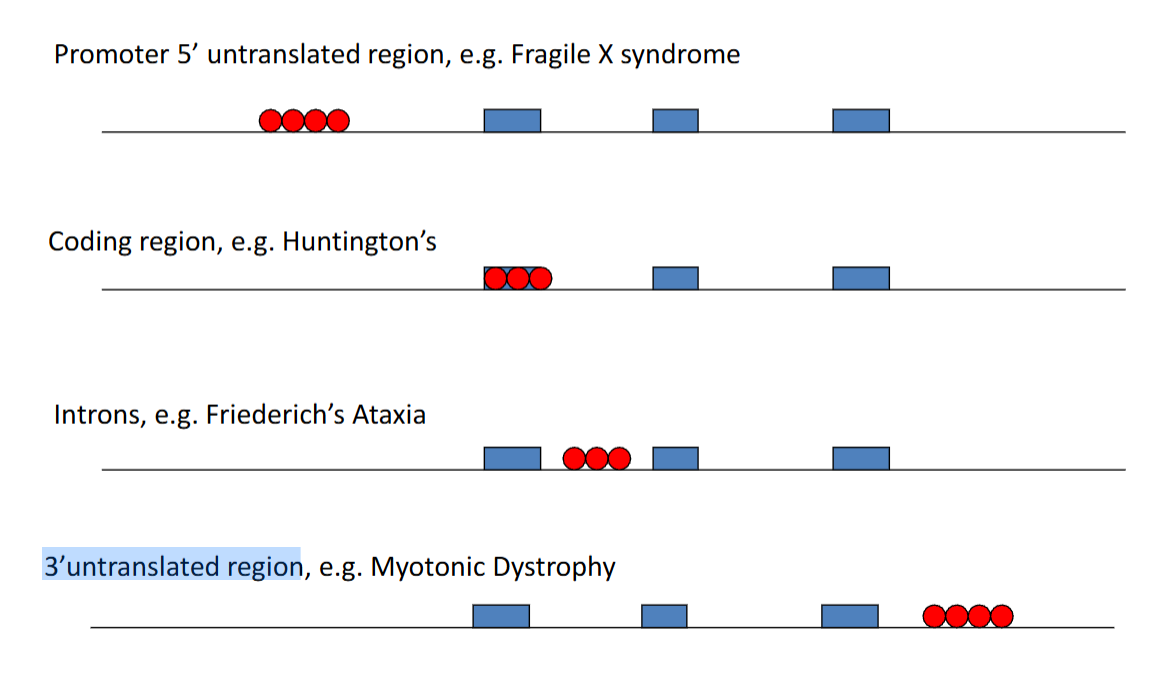
**What is one Disease associated with microsatellites in each of the 4 possible locations in genes?
Promoter 5’ untranslated region, e.g. Fragile X syndrome
Coding region, e.g. Huntington’s
Introns, e.g. Friederich’s Ataxia
3’untranslated region, e.g. Myotonic Dystrophy
****Do Repeats Expand LESS in non coding vs. coding regions?
Coding regions expand less than in noncoding regions
*****What is the Phenotype associated with Fragile X syndrome?
Caused by what repeat? WHERE is the repeat located in which GENE?
Male or female more common?
Inheritance pattern?
Caused by expansion of a CGG repeat
in PROMOTER of FMR-1 gene
X linked Dominant: 1/4000 males, 1/6000 females
Macrocephaly
Large forehead
Long face
Prominent Jaw
Large ears
Mitral valve prolapse
Postpubertal macroorchidism
Joint laxity
MR – borderline to mild (IQ 55-69) 50% of females can be affected

*****Transmission of Unstable Fragile X
Does it act like a X linked Dom?
SHERMAN PARADOX = very COMMON in Fragile X
No it does not act like an X linked dominant gene
due to random X inactivation in females, can prod some FMR = more mild phenotype
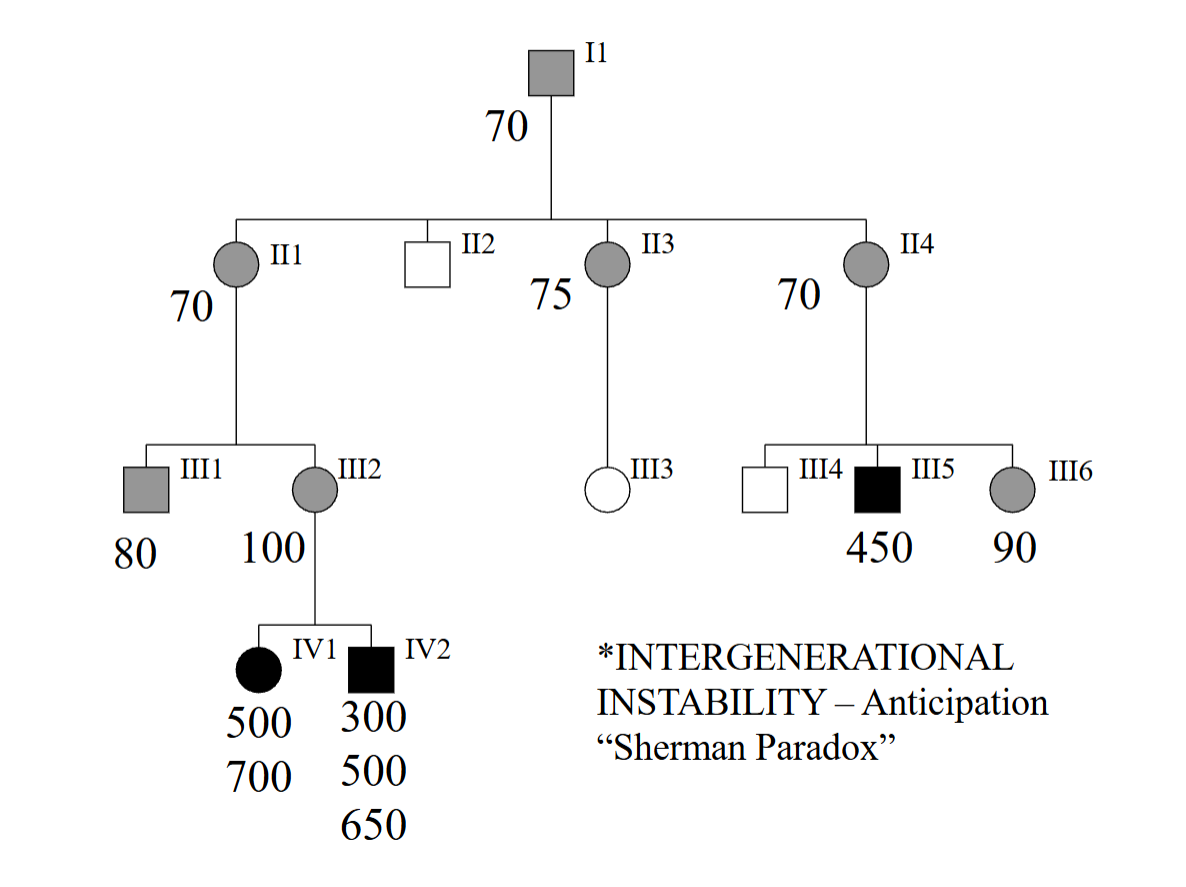
**********What is the Sherman Paradox?
INTERGENERATIONAL INSTABILITY – aka. Genetic Anticipation (a broader term) but specifically in Fragile X
clinical severity of a genetic disorder worsens, and the risk of developing it increases, with each successive generation as it is passed down a family tree

Shows Sherman paradox in Fragile X
***Instability of Microsatellites in Dynamic repeat disorders is Influence by what? (4)
Purity - Are the repeats, pure/uninterrupted?
Location
DNA repair
Size
Which parent it’s inherited from
Founder effect/ genomic background
*****How does Purity affect INSTABILITY (the expansion of repeats)
Specifically in the case of Fragile X what can increase stability?
Evidence in the population?
AGG repeats interspersed in the FMR1 CGG repeat = increase stabiility
In the general population, 94% of alleles have one or two AGG interruptions, which are most commonly observed on the 5′ end of the repeat
By contrast, alleles in fragile X families are less likely to include AGGs at the 5′ end, and they contain long stretches of uninterrupted CGGs at the 3′ end

*****How does the maternal repeat length of the FMR1 gene generally impact the risk of a child inheriting Fragile X?
Risk correlates directly with size.
Shorter premutation lengths = lower/~0% risk of expansion to full mutations = decreased risk of passing on to child
Long = more likely to expand + expansion to full mutations means higher risk of passing onto child
maternal size of the FMR1 CGG repeat is the primary predictor of whether an expanded allele will remain stable, expand into a larger premutation, or balloon into a "full mutation" (>200 repeats) that causes Fragile X Syndrome (FXS) in the child
*****How is maternal repeat length of the FMR1 gene COMPLICATED
Are two mothers with the exact same FMR1 CGG repeat count always share the identical statistical risk of passing a full mutation to their child.?
NO
Their individual risk varies dramatically depending on the number of AGG interruptions present in their repeat tracts. Fewer AGG interruptions mean much higher structural instability.
NO full mutation = less chance of passing on

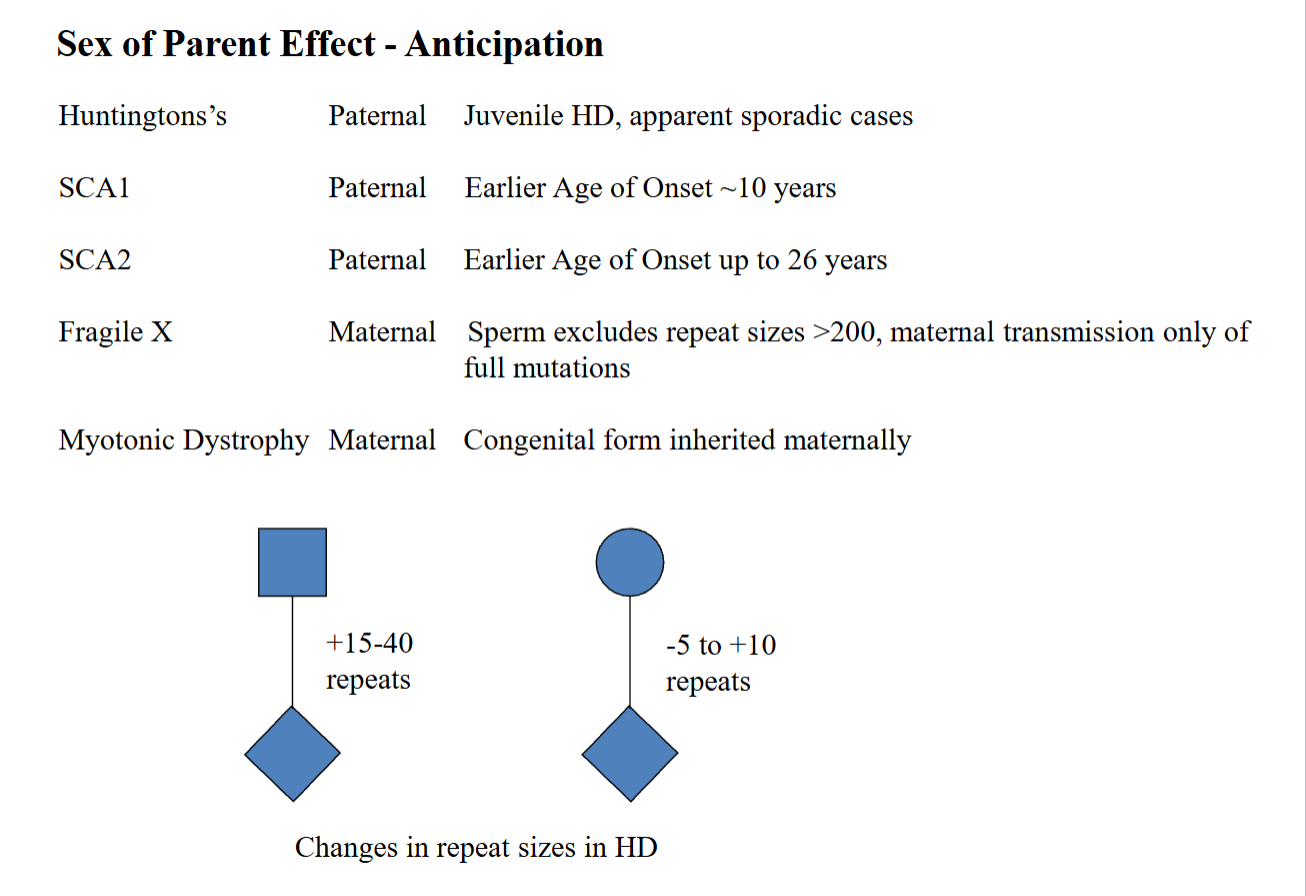
********How does the sex of the transmitting parent affect- Genetic anticipation? Which parent = more likely to have an effect on severity and age of onset in child?
Huntington’s
Fragile X
Myotonic Dystrophy
SCA1(Ataxia)
SCA 2 (ataxia
Certain diseases undergo massive genetic expansion only when passed through one of the parents sexes: the father's sperm (paternal) or mother's egg (maternal)
Note: HD = Huntington’s disease
*****How does genomic background/haplotype influence the stability of Huntington's Disease (HD) globally?
Specific ancestral "founder" haplotypes dictate the mutation rate of the HTT gene.
Europe: High mutation rates (Haplotype A1+2)
East Asia: low mutation rate (Haplogroup C) making the CAG repeat stable and keeping disease prevalence low.
Knowing about the existence of founder haplotypes allows population genetics and the existence of genetic modifiers to be explored

********How does LOCATION affect
Where are nearly ALL daSTRs located?
96% daSTRs (disease associated short tandem repeats) located at Boundaries demarcating 3D (TAD) chromatin domains

******What are TAD Boundaries?
TAD boundary = Topological associating domains
Chromatin (DNA wrapped around proteins) is folded into complex, 3D loops and structural neighborhoods called TADs. The borders separating these structural loops are known as TAD boundaries.

******Hypothesis for Why majority of disease associated STRs are located at TAD boarders?
Genetic, epigenetic, and topological environment at CpG island-rich TAD boundaries makes microsatellites unusually susceptible to instability compared to CpG island-depleted boundaries and all non-boundary locations in the genome.
Not all TAD boundaries are equal. Repeating DNA sequences (microsatellites) are only vulnerable to unstable expansion when they are LOCATED at a CpG island-rich TAD boundary. If they are located inside a 3D loop or at a boundary lacking CpG islands, they remain stable.
Additionally Abnormal Methylation of CTCF present in Diseased
Location + CpG rich + Abnormal methylation

*****What is the role of CTCF sites and how are they affected in disease states?
CTCF sites act as physical boundary anchors that insulate 3D chromatin loops. In diseased states, abnormal
In diseased individuals there is Hyper methylation. CpG hypermethylation disrupts these boundaries, leading to structural failure and unstable expansion

**How are DNA REPAIR involved in Unstable repeat disorders?
Different repeat sequences fold into distinct, highly abnormal physical shapes rather than a clean double helix and each needs a different repair pathway
What are the possible repair pathways involved in Repeat expansion?
Involved alone or in combination

Which specific DNA repair pathway and structural proteins are explicitly highlighted as major drivers of repeat expansion and mosaicism?
mismatch repair proteins
*****Outcome of repair of errors during replication (expansion, no change, mosaicism) depends on what?
1) if repair occurs
2)what strand is repaired
*******Reparation of What strand results in expansion vs. no change vs. mosaicism?
OLD repaired = Small expansion = can evolve to large expansion
NEW = No change
Unrepaired Heteroduplex = Mosaic (daughter strand = a different length)

****Which repair system causes EXPANSION at FMR1 CGG repeats?
When the FMR1 gene is transcribed into RNA, the highly repetitive CGG tract is vulnerable.
A combined Mismatch Repair (MMR) and Double-Strand Break Repair (DSBR) process can mistakenly insert extra repeat units, driving the tract to grow longer (expansion).

******How do expansions of the FMR-1 gene occur?
Why do we observe chromosome fragility at the site of the CGG repeat? Aka. How do CGG repeats causes Fragile X syndrome? What is the mechanism?
stalled replication fork caused by stubborn CGG structures. This replication roadblock triggers late-stage rescue pathways (MiDAS) mitotic DNA synthesis that cause visible chromosomal breaks/fragility

****What is the primary biological purpose of MiDAS (Mitotic DNA Synthesis) at FMR1 full mutation alleles?
How does MiDAS result in fragile sites?
Purpose of MiDAS = It acts as an emergency salvage pathway to ensure stalled genomic repeat regions are successfully duplicated before cell division finishes.
Failure to complete repair before mitosis results in expression of fragile site (chromatin with a gap)

*******Can repeat expansion still occur in NON dividing/differentiated cells?
YES
*****What are the 2 mechanisms that can cause SOMATICALLY generated repeat expansions in NON-dividing cells?
DNA damage
Transcription mediated/ during transcription


*****Explain this graph in relation to HUNTINGTONS disease
Long somatic DNA-repeat expansion drives neurodegeneration in Huntington’s disease
neurons do not degenerate all at once. Instead, individual neurons pass asynchronously through five key pathological phases, shifting from completely harmless to lethal states over time:
Depending on size of repeats when you are born affects the onset of disease
Phase A: Slow Somatic Expansion (Decades): The CAG repeat expands very slowly below a length of ~100 repeats. During this time, the HTT gene remains completely biologically harmless, but structurally unstable.
Phase B: Brisk Somatic Expansion (Years): Once the repeat length crosses a critical threshold (around 100 repeats), the expansion rate drastically accelerates, ballooning toward 150–200 repeats over just a few years.
Phases C, D, & E: The Toxic Climax (Months): Once the repeat length reaches extreme thresholds (>150–200+ repeats), a rapid, catastrophic cellular collapse triggers over a matter of months:
*****Explain mechanism driving GAA repeat expansions in Friedreich’s Ataxia (the FXN or frataxin gene)
In REPLICATING CELLS
Replication dependent (GAA)n repeat expansions in human cells is initiated by triplex
formation ahead of the fork leading to its regression (stalling).
Repeats can expand upon strand slippage during the restoration of the regressed
fork

*****Explain mechanism driving GAA repeat expansions in Friedreich’s Ataxia (the FXN or frataxin gene)
In NON-dividing + SOMATIC CELLS
(GAA)n repeat instability in non-dividing and somatic human cells is promoted by the formation of R-loops during transcription and/or upon transcription-replication collisions (TRCs), which are then recognized by MMR (MISMATCH RPAIRS) and converted into DSBs (double strand breaks).

****Recap on all the different things that drive genetic instability
High GC
MORE CpG islands + CTFT sites
Location near a TAD boundary
Abnormal METHYLATION
MIS MATCH REPAIR pathways= main player of expansion at repeats

***********Recap. Read very carefully
