Inequalites and inequities
 Call Kai
 Learn
Learn Practice Test
 Spaced Repetition
 Match
Match Flashcards
 Knowt Play
1/7

There's no tags or description
Looks like no tags are added yet.
Name | Mastery | Learn | Test | Matching | Spaced | Call with Kai | Chat |
|---|
No analytics yet
Send a link to your students to track their progress
8 Terms
Describe inequality vs inequity?
Inequalities=measure differences or variations in health - differences in health experiences and outcomes between different pop groups according to SEP, area, age, disability, gender, ethnic group
Ie. the social gradient
*Measurable
Inequities - those inequalities that are deemed to be unfair, or stemming from some form of injustice - health inequities are diff in the distribution of resources/services across pop which does not reflect health needs
-Relations of equal and unequal power
Give MOH equity def
Equity recognise diff people with diff levels of advantage require diff approaches and resources to get equitable HO
Outline the major arguments for attempting to reduce inequities in heath
1/they are unfair
2/they are avoidable (unmet need for primary health care e.g due to transport, cost, hours)
3/they affect everyone
4/reducing inequities can be cost effective
Te Tiriti o Waitangi - Manawhenua, Mataawaka
True or false - inequities in HO result from inequties in opportunities
TRUE
Identify the components of the PROGRESS statement and how this can be used in poph
P - place of residence (rural interventions in Ghana)
R - race (caste-related child mortality differentials in Nepal)
O - occuption (legislation to improve safety for coleminers)
G - gender (
R - religion
E - educarion
S - SES
S - social capital
+disability
Progress factors can be linked to burden of disease and then efficacious intervention
Describe the influence income inequties have on health and society
Top 1% have 68% of wealth, poorest 50% earn 2%.
The gap between the rich and poor is widening
Implications of income inequties:
-unequal society
-less social cohesion
-less trust between groups
-increased stress
-reduced economic productivity
-poorer HO
(Reducing inequties can be achieving through the redistribution of resources according to need)
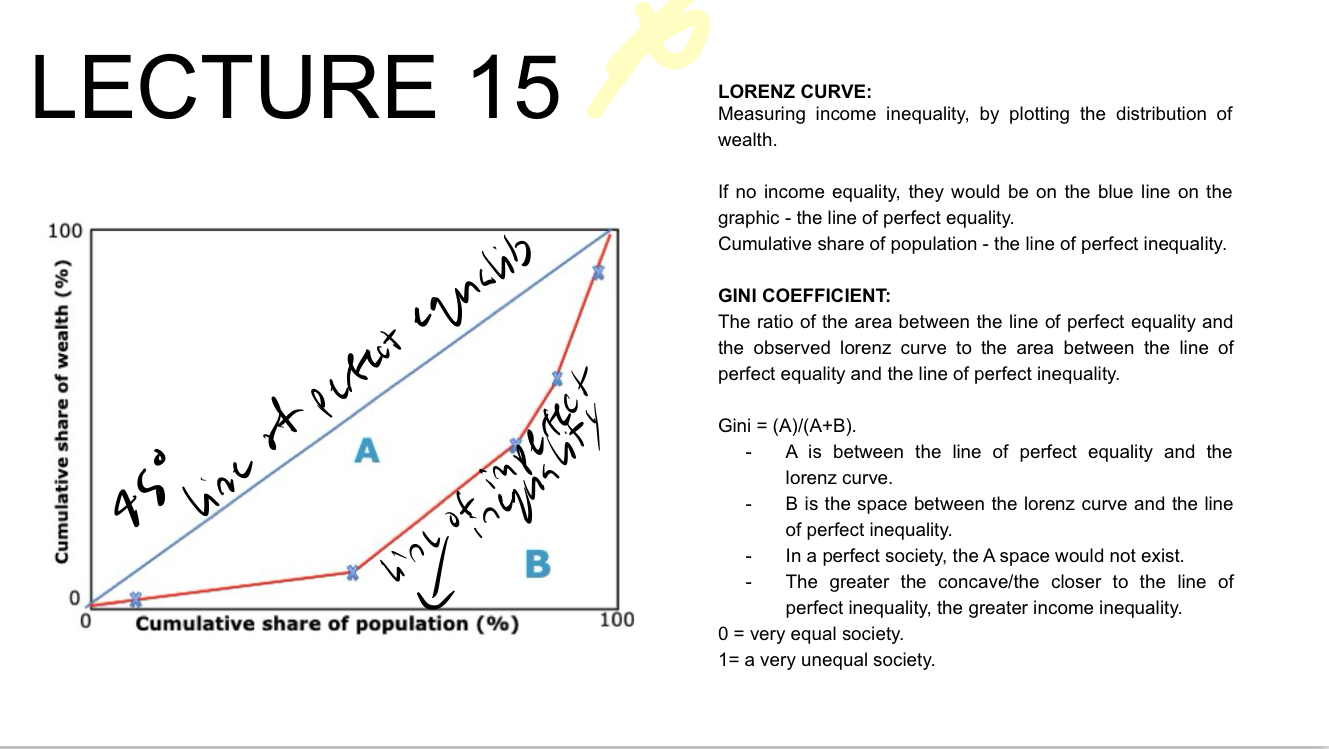
Describe the Lorenz curve and the gini coefficient
Used for measuring income inequality by plotting the distribution of wealth. - if no income inequality they would be on the blue line of graphic (45 degree angle) - the line of perfect equality.
Gini=(A)/(A+B)
A=between the line of perfect equality and Lorenz curve. B is the space between the Lorenz curve and the line of perfect inequality
In a perfect society the A space would not exist!
The greater the concave/closer to the line of perfect inequality (x axis) the greater the income inequality
0=very equal society
1=very unequal society
Recognise the influence privilege has in contributing to inequities
Unequal starting point, inter generational wealth - buffer to stress, connections etc