Ch. 4 Short-Term & Working Memory
 Call Kai
 Learn
 Practice Test
 Spaced Repetition
 Match
 Flashcards
 Knowt Play
1/24

There's no tags or description
Looks like no tags are added yet.
25 Terms
Short-term memory (STM)
responsible for holding onto a small amount of information that has recently been taken from the environment
around 20 seconds
Memory span
the longest sequence that a person can typicall recall
Miller’s number: 7 + 2
memory span is the same regardless of the matieral, as long as it’s meaningful (words, numbers)
Long-term memory
has a large capacity and contains your memory from experiences and information that have accumulated throughout your lifetime
Chunking
grouping a series of random items into smaller number of meaningful units
Miller suggests memory span is not limited to # of items but # of chunks
Random digits are best chunked into groups of 3 items (example: phone number)
Brown/Peterson and Peterson Technique
presenting participants with some items that they must remember. Participants will perform a distracting task then participants are asked to recall original items
Participants study 3 unrelated letters of the alphabet (e.g CHJ), 3 digit number, counted backwards by three’s from this number
Rehearsal
repeating items silently
Serial-position effect
refers to the U-shaped relationship between a word’s position in a list and it’s probability of accurate recall
Recency effect
items at the bottom of a list to be recalled better than items in the middle of a list
Primacy effect
enhanced recall accuracy for items at the beginning of a list
don’t need to compete w/ earlier items
people rehearse early items more frequently
Semantics
the meaning of words and sentences
Proactive interference (PI)
difficulty learning/recalling new material because previously learned material interferes w/ formation of new memories
Release from Proactive Interference (PI)
a memory phenomenon where proactive interference is reduced when a person switches from one category of stimuli to a new category
Increased recall for new category
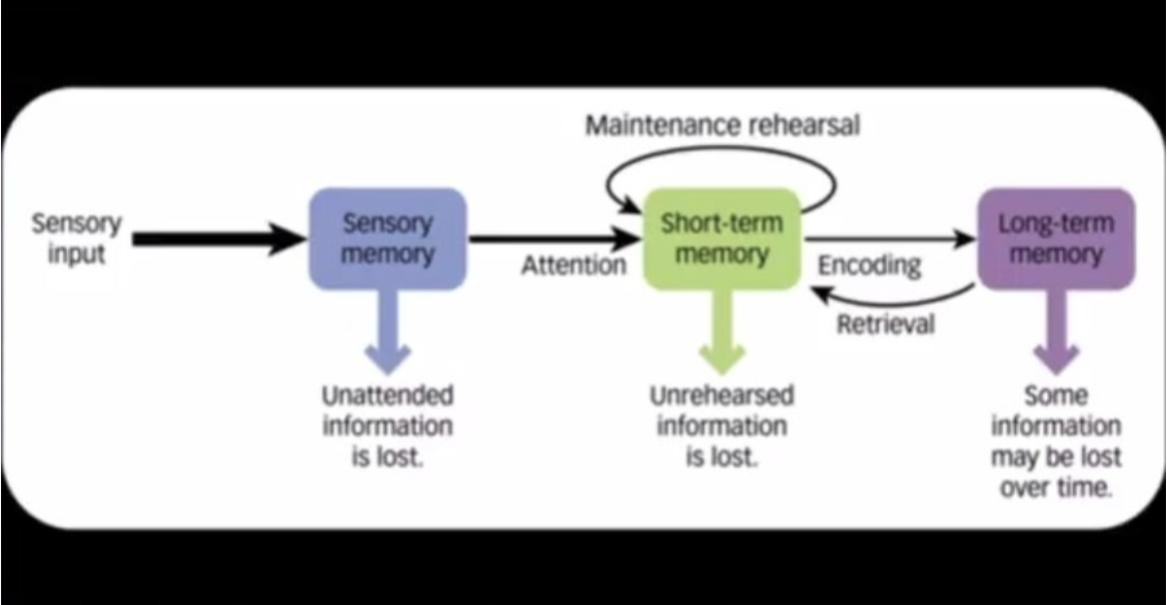
Atkinson-Shiffrin Model
proposed that memory involves a sequence of separate steps. In each step, information is transferred from one storage area to another
Sensory input —> sensory memory —> short term memory —> long term memory
Sensory memory
a storage system that records information from each of the senses with reasonable accuracy
According to Atkinson-Shiffrin Model, info is stored here for 2 seconds or less than most is forgotten
Control processes
intentional strategies such as rehearsal that people use to improve their memory
Working memory
brief, immediate memory for the limited amount of matieral that you’re currently processing; part of working memory actively coordinates your ongoing mental activities
Working memory approach
proprosed by Baddeley, immediate memory is a multi-part system that temporarily holds and manipulates information while we perform cognitive tasks
short term memory
working memory is limited
working and long term memory are not separate systems
Phonological loop
can process a limited number of sounds for a short period of time
processes language, sounds you hear, sounds that you make
active during subvocalization (silently pronouncing words that you’re reading)
Nature of Code in STM: Conrad 1965
Presented participants with a string of letters followed by an immediate recall test. Participants made acoustic confusion errors and recalled items that sounded like those on the list (D, E or V, G)
Visual confusions were rare (E, F or W, V)
Conclusion: STM Is an acoustic sound based code
Phonological similarity effect
memory performance is poorer when items sound similar, indicating the use of an acoustic code in STM
cat, map, man, cap, mad: harder to remember due to similar phonology/sounds
Visuospatial sketchpad
processes both visual and spatial information, allows you to look at a complex scene and gather visual information about objects and landmarks
also stores visual info encoded from verbal descriptions (e.g reading a book and picturing what’s happening)
Central executive
integrates info from the phonological loop, visuospatial sketchpad, episodic buffer, and LTM
plays major role in focusing attention, selecting strategies, transforming info, and coordinating behavior
responsible for suppressing irrelevant info and responses
thought to be an attentional controller

Baddeley-Hitch Model of Working Memory
two distinct storage buffers, one for verbal, and the other for visuospatial information, interact with a central executive controller
Complex span tasks to measure working memory (WM) can predict…
reading and speech comprehension
learning: spelling, vocab, PASCAL
note-taking
essay writing
SAT/ACT scores
fluid intelligence
WMC and Attention Tasks: Conway, et al. 2001
shows that WM capacity is involved in how efficient our inhibitory control of attention is
WM capacity is the efficiency of the central executive