IB Physics HL: Circuits, SHM & Wave Phenomena
 Call Kai
 Learn
 Practice Test
 Spaced Repetition
 Match
 Flashcards
 Knowt Play
1/138

There's no tags or description
Looks like no tags are added yet.
139 Terms
What are the charge carriers?
Metals: free (delocalised) electrons. Electrolytes: positive and negative ions.
Is there an electric field inside a metal?
No current: net field = 0. Carrying a current: yes, there is a field that drives electron drift.
Define electric current.
Current = the rate of flow of charge carriers. I = Δq / Δt.
What happens to electrons with and without a p.d.?
No p.d.: fast random motion, no current. With p.d.: electrons accelerate and drift opposite to the field.
What is direct current (dc)?
Current in one direction only, with constant value, from cells and batteries.
Define potential difference.
p.d. = work done per unit charge on moving a positive charge between two points.
What is an electronvolt?
The energy needed to move an electron through a p.d. of 1 V.
What causes resistance?
Free electrons collide with lattice ions and transfer kinetic energy.
Why does a current-carrying wire heat up?
Electrons gain kinetic energy from p.d. and transfer energy to lattice ions, increasing their vibration and temperature.
What is resistivity?
The resistance of a material per unit length with unit cross-sectional area.
ρ = RA / L
State Ohm's law.
For a metallic conductor at constant temperature, current is directly proportional to the p.d.
diode v I graph

filament lamp vi graph

Why does a lamp's resistance increase?
Increased current raises drift speed and temperature, leading to more collisions and increased resistance.
current voltage and R in parallel and series

What is a potential divider?
Resistors in series share the supply p.d. in the ratio of their resistances (bigger R gets the bigger share).
What is a potentiometer?
A resistor with a sliding contact used as a potential divider,
Why is a potentiometer better than a series variable resistor for a lamp?
A potentiometer allows the full range of voltage from 0 V to the supply value, while a series variable resistor cannot reach 0 V or the full supply value.
How does a thermistor behave?
As temperature increases, resistance decreases.

How does an LDR behave?
As light intensity increases, resistance decreases. It is a semiconductor, non-ohmic; used as a light sensor.

How do sensor circuits work?
In automatic lights, when it gets dark, the LDR's resistance increases, causing the output voltage to increase and turning the lights on.
Define electrical power.
Power is the rate of energy transfer: P = E/t = W/t (1 W = 1 J s⁻¹).
P = VI
energy formula VI
E = VIt
What is emf (ε)?
The energy converted from other forms into electrical energy per unit charge passing through the source. It is the p.d. across the terminals in open circuit.
What is internal resistance (r)?
The resistance of the electrolyte and electrodes; it dissipates energy inside the cell.

What are terminal p.d. and lost volts?
Terminal p.d. is the p.d. across the terminals in a closed circuit. Lost volts are the p.d. across internal resistance.
How do you derive ε = I(R + r)?
1. The same I flows through R and r (series).
2. Energy conservation: ε = V_R + V_r = IR + Ir.
How do you derive V = ε − Ir?
1. ε = IR + Ir, and V = IR.
2. V = ε − Ir: more current leads to more lost volts and lower V.
How do you derive V = εR / (R + r)?
1. V = IR and I = ε / (R + r).
2. V = εR / (R + r).
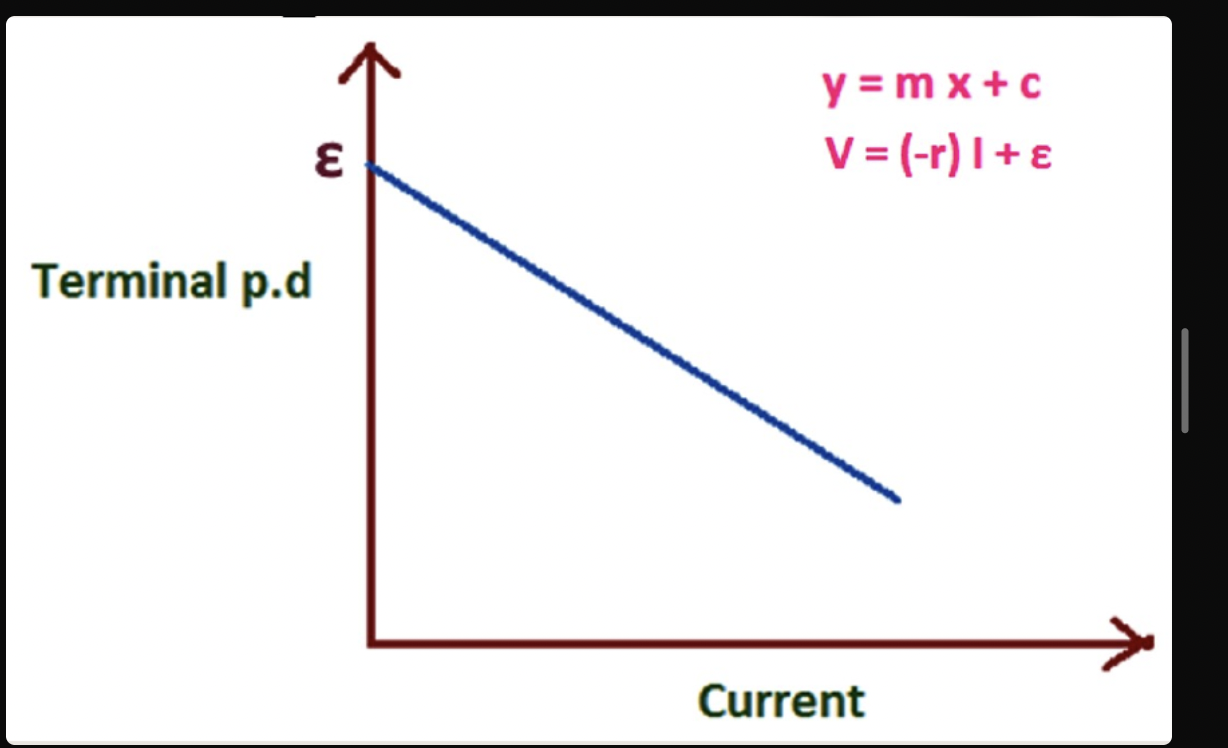
What does the V-I graph of a cell show?
V = −rI + ε; y-intercept = ε; gradient = −r.
power dissipated in load ressistor graph
Power delivered = εQ/t = εI.
ε = IR + Ir, × I: εI = I²R + I²r (power in the load + power in r).
Energy delivered = εIt.
Power to the load is maximum when R = r.

How does charging differ from discharging?
Discharging: V = ε − Ir.
Charging: V = ε + Ir (the charger supplies ε plus the lost volts).
What is a primary cell?
Converts chemical to electrical energy until the chemicals run out; not rechargeable.
What is a secondary cell?
Rechargeable; charging reverses the reaction from electrical to chemical.
What are the advantages of primary cells?
Cheap, light, portable, long shelf life.
What are the disadvantages of primary cells?
Single use; high internal resistance; low current; landfill and pollution.
What are the advantages of lithium-ion batteries?
Very high energy density; rechargeable; fast charging; low internal resistance.
What are the disadvantages of lead-acid batteries?
Very heavy; toxic and corrosive; limited discharge cycles.
What are the disadvantages of secondary batteries?
High currents need large, heavy batteries; replacement cost.
What are the advantages of solar cells?
Free, renewable, clean; no fuel; low maintenance.
What are the disadvantages of solar cells?
Daylight and weather dependent; ~25% efficient; high setup cost; large area; needs batteries for night.
What are the advantages of wind energy?
No fuel cost; no pollution; sustainable.
What are the disadvantages of wind energy?
Inconsistent; needs windy sites; noise and visual impact; high setup cost.
What are the advantages of mains (fossil fuel) energy?
Reliable any time; existing infrastructure.
What is simple harmonic motion (SHM)?
Periodic motion that repeats in equal intervals of time.
What is oscillating motion?
Periodic motion where the body moves to and fro about an equilibrium position.
What is the equilibrium (mean) position?
Where the body would rest if no force acted on it.
What is amplitude (x₀)?
The maximum displacement from the mean position (m).
What is angular frequency formula
ω = 2πf (= 2π/T).
Define simple harmonic motion (SHM).
Oscillatory motion in which the restoring force is directly proportional to the displacement from the mean position and is directed towards the mean position.
What are the conditions for SHM?
1. a ∝ x (acceleration proportional to displacement).
2. Acceleration is directed towards the mean position (opposite to displacement).
acceletation formula shm
Together: a = −ω²x.
What does the a-x graph look like in SHM?
A straight line through the origin with a negative gradient = −ω².

What are the equations of motion for SHM?
x = x₀ sin(ωt + φ), v = ωx₀ cos(ωt + φ), a = −ω²x₀ sin(ωt + φ).
What is phase difference?
How much one wave is shifted horizontally relative to another.
Method: find the time lag between the 2 waves and compare it to the total period: Δφ = (Δt / T) × 2π (or × 360°).
Distance from phase difference: take the fraction of 360° and multiply by λ, e.g. 180° → λ/2.
How do you derive the time period of a mass on a spring?
F = −kx = ma → a = −(k/m)x, so T = 2π√(m/k).
How do you derive the time period of a simple pendulum?
T = 2π√(L/g) for small angles.
Define a wave.
A disturbance that travels through a medium, transferring energy and momentum, with no net motion of the medium.
How do progressive and standing waves differ?
Progressive waves travel continuously; standing waves are confined to a region.
What do wave graphs show?
Displacement-distance graph shows all particles at one instant; displacement-time graph shows one particle over time.

Which way does a particle on a moving wave move?
Shift the wave slightly in the direction of travel; it oscillates between + and −.

What wave equations do you use?
v = d/t, v = λ/T, v = fλ.
What is intensity?
The energy transferred per unit time per unit area perpendicular to the direction of propagation.
I ∝ amplitude²
What are wavefronts and rays?
Wavefront: a surface of constant phase; Ray: the direction of energy transfer.
What are the laws of reflection?
1. Angle of incidence = angle of reflection. 2. The incident ray, reflected ray and normal are in the same plane.
What is refraction?
The change in direction of a wave caused by a change in speed when it passes from one medium to another.
What is refractive index?
The ratio of the speed of light in a vacuum to its speed in the medium: n = c / v.
What is Snell's law?
sin i / sin r = constant = v₁ / v₂.
What are the laws of refraction?
1. The incident ray, refracted ray and normal are in the same plane. 2. Snell's law applies.
What is dispersion?
The splitting of radiation into its constituent wavelengths.
What is the critical angle (c)?
The angle of incidence that results in total internal reflection.
What is total internal reflection (TIR)?
Occurs when light travels from a denser to a rarer medium and the angle of incidence is greater than the critical angle, resulting in all light being reflected back into the denser medium.
What is diffraction?
The spreading of waves around corners or through apertures.
What are the conditions for diffraction?
Wavelength (λ) must be the same order of magnitude as or larger than the obstacle or aperture.
What is Huygens' principle?
Every point on a wavefront is a source of secondary wavelets that spread out in the forward direction at the speed of the wave.
How does single-slit diffraction work?
The first minimum occurs when the path difference between wavelets from the top and middle of the slit is λ/2.
What is the condition for pronounced diffraction?
Wavelength (λ) must be greater than or equal to the slit width (b).
Why is there a central maximum in diffraction?
Secondary wavelets from all points of the wavefront arrive in phase, leading to constructive interference.
How does the first minimum form in single-slit diffraction?
At the point where the path difference between wavelets is λ/2, causing cancellation.
How does diffraction prove the wave theory of light?
The pattern of maxima and minima can only be explained by the interference of waves.
What is interference?
When two waves of the same frequency and constant phase difference superpose, resulting in regions of maximum and minimum intensity.
What is net amplitude in wave interference?
The resultant displacement where the waves meet, calculated by adding their displacements.

What are the conditions for good interference in Young's double slit experiment?
Two sources must be coherent, monochromatic, and have similar amplitudes.
When is interference constructive or destructive?
Constructive interference occurs when the path difference is nλ; destructive when it is (n + ½)λ.
What is fringe spacing?
The linear separation between consecutive maxima or minima, given by s = λD / d.
Compare single slit: y = λD / b (b = slit width).
What does the double-slit intensity pattern look like?
Interference fringes modulated by a single-slit diffraction envelope.
What changes with more slits in interference patterns?
Principal maxima become narrower and taller, with intensity proportional to the square of the number of slits.
What is a diffraction grating?
A device with many equally spaced slits used to determine the wavelength of incident light.
d sinθ = nλ
d = 1 / (number of slits per metre) = the separation of consecutive slits.
Method: if given lines per mm, convert to per metre first, then d = 1/N.
What is the relationship between slit width and intensity in multiple slits?
Width of principal maxima is inversely proportional to the number of slits, and intensity is proportional to the square of the number of slits.
What are electromagnetic waves?
Waves produced by accelerated charges or changes in energy of charged particles, characterized by time-varying electric and magnetic fields.
What is natural frequency (f₀)?
The frequency at which a mechanical system vibrates when displaced from rest and allowed to vibrate without any external force.
What is damping?
Caused by friction and fluid resistance, the damping force acts opposite to the direction of motion and is proportional to speed, causing a loss of energy.
What happens to energy in damping?
Work done against the damping force converts mechanical energy into thermal energy, decreasing total mechanical energy.
What are the types of damping?
Light (under-damping), heavy damping, critical damping, and overdamping.
What are forced (driven) oscillations?
A body made to oscillate by an external force at a frequency f_D that can differ from its natural frequency.
What does the resonance curve show?
The amplitude depends on the difference between f₀ and f_D, with a peak at f_D = f₀ for small damping.

What is resonance?
When the driving frequency equals the natural frequency of the body, the amplitude is maximum.
Where is resonance used or a problem?
Used in radio tuning, microwave ovens, MRI, lasers; problems include instability and damage to structures.
What is the principle of superposition?
The net displacement of a particle in a medium where 2 or more waves travel equals the sum of the individual displacements.
What is a standing (stationary) wave?
Formed when 2 progressive waves of the same speed, wavelength, and amplitude travel in opposite directions.