Mechanics
 Call Kai
 Learn
 Practice Test
 Spaced Repetition
 Match
 Flashcards
 Knowt Play
1/32

There's no tags or description
Looks like no tags are added yet.
33 Terms
Draw a displacement time graph for a ball that is launched from the floor, thrown up into the air, reaches a maximum height, falls back down and bounces twice


Explain the shape of the displacement time graph
a. Displacement is positive at all times as the position of the ball is always above the starting point (positive vectors are upwards)
b. As the ball moves upwards it decelerates (as it is moving in the opposite direction to the resultant force): the gradient of the graph, which represents the velocity, decreases
c. At the top of its journey it has zero velocity: the gradient is zero
d. As it falls back down it accelerates (as it is moving in the same direction as the resultant force): the gradient of the graph, which is the velocity, is negative as the direction has changed, and it increases as the ball accelerates
e. When the ball bounces its displacement is momentarily zero
Draw a velocity time graph for a ball that is launched from the floor, thrown up into the air, reaches a maximum height, falls back down and bounces twice


Explain the velocity time graph you have drawn
The velocity starts high and positive when the ball is launched – positive vectors are upwards
b. The velocity decreases as the ball moves upwards as the ball is decelerating as it is moving in the opposite direction to the resultant force of weight
c. When the ball is at the top the velocity is zero momentarily
d. The ball changes direction and the velocity becomes negative as the ball moves down (taking downward vectors are negative)
e. The gradient of this graph, which is the acceleration, remains constant, as acceleration due to gravity is always constant and negative (downwards vectors are negative here)
f. When the ball bounces it changes direction back to moving upwards in a very short amount of time: this is the almost vertical line indicating high positive acceleration due to the high positive gradient
Draw an acceleration time graph for a ball that is launched from the floor, thrown up into the air, reaches a maximum height, falls back down and bounces twice


Explain the acceleration time graph you have drawn
. The acceleration is constant and negative for all of the ball’s flight
b. This is because the acceleration due to gravity is always -9.81m/s2 (the only force that is acting is weight) and it is negative as we have considered upwards vectors to be positive
c. When the ball bounces it experiences a high positive acceleration for a very short time as the velocity is rapidly changing from negative to positive
. Explain the significance of the gradient and area under the line for a displacement time graph, a velocity time graph and an acceleration time graph
a. From a displacement time graph:
b. The gradient is Δs/Δt = v
c. From a velocity time graph:
d. The gradient is Δv/Δt = a
e. The area under the line is the displacement
f. From an acceleration time graph:
g. The area under the line is the velocity,
Sort this list of quantities into scalar and vectors: force, acceleration, mass, time, velocity, kinetic energy, work done, speed, distance, displacement, momentum, gravitational potential energy
a. Scalars: mass, time, kinetic energy, work done, speed, distance, GPE 15
b. Vectors: force, acceleration, velocity, displacement, momentum
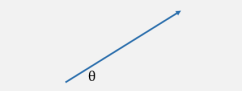
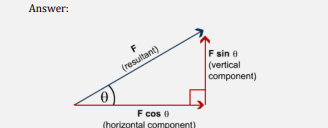
. Draw a diagram illustrating how to resolve this vector into horizontal and vertical components and label their magnitudes in terms of θ

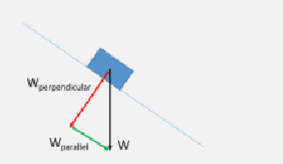
. Draw a diagram to illustrate how to resolve this vector into components that are parallel and perpendicular to the plane

. Draw a scaled vector diagram to illustrate the resultant force acting on this object. State its magnitude and direction above the horizontal

.State Newton’s first law
: An object will remain at a constant velocity or stationary if the resultant force is zero.
State Newton’s second law
The resultant force acting on an object is equal to the mass of the object multiplied by the acceleration it experiences in the direction of the resultant force
.State Newton’s third law
When two objects interact they exert equal and opposite forces on each other
.State the criteria that Newton’s third law pairs must satisfy
Newton’s third law pairs of forces must always:
a. Act on different objects
b. Be the same size
c. Be the same type of force (eg. Both gravitational/both electrostatic)
d. Act in opposite directions
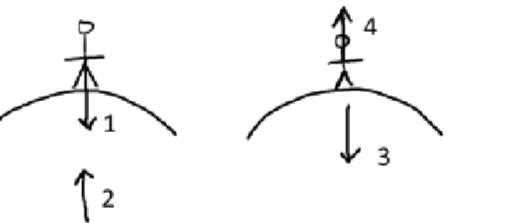
State the Newton’s third law pairs for a person standing on the ground and draw the force arrow diagram for these
Force 1 = pull from earth on person (weight)
b. Force 2 = pull from person on earth
c. Force 3 = push from person on ground 17
d. Force 4 = push from ground on person (reaction)
A rocket ejects gas backwards whilst in deep space. Explain, using Newton’s laws, what happens to the motion of the rocket
. The rocket applies a force on the gas backwards
b. Due to Newton’s third law, the gas applies an equal and opposite force on the rocket forwards
c. The rocket experiences a resultant force, so due to Newton’s second law it accelerates forwards
. Define centre of gravity:
The centre of gravity of an object is a point where the entire weight of an object appears to act
. Define moment
moment = force x perpendicular distance between the line of action of the force and the pivot
tate the principle of moments
the sum of the anticlockwise moments is equal to the sum of the clockwise moments for a system in rotational equilibrium

Apply the principle of moments to solve this problem:

Explain how the velocity changes throughout a skydive / a ball falling through a fluid
Initially, the resultant force is weight
b. FR = W = mg = ma so a = g due to Newton’s second law. So the person/ball accelerates at g = 9.81m/s2, the acceleration due to gravity
c. As their speed increases, air resistance increases
d. This causes the resultant force to decrease
e. Until air resistance = weight and the resultant force is zero f. At this point the acceleration is zero due to Newton’s first law– they are falling at terminal velocity
Conservation of energy
sum of energy remains constant before and after the collision
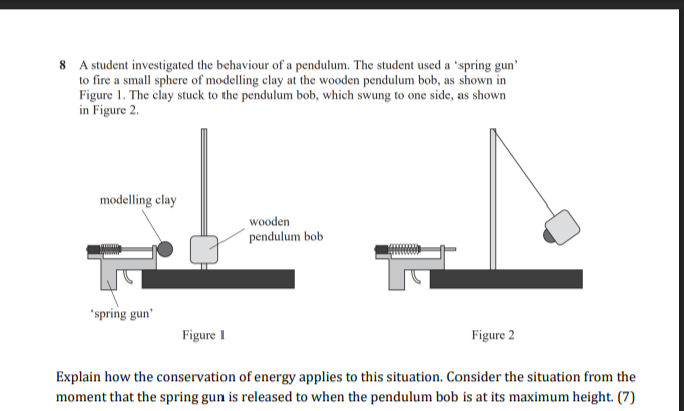
The spring gun stores elastic potential energy - This is transferred to the kinetic energy store of the modelling clay - The clay then moves to the pendulum bob and collides inelastically with it - Some of the kinetic energy store of the clay is transferred into its internal energy / thermal energy stores at it deforms and sticks to the bob - The rest of the kinetic energy is now stored by the bob, clay system - As the pendulum moves upwards, the kinetic energy is transferred into gravitational potential energy - At the maximum height all of the kinetic energy has become gravitational potential energy
. Define work done
Work done is force x displacement in the direction of the force
. Define efficiency
(Useful work done / total work done) x 100
b. (Useful energy output / total energy input ) x 100
c. (Useful power output / total power input) x 100
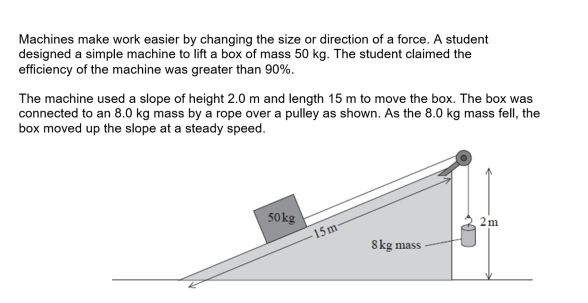
a) Describe what the total work done on the 50kg mass is
The total work done is the change in gravitational potential energy of the 8kg mass. This mass can only move downwards by 2m, so this is 8 x 9.81 x 2. This is the same as the tension in the string (equal to the 8kg weight as the system moves at a constant velocity) x the displacement in the direction of that tension force, 2m up the slope. b. This total work done goes into doing two things: i. raising the box up – doing work against gravity to increase its gpe ii. And doing work against friction, transferring energy to the surroundings
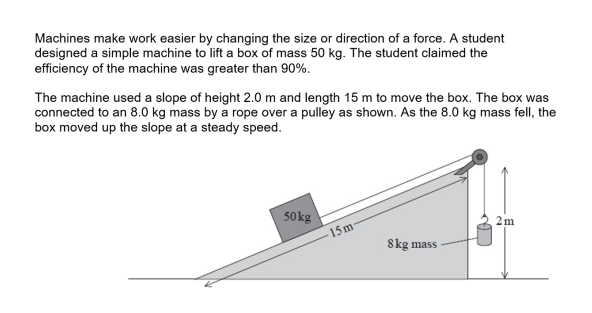
b) Describe what the useful energy output is.
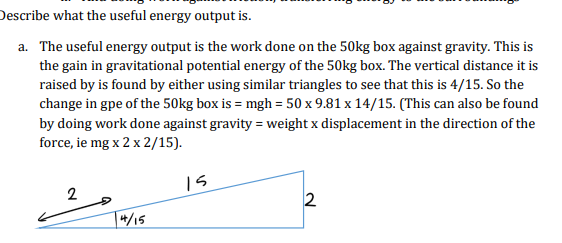

c) Explain how you could find the energy dissipated by the system
. There is work done against friction, which transfers energy to the surroundings b. This can be calculated using: work done against friction = total work done (gpe change of 8kg mass) – work done against gravity on the box
. Conservation of momentum
the vector sum of the momenta before a collision is equal to the vector sum of the momenta after a collision provided no external forces act
. Explain how conservation of momentum applies to a situation where an object ejects gas and starts moving eg. a rocket burns gas, starts moving from rest in deep space:
Before the gas is ejected, the total momentum of the system is zero
b. As no external forces act, the total momentum after the explosion is zero
c. When the gas is ejected, the gas experiences a resultant force downwards
d. As force = rate of change of momentum, the gas’s momentum increases in the downwards direction
e. Therefore the rocket must also experience a change in momentum equal and opposite to the gas’s momentum (due to Newton’s third law, the force is equal and opposite) f. So it has a momentum upwards that is equal in size and op
. Impulse
resultant force x time (or impulse = change in momentum)
. Linear momentum
– product of mass and velocity