Anatomy and Physiology Exam 2
 Call Kai
 Learn
 Practice Test
 Spaced Repetition
 Match
 Flashcards
 Knowt Play
1/28

There's no tags or description
Looks like no tags are added yet.
29 Terms
What is Endocrinology?
What did Aristotle study that relates to this?
Who did the first Endocrinology experiment?
What were their findings?
What is the endocrine gland?
a branch of medicine that studies the endocrine system and the hormones it produces to regulate metabolism, growth, sleep, reproduction, and mood.
The castration of male quadrupeds.
A.A. Berthold was responsible for this experiment and it consisted of the testis had effect on organisms. He did this by castrating chickens and reattaching them on different parts of the body.
He found that when he attached the testis back on the body he found that the blood vessels regrew meaning that they do have an effect on chemical traits via blood vessels.
A gland that is derived from epithelial tissue that secretes hormones into interstitial fluid.

What is this?
What are the red dots and what do they do?
Adrenal gland
Those are blood vessels they not only transport oxygen but hormones as well
Describe Amino Acid based horomones
Since they do not require blood carrier and dissolves in bodily fluids they are considered …
Describe their receptors and what indirect effect does it cause?
When are they made and released
Describe their half life
What are some examples of this?
Amino Acid based hormones ( mono amines, proteins and peptides ) and is considered the most common hormone type made up of 1 or more A.As.
Hydrophilic
They are membrane-bound meaning they cannot not pass through them having an indirect effect on the target cell ( 2nd messenger system being essential )
They are usually made in advanced and stored in secretory vesicles and release when a signal hits them.
Short
Thyroid horomone and growth horomone

What is this chart about?
What are the steps?
What is this an example of?
The synthesis, processing and secretion of peptide hormones.
Translation and Entry b
Processing in the Endoplasmic Reticulum
Transport and processing in the Golgi Complex
Packaging and cleavage in secretory vesicles
Exocytosis via release signal
Movement into the bloodstream
Insulin

Where do lipid based steroids come from?
Why are they considered Hydrophobic
How does this compare to Thyroid and Parathyroid glands
What happens if a steroid takes place in these glands
Who did an experiment on this and did it work?
Cholesterol
They need blood carrier proteins since they do not dissolve in fluids
Long half life, Hydrophobic, can go through the membrane, made when needed and stored in the nucleus and receptors are stored in the nucleus or cytosol
Too much of the steroid will be made.
Charles Edward Brown Seagull tested lipid based steroids on himself by injecting bull test into himself. This experiment did not work since he did not need anymore testosterone.

What does the Hypothalamus and pituitary gland do?
What is another name for the Hypothalamus and how does it react to the pituatary gland?
What are the anteriror pituitary hormones?
What does Vasopressin (ADH) and Oxytosin do and where are they located/
Which horomone does Acromegaly effect?
Regulates nearly every aspect of the endocrine system by linking the endocrine to different nervous systems.
The master gland and it directly influences horomones secreted by the pituitary gland.
Gonadotropins and thyrotropins
Prolactin - mammary gland production
Growth horomone - effects miotic activity
Follicle-stimulating horomone & Luteinizing horomone - Testecular + ovarian function
Adrenocorticotropic Horomone - cortisol release, glucose homeostasis and stress horomone
Thyroid stimulating horomone - T3 + T4
They are located in the posterior pituitary gland
Vasopressin is involved in water reabsorption in kidneys
Oxytocin helps with smooth muscle contraction
It effects the growth horomone
1. What does the Pineal gland do?
Helps with circadian Rythyms

What are Thyroid and Parathyroid glands used for
Thyroid gland is for metabolism, development and the Parathyroid gland is for Ca 2+ production

What are Adreanal Glands?
Describe the horomones in each area,
Horomones in the medulla and cortex
Horomones in the medulla are neurohoromones (epinephrine and norepinephrine). The hormones in the cortex are 25 different types of steroids

What are the glands and their functions in the Pancreas?
Exocrine gland - Digestion and Endocrine gland - insulin, glucagon, somatostatin.

1. What are the horomones and their functions in Gonads?
S*x steroids: Estrogen, Tetesterone, progesterone, and dihydrotetesterone. Also A.A. based Inhibin.

What horomone does Adipose tissue have?
Leptin which decreases hunger and is important for metabolism.

Describe this pathway
The negative feedback in this interaction stops making Parathyroid cells when there are to many and creates more when they are needed.
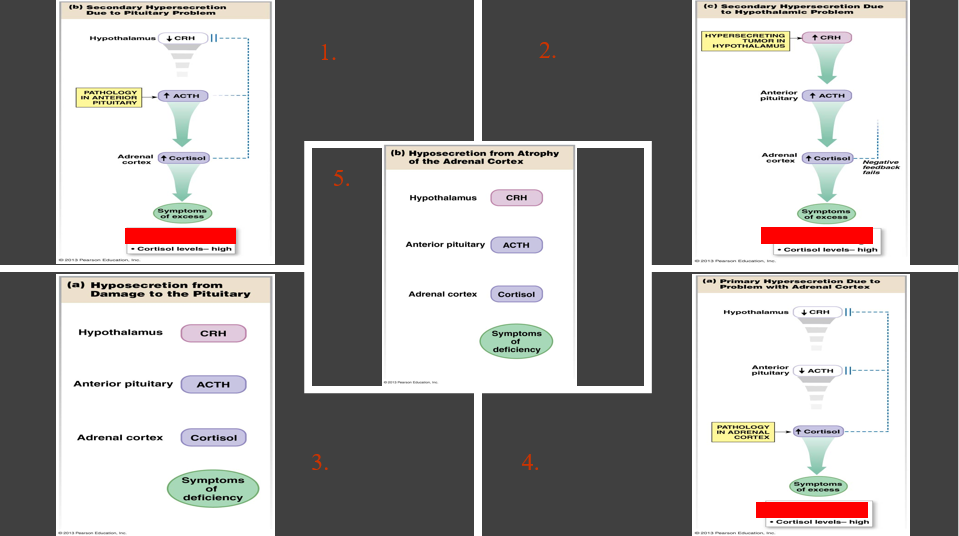
Axe the pathways by telling which ones are high or low
Low, High, High
High, High, High
High, Low, Low
Low, Low, High
High High, Low
Describe Horomone Interactions
Synergism Combined effects of horomones can be stronger than their summed indicidual effects
Permissiveness - Where one horomone permits another to react ( takes place beteween multiple horomones
Antagonism - When two horomones have the opposite effects
Slides to ask about
15, 17, 18, 22, 28, 31,
Neurons
Neuroglia
Resting membrane potential
Gated channels
Action and graded potentials
Synapse Function
Convergence Divergence