multiphasic liquid dosage forms suspensions
 Call Kai
 Learn
Learn Practice Test
 Spaced Repetition
 Match
Match Flashcards
 Knowt Play
1/56

There's no tags or description
Looks like no tags are added yet.
Name | Mastery | Learn | Test | Matching | Spaced | Call with Kai | Chat |
|---|
No analytics yet
Send a link to your students to track their progress
57 Terms
what are disperse systems (dispersions)?
they are heterogeneous systems - systems containing particulate matters or globules distributed throughout a medium
-particles in liquid = solutions
-globules in liquid = emulsions
contains two phases:
dispersed phase (internal phase)
usually the suspended particles
continuous phase (dispersing phase/dispersion medium)
usually the suspension liquid

black dots are the drug (dispersed phase)
the blue is water (continuous phase)
classification of liquid dispersion systems
molecular dispersion
< 1 nm
particles invisible in electron microscope, undergo rapid diffusion
ex: glucose solution, saline

classification of liquid dispersion systems
colloidal dispersion
1-500 nm
particles invisible in ordinary microscope but seen under electron microscope, diffuse very slowly
ex: milk, fog, paint, colloidal polymer, dispersions

classification of liquid dispersion systems
fine dispersion
0.5-10 µm
particles visible under microscope, particles do not diffuse
ex: magmas and gels

classification of liquid dispersion systems
coarse dispersion
10-50 µm
particles visible under microscope, particles do not diffuse
ex: blood, suspensions and emulsions

-pharmaceutical suspensions typically fall under this category
what are suspensions?
a dispersion of finely divided solid materials suspended in a liquid medium in which the drug has minimum solubility
ex: ibuprofen and amoxicillin
suspensions: pharmaceutical applications
oral suspensions
have 2.5-10% (w/v) of solids e.g. antacids, antibiotics
suspensions: pharmaceutical applications
externally used suspensions
have 20% (w/v) of solids e.g. calamine lotion
suspensions: pharmaceutical applications
parenteral suspensions
are generally used for intra-muscular injections and have 0.5-30% (w/v) solids e.g. antibiotics, steroids
suspensions: pharmaceutical applications
topical suspensions
used for delivery of drugs to the eye e.g. anti-inflammatory drugs (Nevanac suspension)
suspensions: pharmaceutical applications
rectal suspensions
used for radiologicals and for treating intestinal disorders
suspensions: pharmaceutical applications
aerosols
formulated as suspensions - solid particles dispersed in a volatile propellant
what are the advantages of suspension dosage forms?
for insoluble drugs
reasonably smaller volume than solutions
greater stability against hydrolysis and oxidation compared to aq solutions
masking of disagreeable taste of drug
easier to swallow compared to solid dosage forms (e.g. tablets)
depot therapy - for sustained effect
depot: like a warehouse; if you inject a drug into body, it forms a warehouse and slowly releases the drug over a period of time
topical dosage form for water insoluble drugs
how can you have greater stability against hydrolysis and oxidation in a suspension dosage form?
solutions are more prone to oxidation and hydrolysis
suspensions are less prone to oxidation and hydrolysis
reactions do not take place in solids because there is no molecular mobility
in suspensions, the drug is a solid, so not soluble
because it is solid, hydrolysis cannot attack the drug because the drug is not in liquid form. the same goes for oxidation.
what are the disadvantages of suspension dosage forms?
difficulty maintaining uniformity and accuracy of doses
sedimentation followed by compaction of particles
loss on storage and transport
usually more difficult manufacturing process compared to simple dosage forms
major problem associated with suspensions:
inadequate dispersion of the particles in the vehicle
settling of the dispersed particles
caking of these particles in the sediment that resists re-dispersion
what are the desired features of suspensions?
should settle slowly but re-disperse quickly upon only mild shaking
ideally, you don’t want any settling
second best is it settling slowly, but it must re-disperse quickly
should avoid forming hard cake
easy to pour (from bottle), easy to spread (on the skin) or easy to flow (through syringe needle)
must remain sufficiently uniform for at least the period between shaking the container and removing the required doses
sufficient physical, chemical and microbiologic stability
pleasant taste
which of the following route of administration typically does not involve application of pharmaceutical suspensions?
a) topical
b) intramuscular
c) intravenous
d) rectal
c
which of the following is NOT a desired feature of pharmaceutical suspensions?
a) settle slowly and redisperses quickly
b) cakes quickly
c) uniformity
d) sufficient physical & chemical stability
b
flocculation and deflocculation

focus on the height of sedimentation
for flocculated suspension, the particles settle fast, and is not as compact as the deflocculated suspension
for deflocculated suspension, while it takes more time for the sediments to settle, they are more compact
is flocculation desirable in preparation of suspension?
desirable
there is no caking
flocculation = settle quickly, less compacting
types of suspensions
flocculated suspensions

particles are in the form of flocs or aggregates (close to one another but not touching each other)
weakly bonded
rapid sedimentation
easily resuspendable
resists complete settling
less prone to compaction
types of suspension
deflocculated suspensions

particles are in a finely divided state
settle slowly
closely packed arrangement
form hard cake
difficult to redisperse if caking occurs
properties of suspension
what is viscosity (η)?
is the ratio of force applied (shearing stress, F) to the rate of flow (rate of shear, G) of a liquid
η = F/G
G = F/η
viscosity influences the physical stability of suspensions
classification of flow
newtonian flow
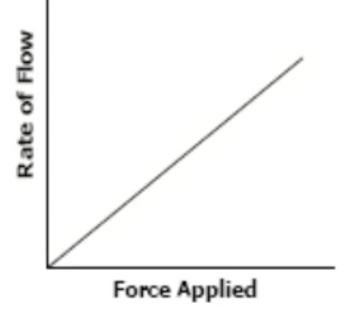
slope = 1/η
larger the slope, lower the viscosity
ex: water
classification of flow
non-newtonian plastic flow

B>A
you have to provide a certain minimum force for the liquid to move/flow
ex: ointments
when you invert an ointment (will not move)
you use your finger(s) to spread it on skin that it moves(flows)
when you stop spreading the ointment, the ointment remains on the part of the skin it was left on without moving (force)
classification of flow
non-newtonian pseudoplastic flow

B>A
there is no minimum force to begin with, but it just starts going and going
ex: cream
when inverting cream in a jar, it will most likely not flow out
but applying only the slightest of force will make it flow
classification of flow
non-newtonian diatant flow

A>B
when you first apply force, it goes linearly, but then you apply too much, it starts to plateau
ex: toothpaste
has high solid contents
when trying to make toothpaste, you should not apply too much force as it can make the material resist the flow (converting the material into a hard solid mass)
what kind of flow does most flocculated suspensions demonstrate?
non-newtonian pseudoplastic flow
what kind of flow does most deflocculated suspensions demonstrate?
non-newtonian dilatant flow
the greater the slope…..
the smaller the viscosity
makes the flow nicer (better)
essentially, B should be greater than A to be better
what is thixotropic flow?

gel → sol
when force (shear stress) is applied, it will convert into a liquid with time
sol → gel
when leaving the sol alone (on standing), it will convert back into gel with time
THIXOTROPIC IS A DESIRABLE PROPERTY IN SUSPENSIONS
what are the methods of preparation for suspension formulation?
deflocculated suspension: using a suspending agent to prepare deflocculated suspensions
controlled flocculation using flocculating agents
flocculated suspension in a structured vehicle
the main steps in the preparation of suspension
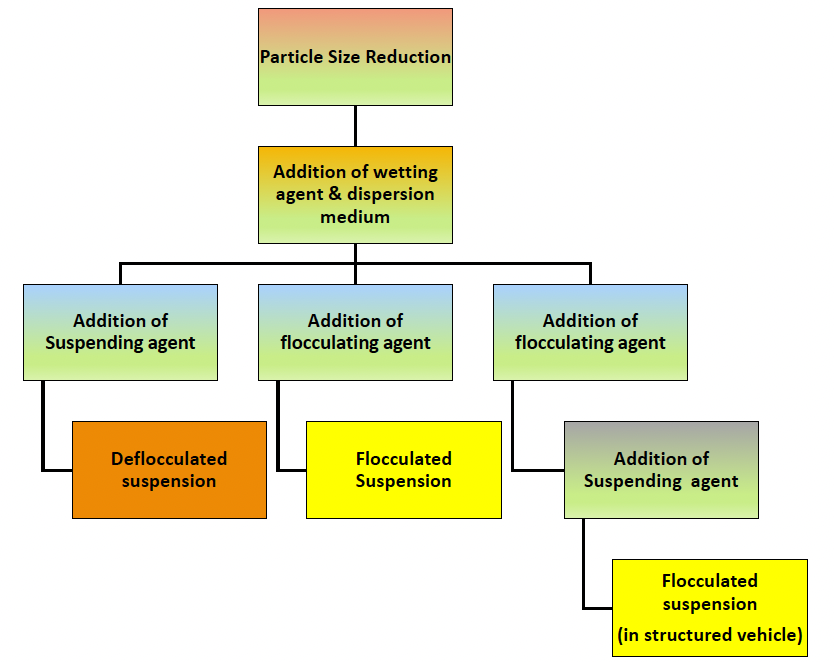
reduce the particle size (fine particle size)
add wetting agent to disperse the suspended particles
wetting agent: to reduce the surface tension of water so that it spreads, wets, and penetrates surfaces instead of beading up and running off
helps it disperse into the surface
after adding the wetting agent and dispersing the particles, one of three things can happen
addition of suspending agent
the job of suspending agent is to increase the viscosity
in doing so, it will dispense nicely and dispense slowly (deflocculated suspension)
addition of flocculating agent
this agent causes flocculating formation
creates flocculated suspension from that formation
addition of flocculating agent then addition of suspending agent
essentially a flocculated suspension in a structured vehicle
means there will be an increase in viscosity of flocculated suspension
flocculated suspensions are desirable because they give you stable suspensions
the addition of suspending agent makes the suspension more desirable by having the settlement of sedimentation be slower
which of the following accurately characterizes colloidal dispersions?
a) particles diffuse very rapidly
b) particles diffuse very slowly
c) particles invisible in electron microscope
d) particles visible in ordinary microscope
e) particle size range is 0.5-10µm
b
the graph shown below is an example of __________

a) newtonian flow
b) plastic flow
c) pseudoplastic flow
d) dilatant flow
c
what are wetting agents?
wetting: vehicle completely touching solute particles
contact angle (ϴ)
angle between a liquid and the surface over which it spreads
ranges from 0 to 180 degrees
low contact angle means high wetting
wetting is most important for the initial dispersion during the preparation of an insoluble powder in a vehicle
e.g. alcohol, glycerin, surfactants
alcohol and glycerin occupy the air spaces (top example)
alcohol can dissolve both organic phase and aq phase
means that alcohol and glycerin can interact with the particle and interact with the water (pulling the particle inside, towards water)

what is the point of suspending agents?
to reduce the rate of sedimentation
to enhance the appearance of the suspension
the concentration of suspending agents is usually 0.5-5% w/v
the suspending agent should preferably exhibit pseudoplastic flow and thixotropy
types
natural hydrophilic polymers e.g. tragacanth, xanthum gum, acacia
synthetic hydrophilic polymers e.g. methyl cellulose, carboxyl methyl cellulose
clays e.g. bentonite, veegum
what is controlled flocculation?
flocculating agents are added to reduce and control the particle surface charge to an optimum level
assures particle dispersion for sufficient period of time and prevent formation of a compact sediment that is difficult to redisperse
flocculating agents:
electrolytes
surfactants
polymers
electrolytes as flocculating agents
electrolytes act by reducing the electrical barrier between the particles
sodium phosphate, potassium chloride
important points when choosing flocculating agents:
the surface charge of the drug particles
the valency of the electrolyte
electrolyte concentration

you can bring the particles closer together by reducing the charge density on the particle
polymers as flocculating agents
high molecular weight compounds
particularly useful for drugs that do not carry a charge
acts as flocculating agents by the adsorption of the polymer chains on the particle surface while the remaining parts of the polymer chain project outside. interaction between these protect polymer chains forms a bridge leading to flocs
can mark the charge on the particles, if the drug particle is charged
ex: xanthum gum and polycrylamide
surfactants as flocculating agents
ionic surfactants act as flocculating agents by reducing the charges on the particle surface similar to electrolytes e.g. docusate sodium

non-ionic surfactants as a flocculating agents by forming a protective layer around to particles e.g. tweens or spans

oral suspension - antacid aluminum hydroxide

aluminum hydroxide gel use?
drug
oral suspension - antacid aluminum hydroxide
sorbitol solution use?
sweetener and viscosity modifier
oral suspension - antacid aluminum hydroxide
syrup use?
sweetener and viscosity modifier
oral suspension - antacid aluminum hydroxide
glycerin use?
wetting agent
oral suspension - antacid aluminum hydroxide
methylparaben use?
preservative
oral suspension - antacid aluminum hydroxide
propylparaben use?
preservative
oral suspension - antacid aluminum hydroxide
flavor use?
flavoring agent
oral suspension - antacid aluminum hydroxide
purified agent use?
vehicle
evaluation of suspensions - Stoke’s Law
rate of sedimentation

where:
d is the diameter of dispersed particle
η is the viscosity of the dispersion medium
g is the gravitational acceleration (m/s²)
⍴s is the mass density of the particles (the dispersed phase) (kg/m³)
suspended media
⍴o is the mass density of the fluid (the dispersion medium) (kg/m³)
outside media
Stoke’s law and rate of sedimentation
as diameter of particles, d increases …..
V (sedimentation rate) increases, faster sedimentation
Stoke’s law and rate of sedimentation
as density of internal phase, ⍴s increases …
V (sedimentation rate) increases, faster sedimentation
Stoke’s law and rate of sedimentation
as density of external phase, ⍴o increases …
V (sedimentation rate) decreases, slower sedimentation
Stoke’s law and rate of sedimentation
as viscosity of medium, η decreases …
V (sedimentation rate) decreases, slower sedimentation
suspension stability
the suspension should be redispersible on shaking
a relatively narrow particle size distribution forms a good stable suspension
if we were to have a broad particle size distribution, it will create gaps which is not good because it create cake compact. that’s why we want narrow.
drugs in suspension can undergo polymorphic conversion on storage
change in pH of the dispersion medium can cause precipitation
pH must be kept in certain range so the particle does not dissolve
drastic change in temperature can alter suspension stability
at high temps, molecular mobility is higher
might cause the particles to bombard each other and even grow in size
at low temps, the particles will be trapped
trapped in ice, so flocculation formation (if you have any) will be lost
packaging and storage
all suspensions should be packaged in wide-mouth containers having adequate airspace above the liquid to permit thorough mixing by shaking and ease of pouring
most suspensions should be stored in tight containers protected from freezing, excessive heat, and light
it is important that suspensions be shaken before each use to ensure a uniform distribution of solid in the vehicle and thereby uniform and proper dosage
correctly identify the mechanism by which polymers acts as flocculating agents.
a) by reducing the electric barrier between the suspended particles
b) by adsorption on the particle surface
c) by forming a protective layer around the particles
d) by increasing the electric barrier between the particles
b