ASTROBIOLOGY (1-9)
 Call Kai
 Learn
Learn Practice Test
 Spaced Repetition
 Match
Match Flashcards
 Knowt Play
1/57

Earn XP
Description and Tags
#9747ce
Name | Mastery | Learn | Test | Matching | Spaced | Call with Kai | Chat |
|---|
No analytics yet
Send a link to your students to track their progress
58 Terms
what is an ‘isotope’? (L2)
Isotopes are defined as atoms with the same atomic number but different mass numbers, or as atoms with the same number of protons but different numbers of neutrons.
what is ‘ionic bonding’? Describe its properties and how it’s used by life. (L2)
Ionic bonding : a force of attraction between positively and negatively charged ions.
Typically strong
Most ionic compounds are crystalline solids at room temperature. (crystalline solid = a material whose constituents are arranged in a highly ordered structure (lattice))
→ life uses ionic bonds referred to as "salt bridges". These ionic bonds hold amino acids together
what is ‘covalent bonding’? Describe its properties and how it’s used by life. (L2)
Covalent bonding : a result of two positive nuclei being held together by their common attraction for the shared pair of electrons.
Takes place between atoms with small differences in charge, which are close to each other in the periodic table, or identical atoms
Due to the strength of covalent bonding, thermal motion cannot break bonds which allows molecules to form.
→ life uses covalent bonding referred to as "disulfide bridges". Disulfide bridges are covalent bonds between R groups containing sulfur. (R group = the unique variable chemical group attached to the central carbon of an amino acid that defines its identity and distinct properties).
how does life use covalent bonding in extreme environments? (L2)
Extra covalent bonds can be introduced by organisms to enable them to survive at extreme conditions
how does life use ionic bonding in extreme environments? (L2)
Extra ionic bonds can be introduced by organisms to enable them to survive at extreme conditions
what are ‘van der Waals forces’? Describe its properties and how it’s used by life. (L2)
van der Waals forces : intermolecular forces acting between molecules which relate to the solubility and volatility of organic molecules. (exists in all atoms)
Dipole-dipole "Keesom" Forces = occur exclusively between two permanent dipoles (polar molecules)
Dipole-Induced dipole "Debye" Forces = occur when a polar molecule with a permanent dipole distorts the electron cloud of a neighbouring non-polar molecule, inducing a temporary dipole
Dispersion forces (ldf) = weak, temporary attractive forces that are caused by movement of electrons in atoms and molecules. (important for inert gases and covalently-bonded molecules)
→ life uses van der Waals forces because there are no physical bonds in terms of transferring/sharing electrons, resulting in weaker bonds. their weakness allows molecules to interact without requiring huge amounts of energy (e.g. allowing geckos to stick to glass)
what is ‘hydrogen bonding’? Describe its properties and how it’s used by life. (L2)
Hydrogen bonding : electrostatic forces of attraction between molecules that contain highly polar bonds.
Found in molecules containing –OH groups.
A hydrogen atom, having one electron, can be covalently bonded to only one atom. However, the hydrogen atom can involve itself in an additional bond with a second atom of a strongly electronegative element such as fluorine, oxygen or nitrogen. This second bond permits a hydrogen bond between two atoms or structures
→ life uses hydrogen bonding to hold large biological molecules together. Hydrogen bonds are important for DNA replication. (DNA is unwound and hydrogen bonds between bases are broken to form two template strands)
how does life use hydrogen bonding in extreme environments? (L2)
Hypothermophiles grow at > 80 degrees C. Hyperthermophiles use Ferredoxin (an ancient protein) that contains extra hydrogen bonding throughout their structures. This creates a dense network which locks the protein shape in place, preventing hydrogen bonds from breaking apart at extreme temperatures. (washing machine example)
what is ‘metallic bonding’? (L2)
the electrostatic force of attraction between positively charged ions and delocalised electrons
why does life not use metallic bonding? (L2)
Life uses metal ions, but no organisms use metallic bonding to construct bulk metallic objects. This is because it is extremely energetically costly for an organism to extract a sufficient number of metal ions to construct metallic structures, therefore decreasing the probability of life forms using metallic bonding.
why is hydrogen bonding important for DNA? (L2)
Hydrogen bonds hold the two complementary strands of the DNA double helix together and allow them to separate easily for replication and transcription
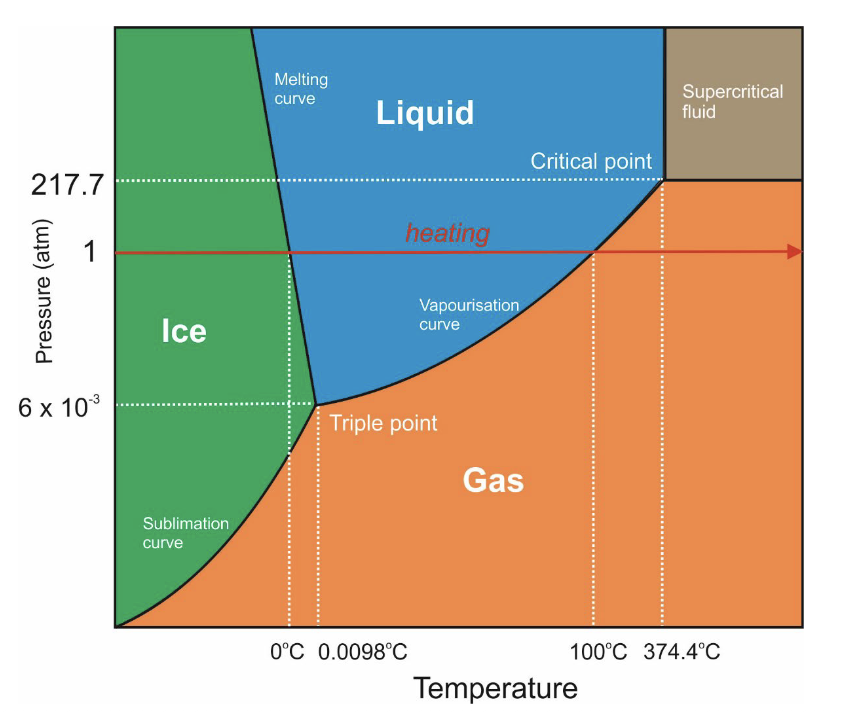
what is the significance between water and its negative ‘melting curve’? (L3)
Water has a negative melting gradient which is a strange behaviour. Water's negative melting gradient means that the density of solid water (ice) is less than liquid water.
Ice has a crystalline structure which creates a less dense structure meaning ice sits on top of its liquid form. Most matter has solids that are more dense than the liquid.
→ Nonetheless, this does not mean water has a special property for life.
describe water on Mars, including it’s early history. (L3)
Mars' low surface pressure means it cannot sustain liquid water, instead water on mars is found as a solid (ice). Ice on Mars sublimates due to the surface pressure (sublimate = solid -> gas without turning to liquid in-between). In the early history of Mars there was a large quantity of liquid water, meaning the pressure on the surface of mars must have been a lot higher than it is now. We know this because dried up rivers and water basins suggest water must have been stable to carve the surface of Mars.
what is meant by a ‘phase diagram’? (L3) xxxxxx
a phase diagram allows us to predict the state of matter at given pressures and temperatures
States of matter:
Solid → liquid → gas → plasma
--------increasing energy---------->
what is ‘plasma’ and where is it found? (L3) xxxxxx
Plasma is a mixture of atoms, ions and dissociated electrons (a hot ionized gas). It's very hot because it's created by heating the molecules to extremely high temperatures.
Plasma in nature:
Stars
Lightning
Aurora borealis
Plasma does not contain molecules. It is a gas that is composed of ions.
Some or all the electrons in the outer orbitals have been stripped away.
The results is a collection of ions/electrons which are no longer bound.
Makes up more that 99 percent of the known visible universe.
what is ‘degenerate matter’ and where is it found? (L3) xxxxxx
Degenerate matter is a collection of free, non-interacting particles which occurs at very high density or at low temperature/pressure. Almost like a plasma and metallic bonding -- caused by intense pressure forcing electrons out of orbit of the atom
Degenerate matter is found in white dwarf stars, which are usually about the size of the earth
discuss the astrobiological consequences and relevance of different types of matter. (L3)
what are the ‘CHNOPS’ elements? (L4)
Life is made of just a few elements : CHNOPS
C - Carbon
H - Hydrogen (Hydrogen is not special, it just happens to bind to any spare electron)
N - Nitrogen (amino acids, DNA)
O - Oxygen
P - Phosphorus (DNA, ATP)
S - Sulfur (amino acids)
carbon is the central molecule for constructing structures of life "carbon-based life". why is carbon the basis of life and not silicon? (L4)
why carbon:
Bond energies of CHNOPS are similar making it easier to swap them around
Once it is linked, it is quite stable
A wide variety of double and triple bond configurations allows a wide variety of molecules and networks
why not silicon:
silicon chains are possible, and you can link them to carbon compounds
the problem is that Silicon tends to form complex chains structures with oxygen. silicon is a bigger atom with electrons further apart so when you add oxygen it creates sand. any environment with oxygen, silicon will form sand instead of the diversity of molecules like carbon can. (minerals/silicates)
-> Therefore the chemistry of silicon is much more limited
what are the four major classes of life and what are they used for? (L4) xxxxxx
Major classes of biological life :
Proteins : long chains of amino acids
Sugars : used in storage and transport
Lipids : membranes and energy
Nucleic acids : information storage
what is meant by the term ‘chirality’? (L4) xxxxxxx
Know about the structure of DNA, its four bases, repeating sugar- phosphate backbone. (L4) xxxxxxx (not including RNA)
Know what characteristics water has that make it a suitable solvent for life and why ammonia also has some suitable characteristics. (L4) xxxxxxx
Know some of the major features of a cell. (L5)
explain how membranes form and draw a basic membrane structure involving two lipid layers. (L5)
Understand that there are two different types of bacterial membrane. (L5)
Know the difference between RNA and DNA. (L5)
Know what a ribosome is. (L5)
Understand and be able to explain transcription and translation. (L5)
how are organics detected in space using spectroscopy? (L6)
absorption spectra: shows dark gaps (missing wavelengths) where light has been absorbed by a substance
emission spectra : shows bright colored lines of light released by excited atoms
describe the structure and importance of interstellar grains in organic chemistry. (L6)
billions of interstellar grains are drifting throughout space.
structure:
interstellar grains are little pieces of silicate and ice. silicate (silicon that comes into contact with oxygen) cores are surrounded by ice and they are formed by exploding stars or planets.
importance:
interstellar grains provide a surface where things can come into contact with eachother. the grain will absorb energy and warm up where there is higher temperature (e.g. a nearby star). - now we've got chemical reactions.
what is the importance of radiation in driving chemical reactions? (L6)
molecules in space lack the thermal energy to collide and overcome chemical activation barriers due to the low temperatures. radiation provides energy via electrons and energetic particles, which break molecular bonds and create free radicals. because free radicals are so unstable, they form new, complex molecules spontaneously, without needing any heat at all.
describe one example of a location in space where organic compounds can be found and a basic description of the characteristics of this locations. (L6)
supernova explosions/shock waves:
when a star collapses and goes supernova, it sends out shockwaves throughout the universe. shockwaves increase the density and the temperature of local space, which allows chemical reactions to occur and therefore the formation of complex organic molecules. as the shockwave passes through it heats up the area. it then rapidly cools down again once the wave has passed, creating a spike and then a drop of temperature. (shocks compress and heat the gas, molecules get heated and then cool/condense)
Sound speed ~1km s-1
Density jumps by 4-6, gas temperature ~3000K
what are ‘PAHs’ and what is their relevance to organic chemistry? (L6) xxxxxxx
PAHs = “Polycyclic Aromatic Hydrocarbons”
PAHs are large, complex organic molecules consisting of sheets of benzene (carbon) rings.
Form spherical objects
If you put them in a membrane, they can transfer electrons through the membrane
Complexity in space leading to building block of life
Become surfaces for organic chemistry to begin on
Understand generally why the discovery of interstellar organic chemistry is important in our understanding of the possible origins of life (L6)
Understand the principles behind the hierarchical classification of life. (L7)
Understand the difference between homology and analogy. (L7)
Know what a monophyletic group is. (L7)
Understand how DNA is used to build phylogenetic trees. (L7)
Understand and give at least two examples of the different types of Horizontal Gene Transfer and why they make building phylogenetic trees difficult. (L7)
Know how phylogenetic trees can be used to test hypothesis (with an example). (L7)
Be able to explain the hypothetical implications of these ideas for the search for life elsewhere. (L7)
abc (L8)
abc (L8)
abc (L8)
abc (L8)
abc (L8)
abc (L8)
abc (L8)
abc (L8)
what is meant by ‘extremophile’? (L9)
an organism that lives AND thrives in physical or chemical conditions that are normally lethal or harmful to most life on Earth. extremophiles are not only ABLE to survive in extreme conditions, they PREFER to live in these conditions.
describe at least 2 examples of an adaptation to an extreme and the biochemical basis of that adaptation. (L9)
Hot environments : '(hyper)thermophiles' —————
Challenges:
increased membrane fluidity
denaturation and breaking down of molecules
Adaptations:
introduction of thermostable proteins and enzymes
increase in the number of covalent and ionic bonds to prevent molecules from unfolding or breaking apart.
Cold environments : 'psychrophiles' ———————--
Challenges:
membrane damage from ice
decreased membrane fluidity
limited availability of liquid water
Adaptations:
membrane composition: fatty acids can stack together. an introduction of a single double bond into a lipid prevents close packing making membranes more fluid at low temperature (introducing unsaturated fatty acids creates movement in the membrane)
introduction of antifreeze agents: bind to tiny ice crystal lattices to inhibit ice-recrystallization and lower the freezing point without changing the melting point
Saline/dry conditions : 'halophiles' ————————
Challenges:
osmotic pressure,
membrane integrity
Adaptations:
controlling water loss from cells: preventing cells from shrivelling up,
go into a state of dormancy
pH : 'acidophiles' —————————————————
Challenges:
breakdown of cellular components: regulating protons that are pumped across the membrane to gather energy, changing the concentration requires careful control of protons across the cell membrane.
limitations to metabolic processes
Adaptations:
regulation of internal pH, both active and passive
High pressure : 'piezophiles' ————————————
Challenges:
tight packing,
impaired cellular structures and activities
Adaptations:
Introduce unsaturated fatty acids to increase membrane fluidity.
changes in gene expression and membrane structure. Comparatively poorly understood?
Radiation: 'radiophiles' ———————————————
Challenges:
breakdown of molecules (fragmentation).
oxidation of molecules
Adaptations:
multiple copies of their genomes are stored as a backup in the case that one gets damaged
become very effective at repairing
introduction of pigments to quench reactive oxygen states and stop the cells from being destroyed (free radicals)
describe an example of how membrane changes can allow for adaptations to given extremes. (L9)
why are extremophiles useful for assessing the habitability of other planetary bodies? (L9)
extremophiles define the outer limits of life, helping scientists understand what kind of life might survive in environments that we might consider as extreme.
they act as models to identify how indigenous alien life or its chemical metabolites might manifest during robotic or human missions.
why are chemolithotrophs generally extremophiles? (L9)
chemolithotrophs have very little energy available to them, energy can also be a limit to life
what is an example of the study of extremophiles being applied to practical industrial use? (L9)
high temperature enzymes/catalysts for industrial products such as heavy-duty laundry detergents
why might microbes, particularly extremophiles, be useful in human space exploration? (L9)
biotechnology applications: studying these cellular defense tools helps researchers design better shielding, bio-remediation strategies for radiation, or protective treatments against cellular damage in space.