calc ch14
 Call Kai
 Learn
 Practice Test
 Spaced Repetition
 Match
 Flashcards
 Knowt Play
1/40

There's no tags or description
Looks like no tags are added yet.
41 Terms
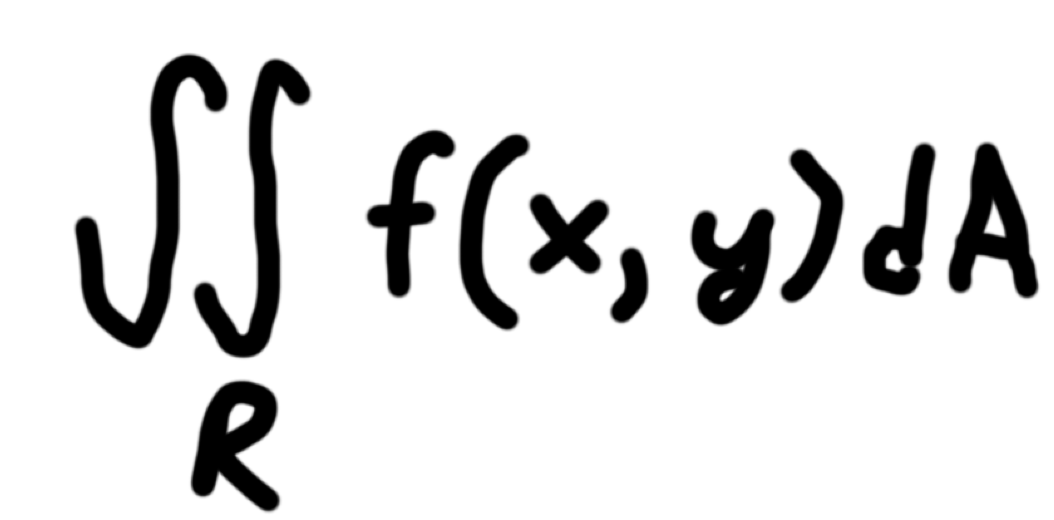
cartesian coordinates double integral general formula
Where R means the bounds within region R
f(x,y) is the z=… that you are integrating under
dA is the infinitesimally small area element that you add up across R

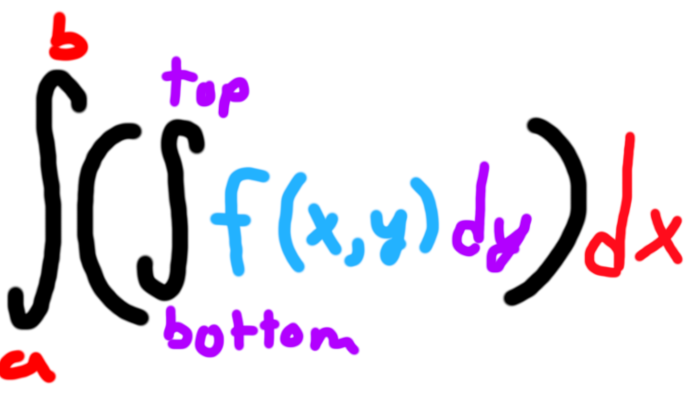
how to calculate (using a top and bottom function):
give bounds
give constraints on bounds/answer
a and b need to be constants because the integral evaluates to a constant
f(x,y) would be z=… which is the function you are integrating
top & bot refer to top function and bottom function. this would be y = …; THIS CAN JUST BE A CONSTANT AS WELL RATHER THAN SOME FUNCTION f(x)

how to calculate (using a right and left function):
give bounds
give constraints on bounds/answer
a and b need to be constants because the integral evaluates to a constant
f(x,y) would be z=… which is the function you are integrating
right & left refer to right function and left function. this would be x = …; THIS CAN JUST BE A CONSTANT AS WELL RATHER THAN SOME FUNCTION f(y)

visualize: what would the region R look like for this double integral? + what type of region is this?
vertically simple region b/c outer integral is bounded by 2 lines x=…


visualize: what would the region R look like for this double integral? + what type of region is this?
horizontally simple region b/c outer integral is bounded by 2 lines y=…

note that for double integrals, when you are below the z-axis, you get a ____ volume, leading to possible cases of a volume of ____ when you have symmetric ____
when below z-axis you get a negative volume leading to possible cases of volumes of 0 when you have symmetric regions above and below xy plane
in picture, green would be positive volume and red would be negative volume

cartesian coordinates: how to mess with bounds to flip them
when thinking about the region R, think about how to rewrite the function in terms of x=… instead of y=… if it’s already y=… or y=… instead of x=… if it’s already x=…
then consider what the new min and max x or y values will be for the outer bounds
NOTE THE DRAWING’S BOUNDS ARE ALL BASED ON REGION R! TO DO THIS MATHEMATICALLY, YOU JUST SET
a<=either x or y<=b
c<=either x or y<=d
and then try to use this system to isolate new values and find the new bounds. a,b,c,d would all come from the bounds of the integrals, and the thing in the middle will literally just be x or just be y

polar coordinates double integral general formula
recall that x= rcosθ; y= rsinθ in polars. the integral in the picture is the same f(x,y) as before, just with the polar representations subbed in
note the rdr → you need to distribute the r amongst the function and then integrate
outermost bounds are constants
f(theta) meaning r=…
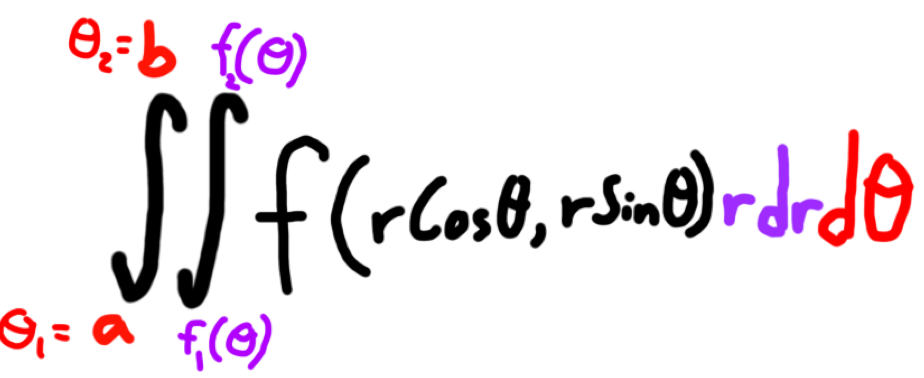
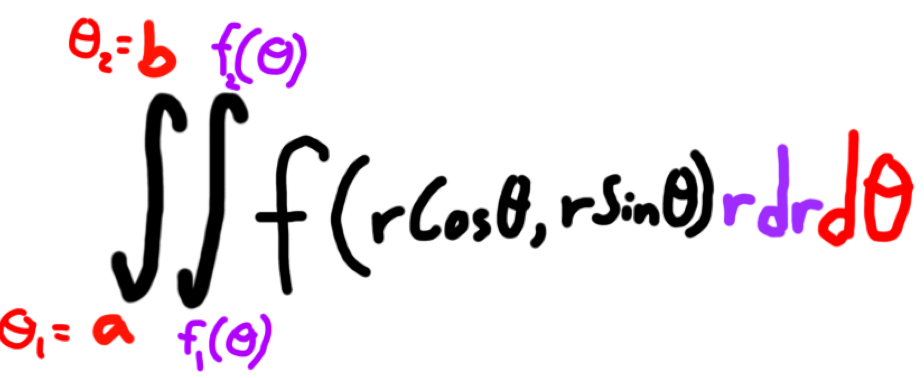
how to figure out inner bounds for double integrals in polars aka
f2(θ) and f1(θ)
Imagine a ray at some randomly fixed angle θ starting from the origin
f2(θ) represents how far out you can go from the origin before you hit the outer boundary of the region
f1(θ) represents how far out you can go from the origin before you hit the inner boundary of the region
Note: the inner boundary would be 0 if there is no inner boundary (e.g. just a circle rather than a ring)
THE TWO BULLET POINTS ABOVE ARE LIKE “FAR FUNCTION” AND “NEAR FUNCTION” FOR THE INNER INTEGRAL’S BOUNDS
Note that
in the left side of the picture as theta changes, both f2θ and f1θ will change, which is why you leave them as functions of theta rather than a constant
The right side of the picture is an example where f1θ doesn’t change regardless of θ, so the lower bound for the inner integral would be f1θ = c and in this case c = 0.
THE EXAMPLES AREN’T THE BEST BECAUSE A CIRCLE WITH RADIUS r WILL = the constant r FOR ALL THETA AS WELL SO THOSE WOULD ALSO BE CONSTANTS, BUT IMAGINE THAT THESE FUNCTIONS IN THE PICTURES AREN’T CIRCLES!

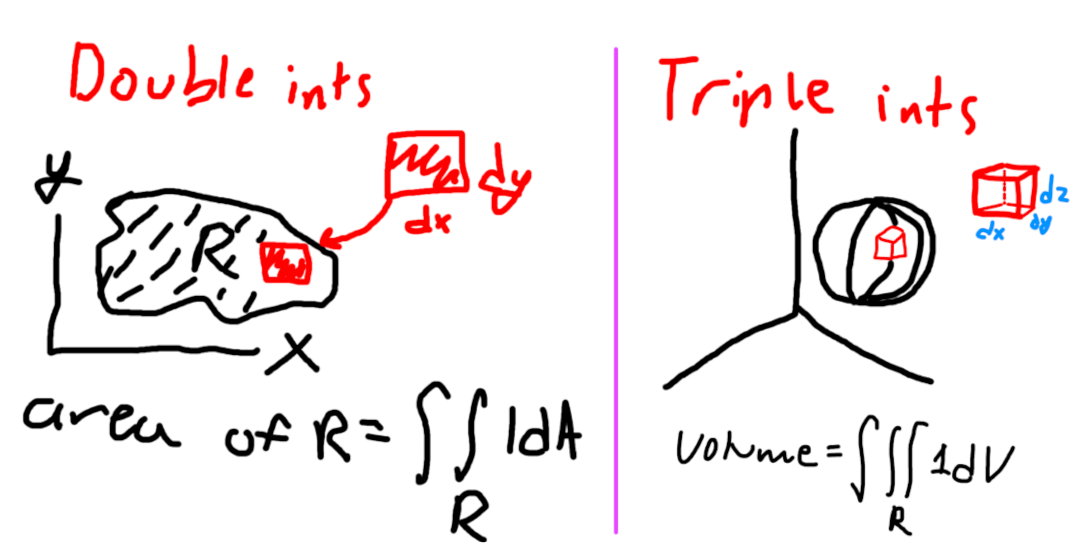
Double vs Triple integrals explained + picture
Double integrals use (dA) to add up a bunch of tiny 2D area elements across a region (R). When integrating a function of two variables, (f(x,y) aka z=…), we multiply each tiny area element by the function's height to find the volume under the function z=…
Triple integrals use (dV) to add up a bunch of tiny 3D volume elements throughout a region (D). When integrating a function of three variables, (f(x,y,z) aka some 4D object), we add up the function's value over each tiny volume element to find the total accumulated quantity throughout the 3D region
If (f(x,y,z)=1), we get the volume of the region itself as you’d multiply all the tiny 3D objects by 1
triple integrals always evaluate to a…
triple integrals always evaluate to a constant
set notation use for 3D integrals (understand how this works + what it’s used for)
writing a function in this form allows you to see the bounds of the integrals… e.g. for a triple integral, the z bounds would be from e to f (note that those could be functions, they don’t necessarily need to be constants)
THE OUTERMOST BOUNDS (a to b) WILL NEED TO BE CONSTANTS SO YOU GET A CONSTANT AS YOUR ANSWER
this is used to restrict the domain of the region/represent a set of all the points in the region so you know what the bounds are

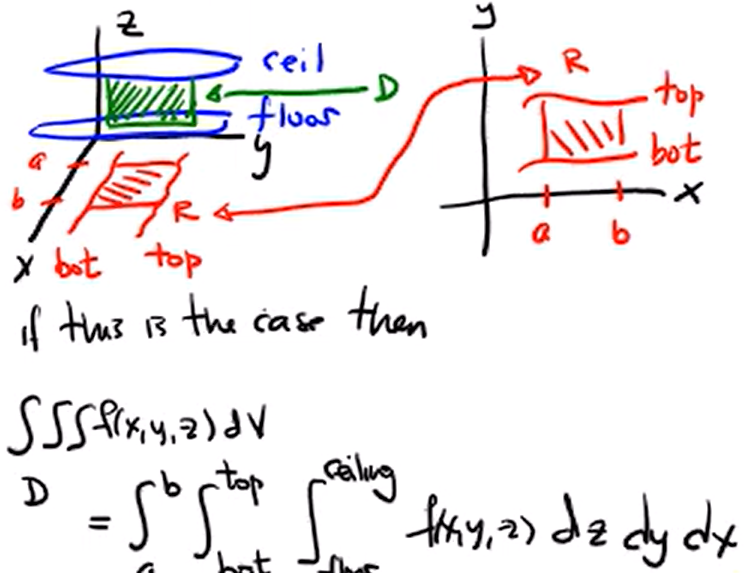
cartesian coordinates triple integral general formula
where
f2 is ceiling function, f1 is floor function
both written as functions z=…
ceiling meaning “bounded above by…”; floor meaning “bounded below by…”
D is the domain in the xy plane (this formula also generalizes to regions D lying in the yz plane or xz plane, you’d just need to rewrite the functions as y=… or x=…); this is where you obtain your outer 2 integral bounds (by turning the function into set notation and doing a<=x<=b and c<=y<=d)
note that you can swap the order of the integration just ensure that the outermost bounds are constants
note that middle integral bounds (lower and upper) will be either [top and bottom] OR [right and left]
dA would be dydx or dxdy depending on order
note that you are integrating a function of 3 variables! this means that if you want the volume of the object within the bounds then your integrand must = 1

dV in cartesian
dz dy dx
note: order for these can be swapped, just make sure outermost bounds are constants!

just know and understand this for triple integrals in cartesian coordinates
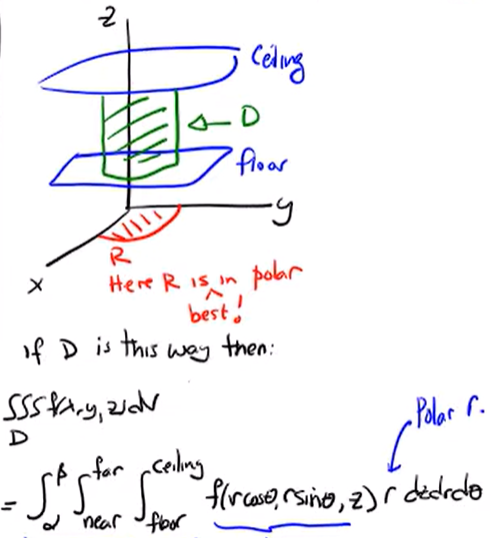
how cylindrical coordinate system works (visualized)
note: coordinates are (r,θ,z)
θ is angle with the positive x-axis; z is just z like cartesian

triple integrals: dV in cylindrical
r dz dr dθ
recall that in cylindrical coordinates, x2 + y2 =
r2 in cylindrical
triple integral formula in cylindrical coordinates
note that
dv = r dz dr dθ … don’t forget the r!
f(x,y,z) is replaced with f(rcosθ, rsinθ, z)
the bounds for the integrals from outer most to inner most will be as follows: theta, r (aka f(θ)), and then z = … which will be like f(rcosθ, rsinθ)
this matches up the dz dr dθ where dz is innermost and dθ is outermost
spherical coordinates: xyz conversion
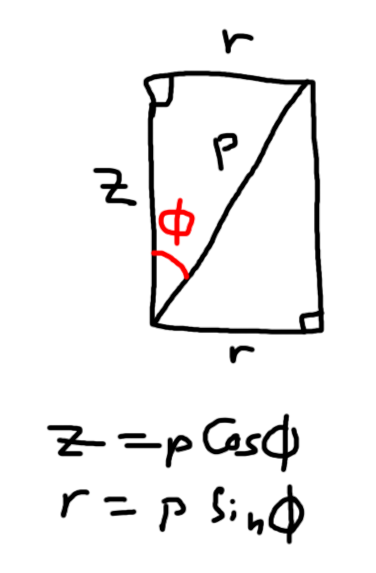
x: pSinΦcosθ
y: pSinΦsinθ
z: pCosΦ
**notice how x and y share rho sin phi
for planes and stuff you will need to sub in these conversions and simplify
identify these shapes in spherical coordinates:
p = constant
Φ = constant
p = constant is a sphere
just imagine rho being rotated the way that the angle bounds phi and theta enable it to be rotated (360 degrees)
Φ = constant is a cone because the angle between the z axis and the line is kept constant and it is rotated
this is what the picture depicts as this is harder to visualize

how spherical coordinate system works (visualized)
and give bounds
p (pronounced “rho”) is distance to origin (bounded by p>=0)
theta is the angle w/ the positive x-axis (bounded from 0 to 2pi)
phi is the angle with the positive z axis (bounded from 0 to pi)
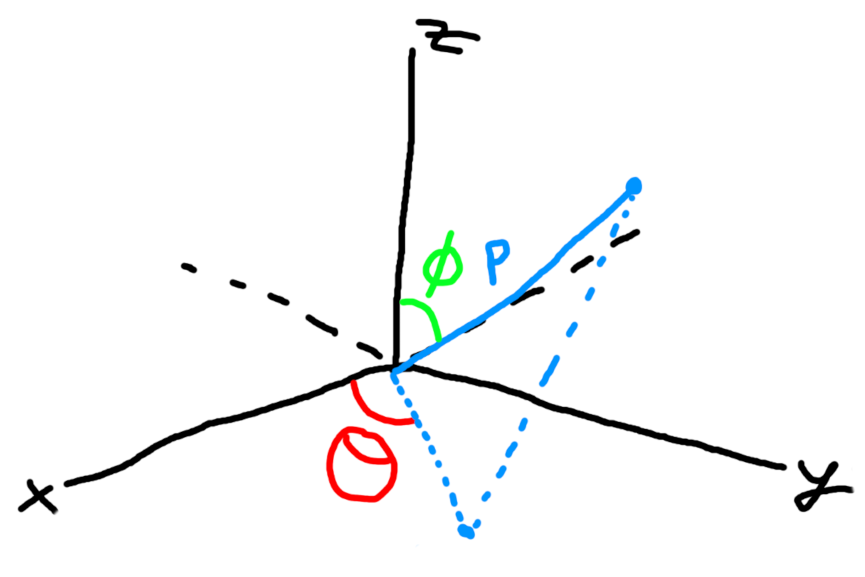
remember this formula for spherical coordinates: x2 + y2 + z2 =
x2 + y2 + z2 = p2
phi angle visualized better
the red represents the angle phi - this is why it’s bounded from 0 to pi
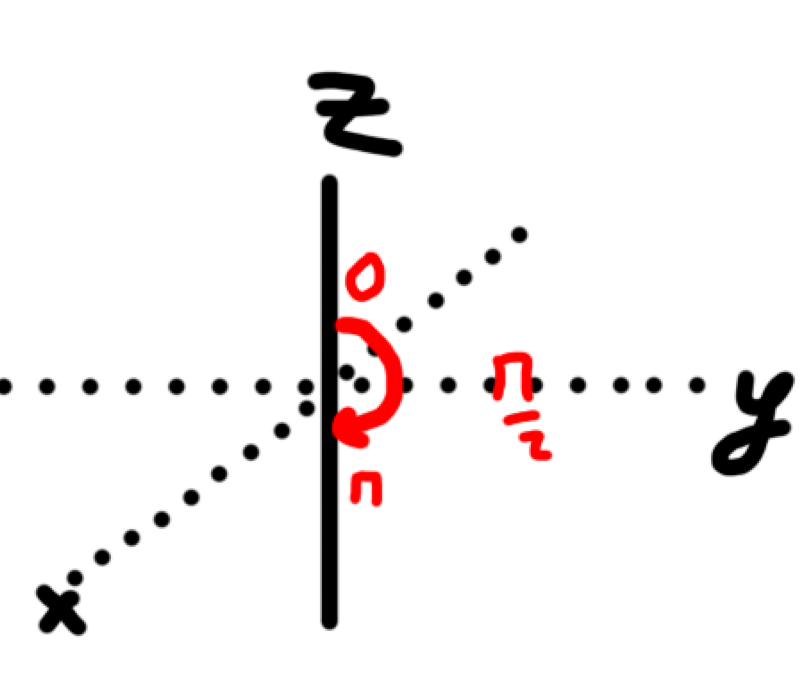

look at this picture for coordinate conversions (x,y,z) → spherical if you can’t memorize the r and z (useful but not strictly necessary to memorize)
this is just useful for the z and then the r which is present in both x and y as r is replaced with rho sin phi (recall polars it is x=rCostheta so spherical → x = rhoSin(phi)cos(theta))
dV for spherical coordinates
p2sinΦ dp dΦ dθ
don’t forget the rho squared sin phi!
spherical coordinates triple integral formula
note the:
dv containing rho squared sin(phi)
for f(x,y,z) you’d sub x,y,z for the values in grey and simplify to get the new function
note that the inner most integral’s bounds will be functions in terms of phi and theta (OR constants if rho is just a constant like a sphere aka these are p=…)

cos2(x) =
.5* [ 1 + cos(2x) ]
sin2(x) =
.5* [ 1 - cos(2x) ]
sin(2x) =
2sin(x)*cos(x)
cos(2x) =
cos2(x) - sin2(x)
sin2(x) + cos2(x) =
1
tan2(x) + 1 =
sec2(x)
r = a +- bSin(θ) where |a| = |b|
shape, bounds, cos and sin symmetry, what does |a| & |b| represent, what does b represent (e.g. if it’s negative)
*note sin could be cos instead
Cardioid
[0, 2π]
Cos = symmetric along x-axis
Sin = symmetric along y-axis
note:
butt always touches the origin
2*|a| represents the distance from the origin to the top of the cardioid
in this picture a=3
if it was a-bSin(θ) then the cardioid would be flipped down like a parabola changing from x2 to -x2 (keep in mind that |a| would still = |b|)

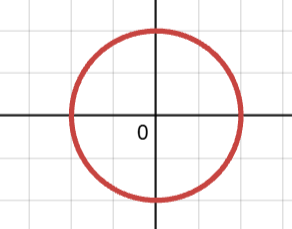
r = #
shape, bounds, additional info
Circle
[0, 2π]
Center: (0,0) with radius r
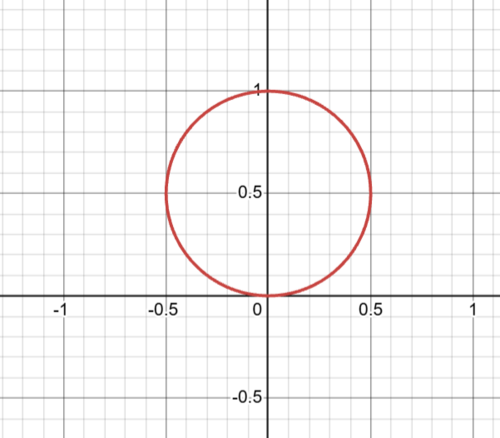
r = aSin(θ)
shape, bounds, additional info
*note sin could be cos instead
Circle
[0, π]
Center: (a/2, 0) for cos and (0, a/2) for sin
Cos = symmetrical across x-axis
Sin = symmetrical across y-axis
Note: a is a constant and the radius of the circle = a
the picture depicts r=1Sinθ
change of variables: visual reason for them
region R is hard to integrate, so you set x=g(u,v) and y=h(u,v) to make a simpler region for integration

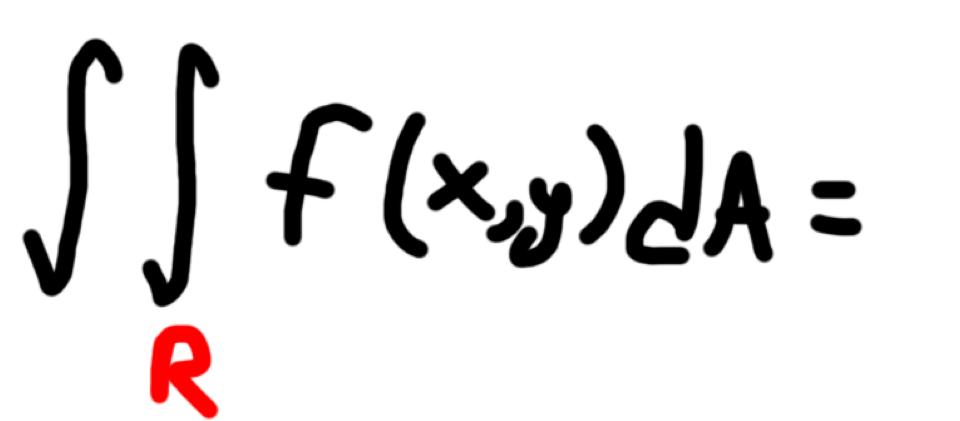
change of variables theorem (formula)
note that the absolute value thing is called the jacobian scaling factor and for that you take the determinant then the absolute value of the result … more info in another slide
you determine u and v based on the bounds x=… and y=… for region R. Just try to make the u-sub simplify the bounds (and ideally the integrand)

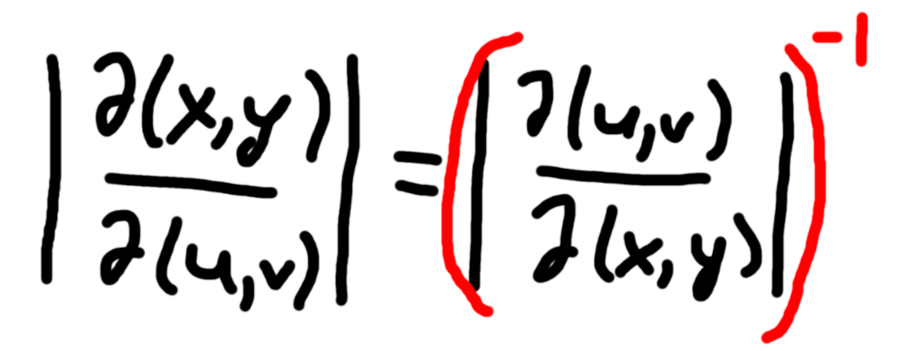
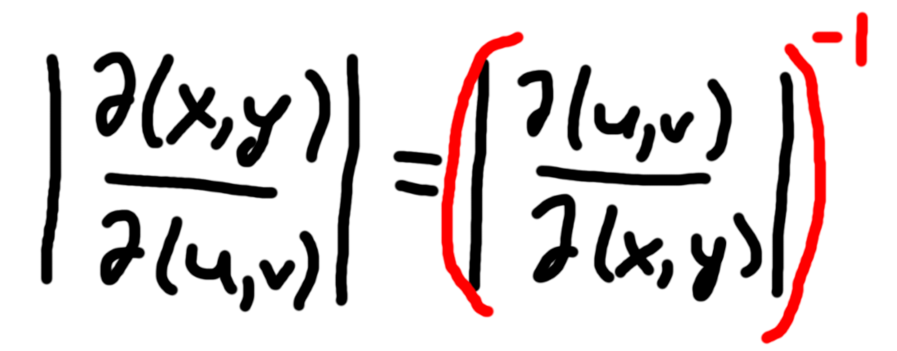
know and understand this rule
the left side is easier when you have x=… and y=… in terms of u and v
the right side is easier when you have your bounds u=… and v=… in terms of x and y
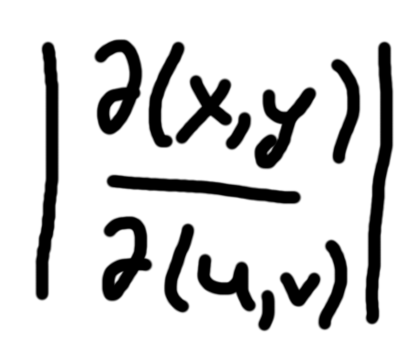
what does this jacobian scaling factor = (how do you find it mathematically)
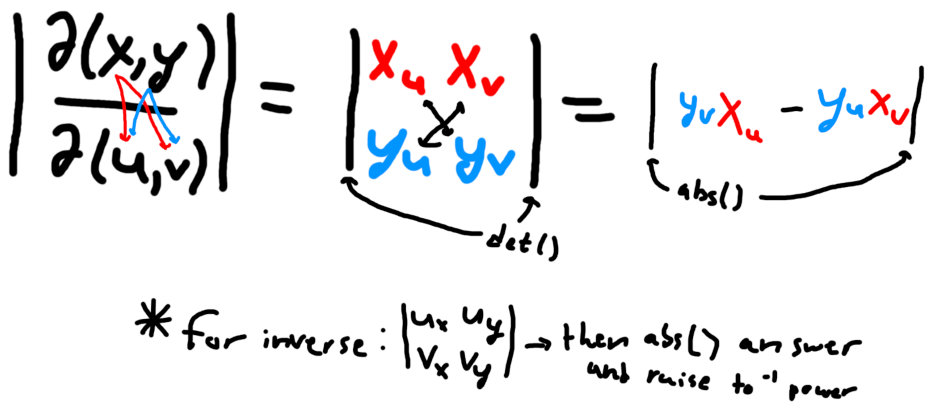
for change of variables & the jacobian scaling factor make sure to look at questions where it’s like x/y = u and stuff like that