part 3 - behaviour and strategies of firms
 Call Kai
 Learn
Learn Practice Test
 Spaced Repetition
 Match
Match Flashcards
 Knowt Play
1/47

There's no tags or description
Looks like no tags are added yet.
Name | Mastery | Learn | Test | Matching | Spaced | Call with Kai | Chat |
|---|
No analytics yet
Send a link to your students to track their progress
48 Terms
market structures and their impact on willingness and ability of firms to enact different strategies
willingness depends on degree of information and threat of competition to implement any one strategy
ability depends on the long run profits of firms and the barriers to entry
a firm will need both willingness and ability before it chooses to implement any one strategy
perfect competition
with perfect information in the market, any strategy that a firm implement can be easily copied by another firm ⇒ no willingness to enact any strategy, since any supernormal profits in the short run will be quickly eradicated
a perfectly competitive firm is a price-taker who follows the market price ⇒ many price strategies are irrelevant to the firm
with no barriers to entry, perfectly competitive firms will earn normal profits in the long run ⇒ no ability to fund many strategies
monopolistic competition
with imperfect information in the market, any strategy implemented is less easily copied by another firm, as compared to perfect competition ⇒ some willingness to enact certain strategies, as supernormal profits in the short run can be preserved for a period of time
with low barriers to entry, monopolistically competitive firms will earn normal profits in the long run → supernormal profits only possible in the short run ⇒ little ability to fund many strategies
oligopoly
with imperfect information in the market, any strategy implemented is not easily copied by other firms + with only a few close rivals that are mutually interdependent, oligopolistic firms often implement strategies to gain market share over their competitors, or to block new competitors from entering ⇒ very high willingness to enact strategies to increase their supernormal profits
with high barriers to entry, oligopolistic firms can keep their supernormal profits in the long run ⇒ high ability to fund many of their strategies
monopoly
with imperfect information in the market, any strategy that a monopoly implements will not be easily copied by another
firmas the dominant firm selling a unique product in the market, the monopolist has little willingness to enact strategies, since these usually will incur costs but does little to make them any more dominant in the market
a monopolist may still have a high willingness to enact some of these strategies if the threat of potential competition is high → the market is contestable
with very high barriers to entry, monopolists can preserve their supernormal profits in the long run ⇒ high ability to fund many of their strategies
contestability of markets
contestable market: one where the threat of potential entry exists due to the ease of entering and exiting the industry
if market is contestable, a firm with few/no existing rivals will behave as if it has a lot of rivals
degree of contestability of a market influences the behaviour of incumbent (existing) firms → their demand is affected by the current state of the industry, and also by potential entrants to the industry in future periods
firms are concerned with maximising overall profits in the long term and hence, they have to pay attention to the contestability of the market
level of barriers to entry → contestability of markets
barriers to entry prevent new firms from entering a market despite the incentive to do so
higher barriers to entry, lower contestability
if there are low barriers to entry, a new firm can easily enter a market to compete with incumbent firms when a supernormal profit opportunity arises
level of barriers to exit → contestability of markets
barriers to exit refer to any restriction that prevents a firm from leaving a market
higher barriers to exit, lower contestability
barrier to exit: whether firms are able to reallocate resources to alternative uses if it chooses to leave an industry ⇒ depends on how much of the resources allocated to production of a certain product can be reallocated
if the capital that was acquired when entering the industry can be sold or used elsewhere, the exit cost will be low, and an entrant can leave the market easily → new firms will therefore be more willing to take the risks of entry
if the capital that was acquired is highly specialised and cannot be sold or used elsewhere, the exit cost may be high, and an entrant cannot leave the market without incurring additional cost → new firms will therefore be less willing to take the risk of entry
ability of potential entrants to overcome barriers to entry and exit → contestability of markets
despite having high barriers to entry and/or exit, a market can still be contestable if there are potential entrants willing and able to overcome the barriers
competitive price strategies: limit pricing and predatory pricing
both are competitive price strategies where a firm charges a price below the profit maximising level
different intents:
limit pricing → keeps potential entrants out (entry deterrence)
predatory pricing → driving out current competitors (market share dominance)
how they work
when a firm sets its price at the profit-maximising level (where MC=MR), this price may be high enough for potential entrants and current rivals to cover their costs and survive ⇒ the firm charges a lower price to achieve its goal of entry deterrence (limit pricing) or market share dominance (predatory pricing)
both will lead to lower profits or possible subnormal profits in the short run
if the firm practising limit pricing succeeds in deterring entrants, it can retain its market share and return to charging high prices that maximise profits in the long run
if the firm practising predatory pricing succeeds in driving out its competitors, it will increase its market share and have fewer substitutes, thus achieving its goal of market share dominance → the higher market power it then enjoys (higher and more price inelastic demand), allows it to charge higher prices in the long run to earn larger supernormal profits
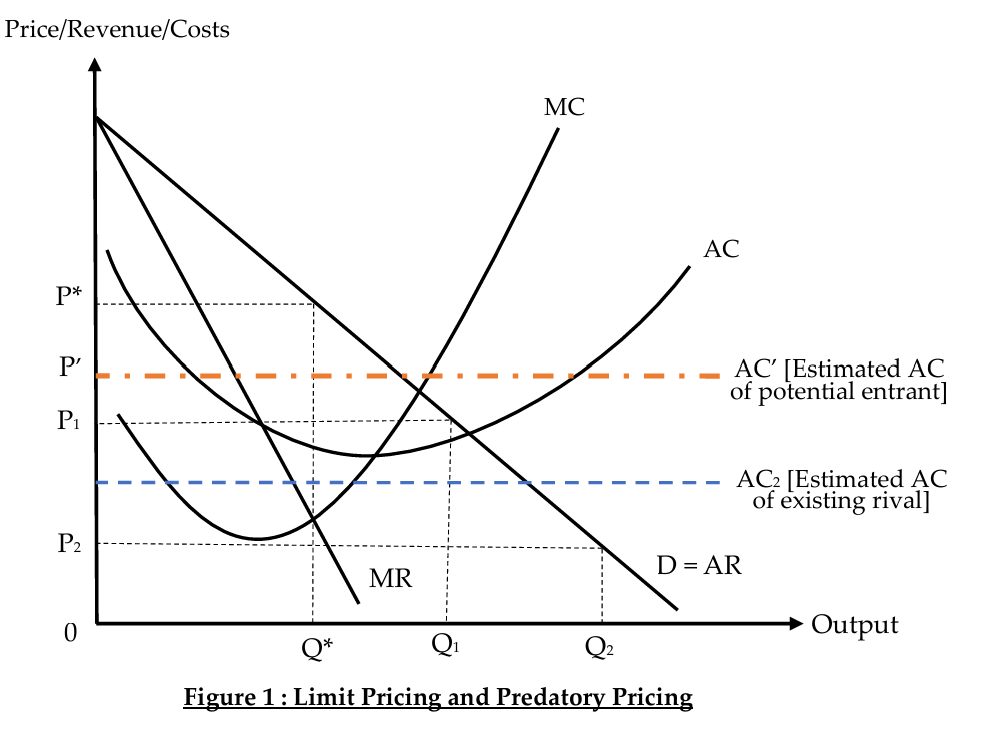
limit pricing → potential entrants are unable to cover costs (how they work)
involves reducing the price the firm charges to below the estimated average costs of the potential entrant (short-run profit maximising level) to deter potential entrants, so that they are unable to break even to survive if they enter the market
the limit price is set below the normal profit maximising price
the monopolist is charging a price lower than the estimated
AC for a potent rivalin figure 1, the profit maximising price is P* and the estimated AC of a potential entrant is at AC’ which means if the firm still charges P*, it will be profitable for the new firm
with limit pricing, the firm can charge a price below P’ such as P1 and still earn supernormal profit, as it is willing to sacrifice some profits in the short run to prevent entry
predatory pricing → current rivals are unable to cover costs (how they work
involves reducing the price the firm charges to below the estimated average costs of current rivals (short-run profit
maximising level) to drive out current competitors, so that they are unable to break even and will thus leave the marketin figure 1, the firm may have estimated the AC of rival firms at AC2 and charge a predatory price at P2 so that consumers will switch away from its rival
in practice, predatory pricing is illegal and courts generally requires a price to be set below a specific measure of the seller's cost, typically average variable cost or average total cost
imperfect information → limitations of limit pricing and predatory pricing
wrongly estimating the average costs of the potential entrant or current rivals will render these competitive pricing strategies ineffective
lack of information may thus result in insufficient lowering of prices resulting in the potential entrant being able to make at least normal profits by entering, hence limit pricing fails in the goal of deterring entry
in the case of predatory pricing, the strategy fails in driving out competitors as rivals would still be able to continue making at least normal profits
the existing firm may underestimate the ability of potential entrant or current rivals in sustaining subnormal profits in the short run
a large firm may be willing to enter a market if it is able to use its reserves to subsidise a loss-making entry.
reduction of profits and ability to bear subnormal profits in the short run → limitations of limit pricing and predatory pricing
a successful implementation of both limit and predatory pricing means that profit levels will decrease, at least in the short run, since the firm will not be producing at the profit maximising price and output
if the strategy requires the firm to lower prices such that it earns subnormal profits in the short run, it will need to have past accumulated supernormal profits or fresh funding from the
entrepreneurthe firm must be able to bear subnormal profits for a long enough time to deter entry or drive its rivals out
inability to do so will render the strategy unsuccessful and the status quo will be re-established quickly once prices return to their original levels
closeness of substitutes with rival’s products → limitations of predatory pricing
in order to decrease the market share and thus revenue of rival firms, the products must be close substitutes so that the magnitude of cross elasticity of demand between the two goods is large and the decrease in price will result in a more than proportionate decrease in demand for the rival’s product
more effective if XED is positive and large
if the two products are not close substitutes, either due to real or perceived differences, consumers will not be responsive to the change in price and hence the firm will not be able to erode the market share of its rivals successfully
price war→ limitations of predatory pricing
competitors may, instead of merely matching the initial price reduction, retaliate by cutting prices even further and trigger successive rounds of price cuts ⇒ price war
may be detrimental to all the firms as heavy losses are incurred throughout the market
when a price war happens, not only does the firm incur losses, it may also fail to gain any meaningful increase in market share after the dust settles and all competitors are still present
government intervention → limitations of predatory pricing
regulatory bodies are on the constant lookout for instances of predatory pricing which may result in the market becoming less competitive and the winner having significant market power that is detrimental to the consumers when prices are eventually increased to reap even greater supernormal profits
the government may step in when it detects such activities to heavily fine and stop the offending firm, or even enact regulation that prevents the firm from increasing prices, thereafter, resulting in the firm incurring the cost of the fine or earning lower profits in the long run
price discrimination
price discrimination refers to the practice of a firm charging different prices for an identical product to different buyers for reasons not associated with differences in cost → allows the firm to earn higher revenue and profits
third degree price discrimination occurs when different groups of buyers are charged different prices for the exact same good, but not because of cost differences
the firm must be a price setter → conditions for 3rd degree price discrimination
price discrimination is only possible for price-setting firms that are able to set the price for its own product
price discrimination is not possible in perfect competition, where firms are price-takers
the firm must be able to identify different market segments with different price elasticities of demand → conditions for 3rd degree price discrimination
to price discriminate effectively, the firm must be able to identify and separate the consumers ⇒ done by gender, income, age, geographical location, usage patterns etc
to enable the firm to price discriminate, the different groups of consumers must have different price elasticities of demand →
allows the firm to charge higher prices for buyers with less price elastic demand
increase in price leads to a less than proportionate decrease in quantity demanded
the gain in revenue from selling at higher prices outweighs the loss in revenue from selling lower quantities ⇒ revenue increases
allows the firm to charge lower prices for buyers with more price elastic demand
decrease in price leads to a more than proportionate increase in quantity demanded
the gain in revenue from higher quantities outweighs the loss in revenue from selling at lower prices ⇒ revenue increases
allows the firm to increase total revenue and profits, ceteris paribus
there must be no or very limited seepage or resale between buyers or market segments → conditions for 3rd degree price discrimination
buyers in the market segment where the price is lower must not be able to resell it to buyers in the market segment where the price is higher ⇒ arbitrage must be effectively prevented
how price discrimination works
buyers in the market are segmented into two or more sub-markets, and different prices are charged for each segment
a higher price is charged in the sub-market where the demand is more price inelastic → consumers in this sub-market are less sensitive to a rise in prices and will reduce quantity demanded less than proportionally
since revenue is price times quantity, the gain in revenue from the higher prices will outweigh the
loss in revenue from the fall in quantity ⇒ result in higher revenue from the sub-market with price inelastic demand
a lower price is charged in the sub-market where the demand is price elastic → consumers in this sub-market are very sensitive to a fall in price and will increase quantity demanded more than proportionally
since revenue is price x quantity, the decrease in revenue from the lower prices will be less than the
gain in revenue from the increase in quantity ⇒ result in higher revenue from the sub-market with price elastic demand
the result is a higher revenue and therefore higher profits for the firm than when a uniform price is charged
limitations of price discrimination
ability to segment the market
if the firm is unable to segment and identify consumers accurately, it will not be able to charge a higher price to consumers with the more price inelastic demand, resulting in the firm being unable to earn higher revenue
seepage/arbitrage
in reality, complete prevention of seepage and resale is almost impossible → success of price discrimination is therefore dependent on setting up sufficient systems to prevent exploitation and staying one step ahead of consumers ⇒ requires additional monitoring costs
cost of implementation
there are costs involved in ensuring that the 3 conditions are satisfied, including market research to segment the market, conducting checks on consumers to prevent resale and setting up specialised technologies to monitor pricing in the market ⇒ will reduce the profits that firm earns and may result in price discrimination causing profits to fall instead
non-price strategies to increase revenue → product differentiation
when one firm’s product is sufficiently different from its rivals’ to allow it to raise the price of the product without all customers switching to the rivals’ products. such differences can be real or imaginary.
aim: further develop or highlight the differences between the products of a firm and its rivals ⇒ firms can potentially enjoy greater market share and market power by catering more to the needs of consumers
the key differences that firms can work on would typically involve enhancing real and imaginary differences between the firm’s and its rival’s products
imaginary differences: through advertising → persuasive language/celebrity endorsement
how product differentiation works
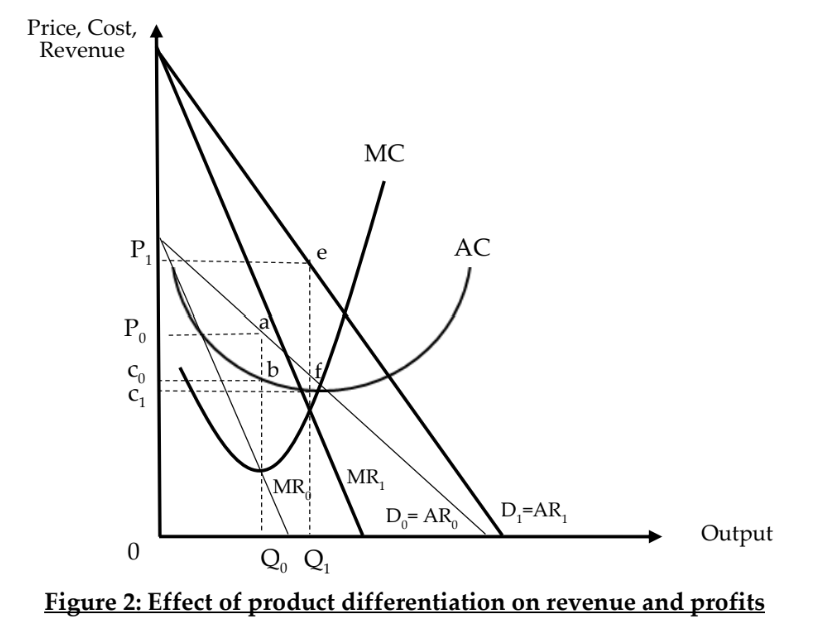
product differentiation will allow a firm’s product to better meet the taste and preferences of consumers, therefore potentially increasing the demand for the firm’s products → demand curve shifts right
product differentiation will also decrease the substitutability of the firm’s product from its rivals, therefore making the demand for the firm’s product less price-elastic → demand curve is steeper
represented by an outward shift of the demand curve from D0 to D1
assuming cost remain constant, the profit maximising level of output where MC = MR will increase from Q0 to Q1 and the profit maximising price will increase from P0 to P1
this results in an increase in total revenue from P0aQ00 to P1eQ10
this may therefore allow the firm to earn higher profits from P0abc0 to P1efc1
limitations of product differentiation
high cost
engaging in product differentiation can be a costly strategy when the firm focuses on major changes to its products, such as technological upgrades
firms require funding for product differentiation, and these
typically come from accumulated supernormal profits or fresh funding from investorsa lack of funding will therefore result in product differentiation being unsustainable, or firms only engaging in cheaper innovation that do not sufficiently decrease the substitutability of its product from rival firms
lack of certainty in outcome
there is no guarantee of success in R&D and firms may not be able to develop any meaningful products or technologies to improve its products ⇒ many things can go wrong during the research phase
this could result in a waste of resources
reaction of rival firms
in market structures like oligopoly, where there is mutual interdependence between firms, attempts at product differentiation will not go unanswered by rival firms who are likely to retaliate with their own attempts to differentiate their
products, therefore eroding the impact of each firm’s actionreaction of rival firms can also be seen in technological firms, where every firm spends large amounts on research and development
firms who are unable to protect the information gained from research and development will find itself vulnerable to copycats
rival firms who gain access to these new technologies developed by the firm will be able to produce products that also possess the same features, without having to incur any R&D cost
when every firm offers similar products, there will be no increase to the market power of the firm that made the
initial investments into product differentiation and hence no increase in revenue or profits
non-price strategies to increase revenue: applying cognitive biases
firms may also account for cognitive biases of consumers in their strategies ⇒ increase their revenue and profits assuming costs stay constant
sunk cost fallacy: arises when a person’s decision is affected by fixed costs rather than marginal costs
one way firms take advantage of this: upselling
loss aversion: refers to the tendency for people to prefer avoiding a loss over making an equivalent or greater gain
one way firms take advantage: offering free trial periods to gain more customers, closing down sales
saliency bias: tendency for people to focus on information that is more prominent and over other less prominent but equally relevant pieces of information
non-price strategies to reduce costs: process innovation
the development of new technologies or more efficient production methods which reduces the average cost of production
how it works:
by engaging in R&D on improvements in technology or efficiency in production processes, the firm may be able to lower its average cost of production and therefore earn higher profits
process innovation can result in a decrease in the marginal cost of production ⇒ both AC and MC decreases → downward shift of the AC and MC curves from AC0 to AC1 and MC0 to MC1
profit maximising level of output and price changes from P0 to P1 and Q0 to Q1
level of supernormal profits increases from P0abc0 to P1efc1

limitations of process innovation
extremely high cost and low certainty of outcome → similar to product differentiation
collusion
an agreement among rival firms not to engage in price competition or other kinds of competitive activities that could reduce their individual profits
firms need to make the decision between competing and colluding → cannot do both simultaneously in a single market
most types of price and non-price competition would be less useful to increase a firm’s profits when all firms engage in it at the same time
two types of collusion: formal collusion (cartel) and tacit collusion
collusion is more likely when
the market is more concentrated → there are few firms
extent of product differentiation is low
there is a clear market leader
formal collusion → cartel
the organisation that results from a formal agreement among firms to collude
in this case, they behave like a joint monopoly
a cartel reduces the level of uncertainty for producers faced with competition from rivals
as producers jointly agree on price and/or output levels, the model used to analyse the price and output decisions of a cartel is the same as that used to analyse a monopoly
e.g.: the Organisation of Petroleum Exporting Countries (OPEC), which was originally founded by Iran, Iraq, Kuwait, Saudi Arabia and Venezuela in 1960
now consists of a total of 11 countries including the founding member and Algeria, Equatorial Guinea, Gabon, Libya, Nigeria and the Republic of the Congo. [Ecuador, Indonesia, Qatar and United Arabs Emirates (UAE) are former OPEC members]
OPEC is a unique example of an oligopoly because it is
not a collusion of firms but rather cross-border cooperation between countries by firms that are controlled by the state
how formal collusion works
when all producers agree to work together, or when a sufficient number of producers come together such that they represent an overwhelming majority in the market, the cartel will act as one large monopoly and adopt the demand, revenue and cost of a monopoly
the cartel will produce at the profit maximising level of output and price, Q* and P*, earning supernormal profits of P*abc.
the cartel will enjoy greater market power as firms are no longer competing as substitutes to each other
this will allow the cartel to limit output and set higher prices, allowing the cartel to earn higher profits overall
firms in the cartel will then have to split the profit maximising level of output Q* among themselves to determine how much each firm will produce
can be done by assigning output proportionate to each firm’s current market share such that each firm should, in theory, enjoy higher profits than if it operated on its own
firms will also enjoy cost savings from a reduction in product differentiation and process innovation activities since colluding as a cartel implies that firms are no longer competing with one another

benefits of formal collusion
increased revenue: collusion enables cartels to act like a monopoly, restricting output when driving up prices
assuming demand is price inelastic, a rise in prices would lead to a less than proportionate fall in quantity demanded, ceteris paribus
this will lead to higher revenues and maximisation of joint profits of the cartel
they can avoid price wars that will likely reduce everyone’s revenue
reduced costs
colluding firms enjoy savings on advertising and marketing costs since they no longer have to compete with one another ⇒ lower costs
less uncertainty
as firms in a cartel collude and agree on the price and output, they experience less uncertainty
incentive to deviate from the agreement → limitations of formal collusions
individual firms in a cartel will have a strong incentive to cheat in order to generate higher profits for themselves
with the agreement or a cartel in place, firms will plan to decrease output collectively so as to charge higher prices and earn higher profits as a whole
an individual firm will be incentivised to:
increase its own output to sell a higher quantity at the higher price and earn higher revenue and thus profits
decrease its own price to attract consumers to switch over to its products and thus earn higher revenue and thus profits
many conditions for the successful formation of a cartel → limitations of formal collusions
there are many conditions that are necessary for the successful formation of a cartel → if the conditions are not met, there is a high chance the cartel will collapse
there are only very few firms, all well known to each other
generally, the smaller the number of firms, the easier it is to coordinate production and arrive at agreements
easier to monitor and prevent deviation
they have similar production methods and average cost
ensures that the firms are likely to charge the same cartel price which is higher than their average cost, with no firm ending up with subnormal profits due to the arrangements
they produce similar products
with differentiated products, it is more difficult to come to an agreement over a common price as firms will face very different costs and demands for their goods
with similar products, agreements on price become easier
there is a dominant firm
ensures that there is a central coordinator to the discussions on price and output, and there will be significant penalties should a firm decide to deviate from the agreements
the dominant firm will be able to increase output or decrease price such that firms who cheat are punished in terms of profits
there are significant barriers to entry
as the cartel acts as a monopoly and likely earns larger supernormal profits, there will be incentive for new entrants
to enter the market and earn the same supernormal profitsthere needs to be sufficient barriers to entry such that the cartel’s decisions cannot be undermined by new entrants
there are no government measures to curb collusion
collusive behaviour is anti-competitive and will lead to higher prices and lower output, negatively impacting consumer welfare
there are government rules and regulations in place to prevent the formation of cartels → in singapore, these are enforced by the Competition and Consumer Commission of Singapore (CCCS)
tacit collusion
a form of collusion where unspoken understandings among competing firms in an industry exist. one such example is where there is a dominant firm price leadership
there may be unwritten ‘rules’ of collusive behaviour, such as in advertising (e.g. you do not criticise other firms’ products,
only praise your own), the design of the product (e.g. lighting manufacturers tacitly agreeing not to bring out an everlasting light bulb) or price leadershipthere are no formal agreements in place, tacit collusion is difficult to track and even harder to regulate ⇒ firms may collude without fear of repercussions from the government
price leadership
a price leader emerges in the industry to set the general industry price while the other firms follow suit
dominant firm price leadership
follower firms set the same price as an established leader in the industry, such as the largest firm that dominates the industry
how it works
by informally following a price leader, firms will set similar prices and restrict output such that the monopoly price and output is achieved, just like in formal collusions
if successful, the benefits enjoyed by firms in tacit collusions would be similar to that in formal collusions
limitations of tacit collusion
lack of information
with formal collusion, members can work together to share information on cost and set a price and output which maximises the overall profit of the industry and benefits all member firms.
with price leadership, firms are unable to do so, and the price leader will need to either estimate the likely cost of fellow firms (do not have accurate information), or simply through luck, get a good gauge of the average ⇒ firms lack essential information on each other’s cost to informally agree on a price to set (determine industry profit-maximising level of price and output)
incentive to deviate
without a formal agreement in place, firms will find it difficult to punish a firm who deviates from the agreed prices. Hence, tacit collusion is prone to breaking apart
internal growth: diversification
internal growth/expansion: an increase in the firm’s productive capacity. the firm may grow by diversification into related products or new products
diversification: the development and production of a wider range of different products, beyond a firm’s initial market
by pursuing diversification, a firm develops new products that allows it to cater to different markets
how diversification works
allows the firm to enter new markets and generate new sources of revenue
by providing a wider range of products, the firm is able to cater to the different tastes and preferences of consumers and therefore capture a larger demand and earn higher revenue and profits as a whole
especially useful when the firm reaches its maximum size in one market and is no longer able to grow further and generate further increases in profits
in the long run, diversification can help a firm spread risks and increase its overall brand loyalty, thus increasing its demand and makes it more price inelastic, increasing its revenue and hence profits
lowered business risk
allows the firm to spread risks and become more resilient to shocks in the market → less subject to the forces of market demand and supply of any one market, and hence fluctuations in revenue and costs and hence profits
a firm producing a single product in a single market is vulnerable to changes in that market’s demand and supply conditions while a firm who produces multiple products in different markets can cover losses in one market with profits from anothe
increased brand loyalty
firms can diversify into products that are complements to each other, to build up an ecosystem of products which cater to the different needs of a consumer → e.g. Apple
consumers who are plugged into such an ecosystem of products will be less willing to change to another rival firm for any product as these substitutes may be incompatible with the current ecosystem
the increased brand loyalty would convert to increased market power and allow the firm to earn higher revenue and hence profits in every single product market
limitations of diversification
high cost
to develop new products and enter new markets, the firm will have to conduct extensive research on the new markets they seek to enter, and hence incur large set-up and innovation cost to develop new products in markets that are new to
themfirms will have to finance this through accumulated supernormal profits or fresh funding from investors ⇒ not a cheap strategy to implement
cannibalisation of existing product lines
new markets and product lines may replace existing products in terms of function
the introduction of new products by the firm will result in a decrease in demand and market power in existing markets, causing a fall in revenue from existing markets → the strategy may therefore not result in an actual increase in overall revenue and hence profits
external growth: mergers and acquisitions
external growth/expansion: growth through mergers and acquisitions
merger: where a firm joins with one or more existing firms to form a larger firm
firms’ assets are combined into a single firm, expanding the productive capacity of the firm
horizontal merger
horizontal merger: a situation where two or more firms that are producing the same product, combine to form a single entity
vertical merger
a situation where a firm in one stage of production combines with a firm in another stage of production → can be forward or backward
forward integration: when a firm integrates with another firm in the next stage of production
backward integration: when a firm buys over a firm in an earlier stage of production
conglomerate merger
conglomerate merger: a situation where a firm merges or acquires another firm from an unrelated industry (i.e. the firms are not directly related).
one way that firms can pursue diversification
how do mergers work
many firms are motivated to grow in size for profitability by increasing revenue and/or reducing costs
horizontal mergers may:
increase revenue by increasing market power through a reduction in number of competitors → demand can increase and become more price inelastic
reduce cost of production by increasing joint production capacity and achieve economies of scale
vertical mergers may:
increase revenue by:
increasing control over production inputs to improve product differentiation
increasing control over production inputs to restrict the availability of such supplies to rival firms so as to increase market power → demand can increase and become more price inelastic
reduce cost of production by:
allowing the firm to combine multiple stages of a production processes to reap technical economies of scale among others
increasing control over production inputs to reduce the cost of securing inputs through dealers or middlemen
conglomerate merger may
increase sources of revenue from different markets to increase overall profits
allow bigger firms to enjoy lower risk and greater stability by diversifying over a range of products and markets
limitations to mergers
legal limits to growth
regulators are on the constant lookout for firms which have grown excessively large → prevent firms from achieving excessive market power that may be detrimental to society
this remains a normative issue in singapore and there is no specific cap on the size of a firm
if the merger results in a market share of 40% and above, or if the merger results in the 3-firm concentration ratio to be at or above 0.7, the merger will have to be reported to CCCS for review
financial constraint
growth of firms is limited by the ability of the firm to raise funds to buy another firm over
firms require funding if it intends to acquire other firms
beyond the acquisition fees, there are likely to be significant legal and administrative fees as well
diseconomies of scale
beyond a limit, the minimum efficient scale (MES) of the LRAC curve, internal economies of scale are fully exhausted and internal diseconomies of scale set in
firms who grow beyond the MES will experience internal diseconomies of scale, experiencing greater average cost and
decreased profits ⇒ firms should not aim to grow beyond the scale of production where MES is achieved
why small firms exist
revenue (demand-side) reasons
nature of product: industries that provide more customised and specialised goods and services tend to be made up of small firms
the need for customisation and specialisation according to the unique needs of each consumer makes thed emand for each firm low, thus limiting the scope for expansion.
in prestige markets where exclusivity is a major factor influencing taste and preferences, firms keep output
low to charge premium pricesbeing small allows control over quality such that the highest quality can be achieved, which again allows the firm to charge premium prices
geographical limitation: demand for a firm can also be limited due to geographical reasons
cost (supply-side) reasons
limited internal economies of scale: not all types of production can or desire to achieve internal economies of scale
the fundamental prerequisite for internal economies of scale is a large market that allows for mass production
firms with limited internal economies of scale will not enjoy significant cost savings compared to a potential new entrant
without this cost-saving advantage, this reduces the barriers to entry of new firms and they will enter the
industry when attracted by presence of supernormal profitsthe higher level of competition because of the lower barriers to entry will cause firms to remain small
high transport costs: a conventional explanation for why many firms producing perishables (e.g. food products) or bulky products (e.g. bricks) remain small
based on the observation that transport cost would be very high for these products to be delivered to distant markets
makes it unprofitable for the producers to sell their products to larger markets, and thus limiting the size of firms