Lipids
 Call Kai
 Learn
 Practice Test
 Spaced Repetition
 Match
 Flashcards
 Knowt Play
1/13

There's no tags or description
Looks like no tags are added yet.
14 Terms
Lipids
Nonpolar and Hydrophobic (contain primarily hydrocarbon regions)
Amphipathic Molecule
Has both hydrophilic and hydrophobic components
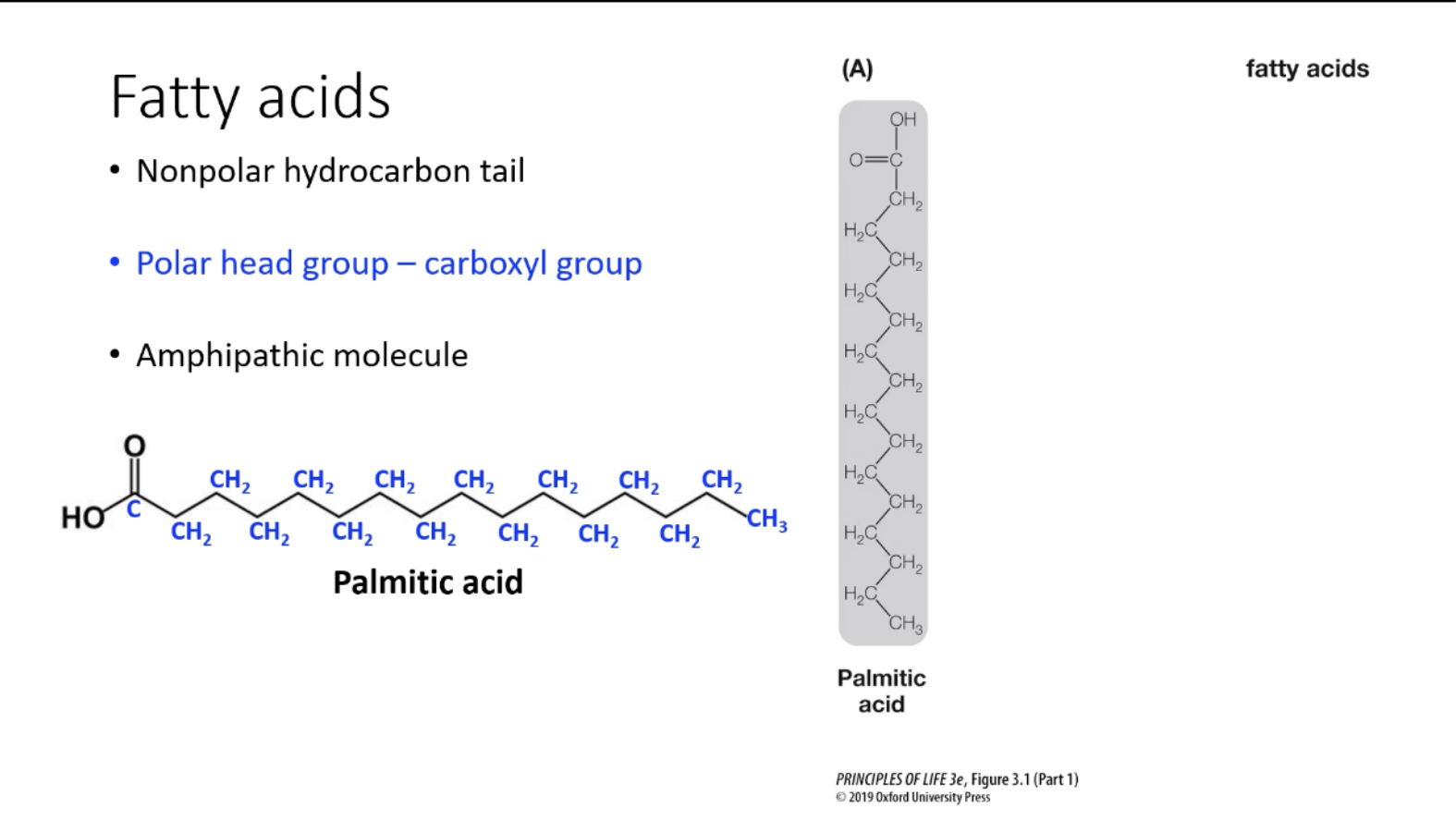
Fatty Acid
Carboxyl group (polar head) attached to a long nonpolar hydrocarbon chain (tail).
Amphipathic: Serves as the building block for triglycerides and phospholipids.
Triglyceride
1 Glycerol (3-carbon alcohol with 3 hydroxyl groups) + 3 Fatty Acids.
Energy Storage: HIGHLY COMPACT AND HYDROPHOBIC. Formed via 3 dehydration reactions

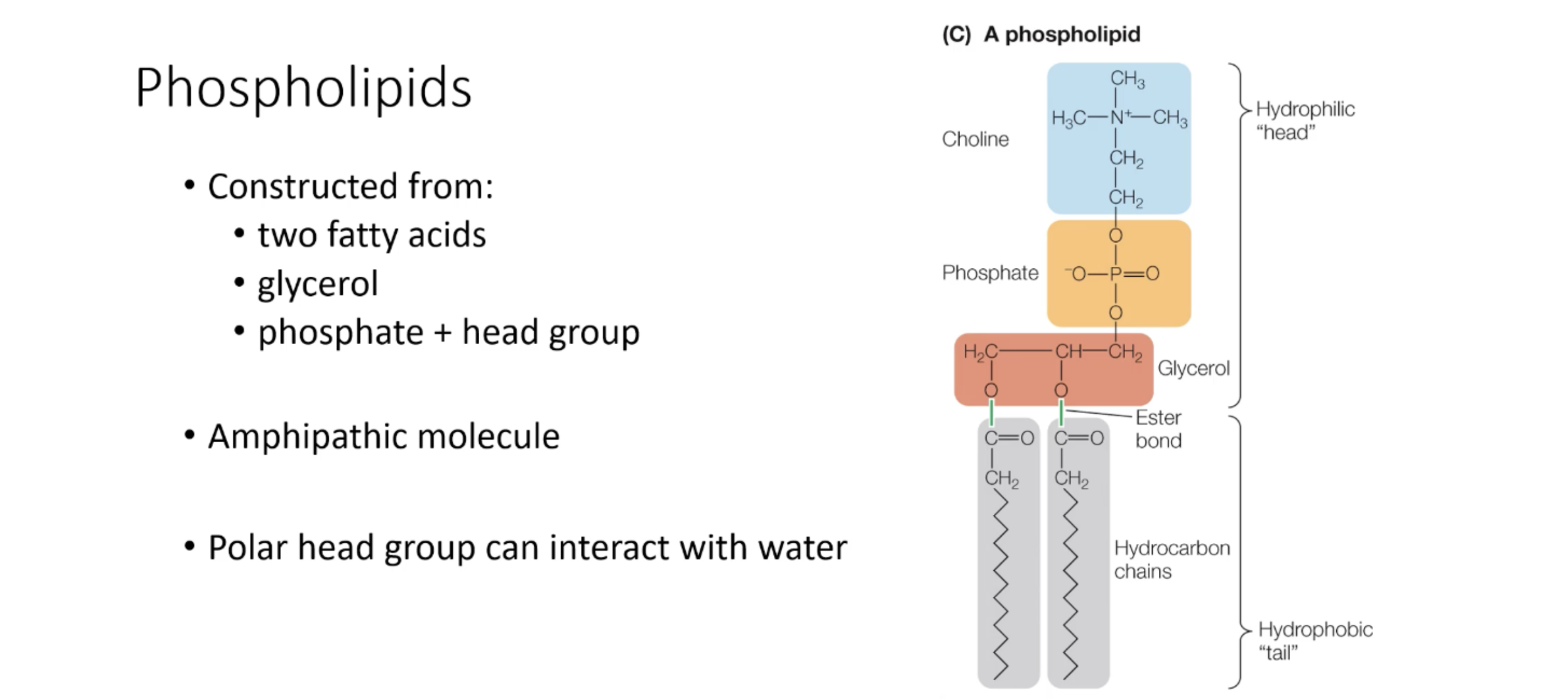
Phospholipid
1 Glycerol + 2 Fatty Acids + 1 Phosphate group (bound to a polar/charged head group).
Amphipathic: Polar head interacts with water; nonpolar tails avoid water. Spontaneously forms a lipid bilayer/sphere in aqueous environments, forming cell membranes.
Saturated Fats
Contain no C=C double bonds in the hydrocarbon tail (saturated with hydrogen atoms).
Straight hydrocarbon tails pack tightly and uniformly via van der Waals interactions.
Solid at room temperature due to higher melting points.
Unsaturated Fatty Acids
Contain one (monounsaturated) or multiple (polyunsaturated) C=C double bonds.
Cis-isomers: Hydrogens attached to the double-bonded carbons are on the same side, introducing a "kink" or bend in the tail that prevents tight packing. Liquid at room temperature (lower melting point).
Trans-isomers: Hydrogens are on opposite sides. Synthesized via partial hydrogenation, causing double bonds to lose their natural bend and behave more like saturated fats.
Fluid Mosaic Model
Where proteins and lipids move laterally within a semi-solid fluid structure. Membrane proteins are categorized by how they interact with the lipid bilayer
Integral Membrane Proteins:
Partially or fully embedded in the lipid bilayer (e.g., transmembrane proteins that span the entire membrane).
Amino Acid Interaction: Regions embedded within the hydrophobic core are rich in nonpolar (hydrophobic) amino acid side chains to interact with the nonpolar hydrocarbon tails. Regions exposed to the intracellular/extracellular aqueous environment consist of polar or charged amino acids.
Transmembrane proteins - span the entire lipid bilayer
Peripheral Membrane Proteins
Associated only with the hydrophilic polar head groups on either the interior or exterior face of the membrane.
Bound non-covalently through hydrogen bonds and ionic interactions.
Anchored Membrane Proteins
Covalently attached to a lipid molecule, which is itself inserted directly into the hydrophobic core of the bilayer.
Regulation of Membrane Fluidity by Fatty Acids (Saturated Fatty Acids)
Decrease Fluidity / Increase Rigidity: Straight tails pack densely with uniform van der Waals interactions, stabilizing the membrane at high temperatures.
Regulation of Membrane Fluidity by Fatty Acids (Unsaturated Fatty Acids)
Increase Fluidity / Prevent Solidification: Kinked cis-double bonds disrupt uniform packing, maintaining fluidity at lower temperatures.
Regulation of Membrane Fluidity by Cholesterol
Cholesterol is a steroid (characterized by a four-fused-carbon ring structure) present within the cell membrane that acts as a temperature buffer or fluidity buffer:
At Moderate/High Temperatures: Cholesterol inserts between fluid, unsaturated fatty acid chains and restricts their movement, reducing membrane fluidity.
At Low Temperatures: Cholesterol inserts between tightly packed, saturated fatty acid tails, disrupting their uniform packing and increasing membrane fluidity (hindering solidification).