Anatomy & Physiology: Biology, Cells, Chemistry, and Homeostasis
 Call Kai
 Learn
 Practice Test
 Spaced Repetition
 Match
 Flashcards
 Knowt Play
1/207

There's no tags or description
Looks like no tags are added yet.
208 Terms
The scientific discipline that deals with the processes or functions of living organisms is:
Physiology
The chemical level of organization:
Atoms can combine and form molecules with complex shapes
__________ refers the ability of an organism to sense changes in the environment and make the adjustments needed to help maintain its life.
responsiveness
Which of the following is the smallest?
1) mitochondria
2) water molecule
3) fat cell
4) cell membrane
5) liver
Water Molecule
How many of the following systems and their organs are correctly identified?
Respiratory system: pharynx, larynx, and trachea
Digestive system: large intestine, liver, and esophagus
Cardiovascular system: heart, thymus gland, and spleen
2
Which of the following shows increasing complexity - simple to complex.
1) Cell : Tissue : Molecule : Organ : Organ System
2) Molecule: Cell : Tissue: Organ System : Organism
3) Tissue : Molecule: Organ System : Organism : Organ
4) Cell : Tissue : Molecule: Organism : Organ System
5) Molecule: Tissue : Cell : Organ System : Organism
2) Molecule: Cell : Tissue: Organ System : Organism
Two or more tissues working together to perform functions is a(n)
organ.
Which of these characteristics of life means "The ability to use energy to perform vital functions?"
1) metabolism
2) responsiveness
3) differentiation
4) growth
5) organization
metabolism
Body temperature "falls back to normal" after exercise due to ... (what process?)
Negative Feedback
The wrist is ___________ to the phalanges of the hand.
Proximal
The lungs are found in the ___ cavity, and the stomach is found in the ___ cavity.
thoracic / abdominal
Your nose is ____ to your knees
superior

Describe the image below using the most appropriate level of organization.
Tissue
"Cutting off your ear" would require cutting in the _____ plane.
Sagittal
How many of the following are examples of negative feedback homeostatic mechanisms?*
1) Susie was running outside and getting hot. Her effectors activated to remove heat.
2) Johnny was mushing his sled dogs across a frozen tundra and he was getting cold. His control center sent signals to his lower limbs for the circulation of blood to decrease.
3) Brenda ran up the stairs, and went into oxygen debt. Since her muscles were creating a great deal of CO2, the chemoreceptors in her aorta detected a change in acidity.
4) Cuthbert has extreme thirst, but no matter how much water he drinks, he is still thirsty.
5) Throckmorton loves movies. At a particularly scary movie, the screen became very bright. His irises (the opening in the eye that looks black) dilated (opened) to accommodate for the extra light.
2
What type of reaction is this?
HCl→ H+ + Cl-
Decomposition (catabolic) reaction
The mass number of an element is:
number of protons + number of neutrons
Surface Tension is...
The ability of water to stick together by hydrogen bonds.
It takes energy to break chemical bonds. Based on the following information, what is the weakest of the chemical bonds shown?*
NaCl is an ionic compound, and it's melting point is 801 degrees C.
HDPE is a covalent non-polar compound used to make plastic bottles for liquids such as milk.
Water has a melting point of 0 degrees C.
hydrogen bond
Johnny has been stranded in the desert after a tragic runaway camel incident. He found shade, but he has no water. What body system will shut down and most likely kill Johnny if he does not find water soon?
Urinary System
In _________, the bond itself can be polar (electrons shared unequally).
Covalent Bond
Most humans can live for approximately ___ days without food and this is due to the large amounts energy stored in our __?
40 days / lipids
Charlie is 17 pounds overweight. Charlie wants to know how many pounds of oxygen he will need to use during exercise to "burn" those 17 pounds off. Train tracks for the correct solution would look like...
(17 pounds of fat)(454g fat/1 pounds of fat)(1 mol fat/860g fat)(78 mol O2/1 mol fat)(32g O2/1 mol O2)(1 pound O2/454g O2)
In an exergonic ("exothermic" is an example) reaction,
large molecules are broken down in to smaller ones.
DNA is a polymer (-mer/-mers = "pieces") made up of monomers (called nucleotides) which consist of which of the following 3 molecule types:
nitrogenous base, phosphate group, Deoxyribose
Excess consumption of a sugar such as fructose, will initially be stored as ____, but then, if not burned/consumed, will be converted into ____.
glycogen, fat
Steroids and cholesterol are_____
lipids
In the activity, "Biochemistry of Weight Loss," a question highlights a little know fact: when losing weight, where does the mass/weight go?
CO2
When insulin binds to its receptors on skeletal muscle cells, it triggers the insertion of GLUT (Glucose Transporter) proteins into the plasma membrane. Immediately after entering the cytoplasm, glucose is phosphorylated into Glucose-6-Phosphate (Enzyme/Reaction 1). How does this enzymatic conversion promote continuous glucose uptake into the cell?
Phosphorylation keeps intracellular free glucose concentration extremely low, maintaining a steep concentration gradient that drives continued facilitated diffusion of glucose into the cell.
Amino acids --> Proteins
Which ones are true for this process?
Catabolic
Anabolic
Inhibited by insulin
Example of a breakdown reaction
Stimulated by insulin
Example of tissue building
Stimulated by insulin
Example of tissue building
Anabolic

What happens to the quantity of GLUT under the influence of insulin?
Increases
The number and arrangement of electrons in an atom's outer energy level determine the atom's
chemical properties.
Under what specific condition(s) should a diabetic individual NOT administer a shot of insulin, and why?*
During periods of high fever or general illness, because administering the hormone can unpredictably complicate the body's natural immunological response.
When they have just consumed a large, carbohydrate-heavy meal, because the insulin will unfortunately not be effective enough to counter the immediate glucose spike.
During a state of hypoglycemia (low blood glucose, typically under 50 mg/dL) or when in the safe range, because administering the hormone would cause blood glucose to drop dangerously low.
After completing a strenuous physical workout, because the increased muscle activity makes the injected insulin metabolize too quickly for effective glucose uptake.
Immediately before an Oral Glucose Tolerance Test (OGTT), because the test measures the patient's natural, uninfluenced pancreatic function.
During a state of hypoglycemia (low blood glucose, typically under 50 mg/dL) or when in the safe range, because administering the hormone would cause blood glucose to drop dangerously low.
Pure water has a pH of 7.0. Blood is...
basic
Insulin promotes this reaction: Glucose --> glycogen* (True/False)
True
The amount of ______________ required to heat __________ of _______________ by _____________.
energy; 1 ml ; water; 1 degrees Celsius
The Golgi Apparatus is most analogous to...
a post office
The Ribosome is most analogous to...
A decoder ring
For every person, it is always a good idea to wear sunscreen when outside in the direct sun (True/False)
True
The four main functions of the cell are...
Get and use energy; make molecules; communication; make more cells
Anaerobic respiration takes place in the _____, whereas aerobic respiration takes place in the _____?
cytoplasm/mitochondria
Which cells would most likely have the largest number of mitochondria?
Muscle cells
What are the 3 parts of cell theory?
All living organisms are composed of one or more cells.
Cells are the basic unit of structure and organization in organisms.
Cells arise from pre-existing cells.
What does the term "black box" mean in science?
We know that something does something, but we do not know why.
What are the 5 characteristics of living things?
Responsiveness, Adaptability, growth, reproduction, and movement.
Define biology.
The study of life
What are the other 4 characteristics of living organisms that change based on the organism?
Respiration, Circulation, digestion, excretion.
Why is responsiveness important?
Organism recognizes changes in interal and external environment to adapt.
Why is adaptability important?
Changes the organism's behavior, capabilities, or structure.
Why are growth and development important?
Growth (an increase in size) and development (changes in structure and function) produce the characteristics of their species.
Why is reproduction important?
Sexual reproduction between two parents produces offspring with varied characteristics.
Define anatomy.
Study of internal and external structures of the body and the physical relationships among body parts.
What is the difference between microscopic and gross anatomy?
Microscopic anatomy: invisible to the naked eye; Gross anatomy: examinations of larger structures.

What cell is this
Smooth muscle cell

What cell is this?
Blood cell

What cell is this?
Bone cell

what cell is this?
Fat cell

What cell is this?
Reproductive cell
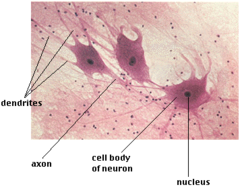
What cell is this
Nerve cell

What tissue is this
Simple squamous epithelium
What is the use of Epithelial tissue?
Covers and protects body surface, lines internal passageways, and produces glandular secretions.
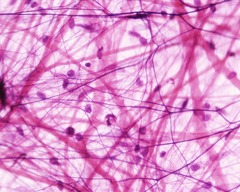
What is this tissue?
Connective tissue
What does connective tissue do?
Fills internal spaces, provides structural support, and stores energy

What tissue is this?
Skeletal muscle tissue
What does muscle tissue do?
Contracts forcefully -> movement

What tissue is this?
Nervous tissue
What does nervous tissue do?
Conducts electrical impulses, carries information
How are structure and function related?
structure determines function
Name the systems of the body.
Integumentary (skin)
Skeletal (Bone)
Muscular (Bicep)
Nervous (Brain)
Endocrine (Pituitary Gland)
Cardiovascular (Blood)
Lymphatic (Bone Marrow)
Respiratory (Lungs)
Digestive (Stomach)
Urinary (Bladder)
Reproductive (Ovaries)
Integumentary system's job
Protect against environmental hazards
Skeletal system's job
Provides support and protects tissues, forms blood cells.
Muscular system's job
Provide movement and heat
Nervous system's job
Directs immediate responses to stimuli
Endocrine system's job
Directs long-term changes in other systems
Cardiovascular system's job
Transports cells and dissolved materials
Lymphatic system's job
Defend against infection and disease
Respiratory system's job
Delivers oxygen to sites where gas exchange occurs between circulating blood.
Digestive system's job
Processes food and absorbs nutrients
Urinary system's job
Eliminate excess water, salts, and wastes
Reproductive system's (female) job
Produce sex cells and hormones, support embryonic development from fertilization to birth
Reproductive system's (male) job
Produce sex cells and hormones
Definition of homeostasis
The presence of a stable internal environment.
What can homeostatic control be compared to?
Air conditioning unit
What are the 3 necessary jobs for homeostatic regulation?
Receptor, control center, effector
What is the difference between negative and positive feedback?
Negative feedback minimizes change to maintain homeostasis; positive feedback accelerates the process to maintain homeostasis.
Definition of Eponym
A commemorative name for something, often named after the person who discovered it.
In which country was cadaver-based anatomy established
In Italy at the University of Bologna
What is the anatomical position?
A position where the hands are at the sides, facing up, and the feet are together. The person is described as supine when face up and prone when face down.
What does superior mean?
Above; at a higher level; toward the head
What does inferior mean?
Below; at a lower level; toward the feet
What does lateral mean?
Away from the midline
What does medial mean?
Toward the midline
What does proximal Mean?
Toward attached base/limb
What does distal mean?
Away from attachment base/limb
What does superficial mean?
Near/at the body surface
What does deep mean?
Toward the interior of the body; farther from the surface
What do posterior and dorsal mean?
Posterior: the back surface
Dorsal: the back
What do anterior and ventral mean?
Anterior: the front surface
Ventral: the belly side
What does cranial mean?
Towards the head
What does Caudal mean?
Towards the tail