Neural Development 1: Progressive
 Call Kai
 Learn
 Practice Test
 Spaced Repetition
 Match
 Flashcards
 Knowt Play
1/27

Earn XP
Description and Tags
*Review Chapter 7, pp. 195-205 1. Neurulation and the origin of the CNS 2. Neural crest and the origin of the PNS 3. Cell proliferation 4. Cell migration 5. Cell differentiation 6. Dendrogenesis 7. Axon outgrowth - Guidance mechanisms 8. Synaptogenesis
28 Terms
Cephalization
The development and concentration of nervous system structures at the anterior (head) end of the body, leading to the formation of the brain.

28 days after fertilization
The developing neural tube begins forming distinct regions of the brain.
Neuromeres
Classified under cephalization; Three initial swellings/segmented structures in the developing neural tube.

Prosencephalon
The forebrain that develops into structures such as the telencephalon and diencephalon in the vertebrate brain.

Mesencephalon
The midbrain that develops into structures such as the tectum and tegmentum, playing key roles in vision and hearing.

Rhombencephalon
The hindbrain that develops into structures such as the metencephalon and myelencephalon, which are crucial for autonomic functions and coordination.

42 days post fertilization
• Prosencephalon divides into Telencephalon and Diencephalon
• Rhombencephalon divides into Metencephalon and Myelencephalon.

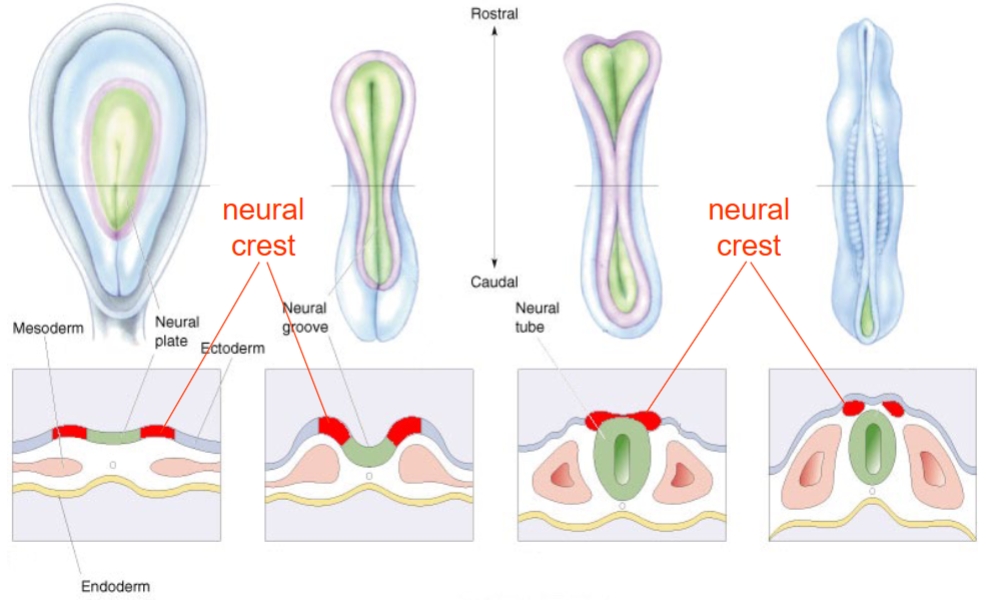
Neural Crest
A group of embryonic cells that forms along the edges of the developing neural plate and neural tube. These cells migrate to different parts of the body and develop into many structures of the PNS, including sensory and autonomic ganglia and parts of peripheral nerves.

Neural Crest Migration
In PNS, sheets of cells are pulled or pushed into place, aggregate into clusters (ganglia) using nCAMs.

Dorsal Route - Neural Crest Migration
Will become pigmented skin cells (purple)
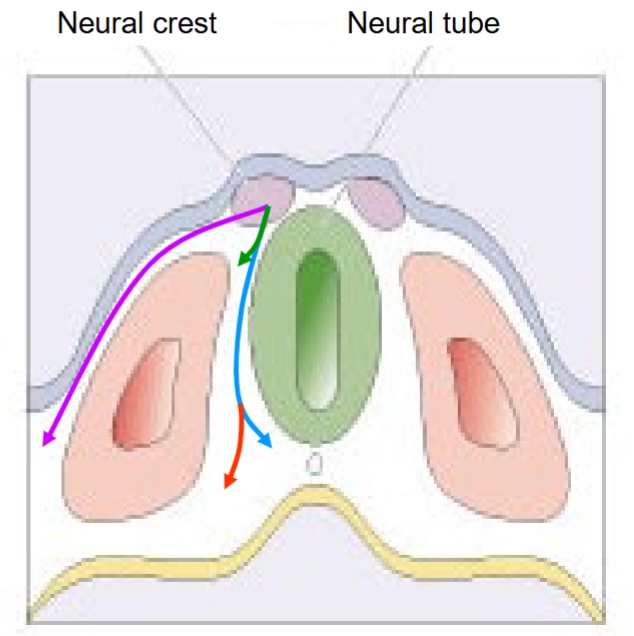
Ventral Route - Neural Crest Migration
Will become dorsal root (green), sympathetic (blue) ganglia, or parasympathetic (red) ganglia depending on how far they migrate

Most CNS cells are generated in
the lining of neural tube aka Ventricular Zones
Early divisions in cell proliferation
“symmetric” (vertical) more stem cells

Later divisions in cell proliferation
“asymmetric” (horizontal) stem cells and neurons or glia


Mantle
Displacement of cells out of the ventricular zone
CNS Migration - Radial glia
extend processes from ventricular zone to outer edge of mantle to guide migrating neurons in a radial pattern. Guidance by glia provides direction and location.

Differentiation
Neurons acquire their identity.

Sonic Hedgehog
Gradient of a protein from notochord determines floor plate cells (highest), motoneurons, interneurons (lowest)

Growth Cone
Sends out filopodia in all directions, Filopodia adhere (or don’t), dragging axon along

Diffuse Growth
A process where growth cones extend unevenly in various directions, allowing axons to navigate and find their targets during neural development. Some right, some wrong, must remove errors.
Ventral posterior nucleus
A thalamic relay nucleus that processes sensory information from the body and face, sending signals to the somatosensory cortex for further interpretation.
Chemical Pathfinding
The process by which growth cones are guided to their targets by chemical signals in the environment, allowing for accurate neural circuit formation during development. chemoattractants and chemorepellents.

Chemoaffinity
The principle that neurons are guided to their precise targets during development by specific chemical markers, ensuring accurate synaptic connections.

Contact Guidance
A mechanism in neural development where growth cones are directed along surfaces or pathways by adjacent cells or substrates, aiding in the formation of precise neural circuits. Differential adhesiveness (nCAMS, cell surface glycoproteins) and mechanical (simply something to travel on)

Pre-programming
A concept suggesting that neurons possess intrinsic molecular cues that guide their growth and connections during development, leading to predetermined neural circuitry.
Retino-tectal projection
Transplant eye to various locations, observe axon outgrowth, always same initially, then corrects…mostly


Synaptogenesis
Functional connections appear in minutes after axons contact targets, mature synapses take several weeks to form, Synaptogenesis signals - differentiate further, die sucker