Serine Proteases
 Call Kai
 Learn
 Practice Test
 Spaced Repetition
 Match
 Flashcards
 Knowt Play
1/44

There's no tags or description
Looks like no tags are added yet.
45 Terms
what is the half life of a protein at 37C, ph7?
between 10-1000 years
proteases
enzymes that catalyze the hydrolysis of the peptide backbone
where does the stability of the peptide bond come from?
the partial double bond character which strengthens the C-N bond and lowers the electrophilicity of the carbonyl carbon
proteases accelerate the hydrolysis of the peptide bond by
activating a nucleophile for a nucleophilic substitution reaction
polarizing the oxygen of the carbonyl to increase the electrophilicity of the carbonyl carbon
stabilizing the tetrahedral intermediate
serine proteases are a class of proteolytic enzymes that require an ______ ____ serine residue for covalent ______
active site, catalysis
trypsin, chymotrypsin, and elastase source and function
pancreas, digestion of proteins and secreted into the small intestines
thrombin function
blood clotting cascade
plasmin function
dissolve blood clots
subtilisin function
bacterial protease
acetyl-cholinesterase is what kind of serine protease?
serine esterase
what does chymotrypsin cleave?
proteins and peptides on the C-side of aromatic residues
what does trypsin cleave?
proteins and peptides on the C-side of Arg or Lys residues
what does elastase cleave?
on the C side of small, nonpolar residues like Gly, Ala, Val, and Ser
true or false. serine proteases have broad specificity
true
ex. chymotrypsin catalyzes the hydrolysis of many esters
chymotrypsin catalyzes the cleavage of p-nitrophenylacetate
the product p-nitrophenol has a strong absorbance at 400nm, allowing the reaction to be followed spectrophotometrically
time course shows a stoichiometric burst of p-nitrophenol followed by a slower steady state rate
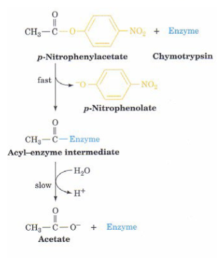
chymotrypsin catalyzes the cleavage of p-nitrophenylacetate: steps
binding of p-nitrophenylacetate to the enzyme active site to form the ES complex
rapid reaction in which an enzyme-acyl intermediate and p-nitrophenol are formed
p-nitrophenol diffuses out of the active site producing the stoichiometric burst
attach of a water molecule then slowly hydrolyzes the acyl-enzyme intermediate to produce free enzyme acetate
Ser-195 discovery
a diagnostic test for serine proteases is that they are rapidly, irreversibly inactivated by diiospropylphosphofluoridate (DIPF)
in chymotrypsin only one serine reacts with DIPF and the result is a completely inactive enzyme
His-57 discovery
discovered using an affinity label: technique where a highly reactive functional group is attached to substrate analog that will have affinity for the active site
the derivatized substrate will bind to the enzyme where the reactive functional group will reach with a neighboring residue
this residue is then identified by sequencing
for chymotrypsin tosyl-L-phenylalanine chloromethyl ketone (TPCK) was used as an affinity label b/c of its resemblance to phenylalanine
how were the residues essential for catalytic activity discovered?
by chemical labeling studies
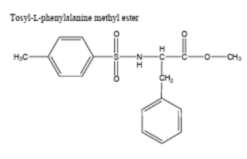
tosyl-L-phenylalanine methyl ester is a substrate of chymotrypsin
demonstrates that it binds in the active site and is hydrolyzed in a typical manner
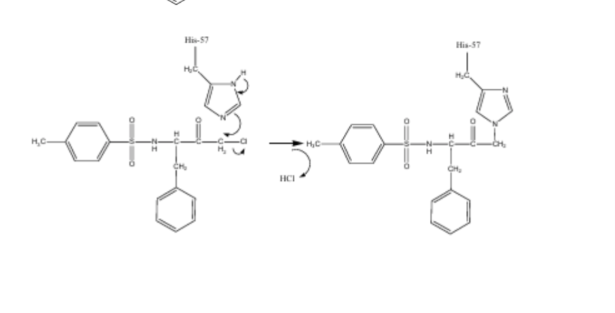
chloromethyl functionality is a strong alkylating group
when TPCK is reacted with chymotrypsin, the enzyme becomes irreversibly inactivated
only one residue is alkylated and that was His-57
chymotrypsin, trypsin and elastase are folded up into two domains, both of which have extensive regions of what?
antiparallel β-sheets in a β-barrel like arrangement
where are the catalytic His-57 and Ser-195 located?
in the substrate binding pocket with an invariant Aspartate residue Asp-102
what are the three residues His-57, Ser-195, and Asp-102 called?
catalytic triad
what is the aspartic acid buried in?
hydrophobic, solvent inaccessible pocket
how are the catalytic triad residues connected to each other?
by hydrogen bonding
x-ray structures provides the basis from the three enzymes substrate specificity
chymotrypsin: the bulky aromatic residues that contribute the carbonyl group of the scissile peptide fit snugly into a hydrophobic pocket located near the catalytic groups
trypsin: there is a similiar pocket w/ the chymotrypsin Ser-189 replaced with an Asp residue
this negatively charged residue electrostatically interacts w/ the positive charge of lysine arginine residues that fit into the pocket
how did elastase get its name?
b/c it rapidly digests the nearly indigestible Ala, Gly, and Val rich connective protein elastin
the large pockets of chymotrypsin and trypsin have been occluded by the side chains of Val and Thr replacing two Gly of trypsin or chymotrypsin
the result is a shallow binding pocket which binds small neutral residues
alanine is the residue that produces the fast rate of hydrolysis
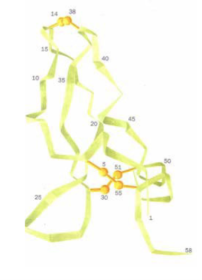
Bovine pancreatic trypsin inhibitor
protects the pancreas from self digestion by prematurely activated trypsin
side chain of residue 15 is a lysine which fits into the binding pocket of trypsin
peptide bond between Lys-151 and Ala-161 is positioned as if it were the scissile bond
crystal structure reveals that this inhibitor binds in conformation of the tetrahedral intermediate
the trypsin catalyzed reaction cannot proceed b/c the inhibitor is so complementary to the enzyme that the LG is tightly bond by the enzyme
it the LG doesn’t leave water cannot get into the active site to hydrolyze the acyl-enzyme intermediate
binds incredibly tight to trypsin w/ a dissociation constant of Kd of 10^-13 M, which is is the tightest protein-protein interaction known
oxyanion hole
analysis of the crystal structures reveal that conformation distortions occur in the formation of the tetrahedral intermediate which causes the carbonyl oxygen to move deeper into a previously unoccupied pocket
what about the oxyanion hole makes DIPF an effective inhibitor of serine proteases?
in the oxyanion hole, the carbonyl oxygen form two hydrogen bonds w/ backbone amide hydrogens Gly-193 and Ser-195. these H bonds allow the enzyme to bind the tetrahedral intermediate in preference to either the enzyme-substrate complex or the acyl-enzyme intermediate
zymogens
many enzymes are biosynthesized as larger inactive precursors
not active until they go specific proteolyic cleavage of one or several peptide bonds
activation is an irreversible process and exploited by biological systems to switch on and off processes at particular times and places
inactive zymogen of insulin
proinsulin
proteolytic removal of residues 31-65 = insulin
residues 1-30 remain linked to residues 66-87 by a pair of interchain disulfide bonds
proenzymes
zymogens that are enzyme precursors
proteolytic enzymes of the digestive tract are synthesized in the pancreas as inactive zymogens
only upon proteolytic cleavage in the small intestine are they activated
trypsinogen
the precursor of trypsin
when enters the duodenum, a serine protease called eneteropeptidase is secreted by the duodenal mucosa
eneteropeptidase hydrolyzes trypsin on the C-side of Lys-15 and upon doing so shortens the enzyme by 15 residues
this one cleavage yields a fully active trypsin, which can activate trypsinogen b/c it also cleaves peptides on the C-side of Lys
cascade effect is called autocatalytic
chymotrypsinogin
zymogen precursor of chymotrypsin
activated by a specific tryptic cleavage of its Arg-15 to Ile-16 peptide bon to from pi-chymotrypsin
pi-chymotrypsin subsequently undergoes self-digestion to excise two dipeptides Ser-14—Arg15 and Thr-147—Asn-148
there by forms the active a-chymotrypsin
proelastase
zymogen precursor of elastase
activated by tryptic digestion which cleaves off a small portion of its N-terminal
true or false. proteolytic zymogens have catalytic power.
false. none of the proteolytic zymogens have any catalytic power. determination of their x-ray crystal structures have shown that the zymogen’s specificity pockets and oxyanion holes are improperly formed such that the amide hydrogen of Gly-193 points in the wrong direction
what is the formation of blood clots the result of?
cascade of zymogen activations
seven blood clotting factors are serine proteases
kallikrein, XII a, XI a, IXa and thrombin
what are the two routs to blood clot formation?
intrinsic and extrinsic pathway
blood clot formation: intrincic pathway
instigated when the blood comes in contact with an abnormal surface caused by injury
blood clot formation: extrinsic pathway
initiated by factors released from injured tissues
blood clot formation: both pathways
both merge at Factor X and culminate in the formation of a blood cloth
thrombin converts fibrinogen into fibrin by excising a peptide that contains a lot of negative electrostatic charge
the fibrin now readily aggregated into ordered fibrous arrays which are subsequently stabilized by covalent cross links