Biochemistry Test 2
 Call Kai
 Learn
Learn Practice Test
 Spaced Repetition
 Match
Match Flashcards
 Knowt Play
1/106

There's no tags or description
Looks like no tags are added yet.
Name | Mastery | Learn | Test | Matching | Spaced | Call with Kai | Chat |
|---|
No analytics yet
Send a link to your students to track their progress
107 Terms
What are enzymes?
highly specific catalysts that can accelerate the rate of a reaction without
being consumed
What are ribozymes
catalytically active RNA molecules
What are proteases
catalyze proteolysis, the hydrolysis of a peptide bond
How can enzymes display specificity
due to the precise interaction of the enzyme and the substrate
What are cofactors?
small molecules that many enzymes require for catalytic
activity
what are the two main classes of cofactors
coenzymes and metals
what are prosthetic groups
a non-protein, non-amino acid component that is tightly, permanently, or even covalently bound to a protein
What is a holoenzyme and apoenzymes
an enzyme without its cofactor
What is the first law of thermodynamics
the total energy of a system and its environment is constant.
What is the second law of thermodynamics
the total entropy of a system plus that of its surroundings always increases
What is Gibbs free energy
a thermodynamic property that is a measure of the energy that is capable of doing work
What does negative delta g mean
a reaction can take place spontaneously.
What does positive delta g mean
a reaction cannot take place spontaneously.
What does a zero delta g mean
a system is at equilibrium, and no net change can take place.
What is an exergonic reaction
spontaneous reactions with a negative delta g
what is an endergonic reactions
nonspontaneous reactions with a positive delta g
How do enzymes affect delta g
They don’t. Delta g depends on the free energy of the products, minus the free energy of the reactants, which provides no information about the rate of a reaction.
What is the equation for delta g

How is ΔG°′ related to Keq
The larger the Keq, the more negative the ΔG°′
what do enzymes do to activation energy?
they decrease the gibbs free energy of activation because enzymes facilitate the formation of the transition state
What is the difference between ΔG, ΔG° (standard free energy), and ΔG°′
(biochemical standard free energy)?
ΔG represents the actual free energy change under real-time cellular conditions, while ΔG° is the constant measured at a chemical standard state of pH0, and ΔG°′ is the constant adjusted to a biochemical standard state of pH7
How does the reaction rate (Vo) change as substrate concentration [S] increases?
It increases until it reaches the Maximum velocity
What does this curve reveal about enzyme behavior at low vs. high [S]?
transitions from a state of high responsiveness to complete saturation as substrate concentration [S] increases.
What does Km represent in terms of substrate concentration and reaction
velocity?
the concentration of substrate at which half the active sites are filled. Thus, KM provides a measure of the substrate concentration required for significant catalysis to take place
What is Vmax, and what does it tell us about an enzyme under saturating substrate conditions?
the maximum initial velocity or rate of an enzyme-catalyzed reaction that occurs when all the enzyme's active sites are fully saturated with its substrate
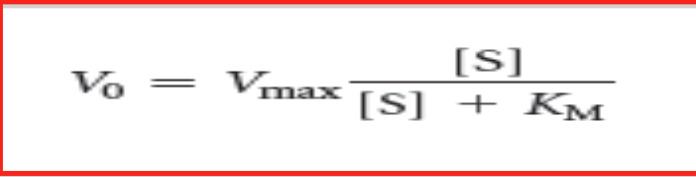
What is the Michaelis-Menten kinetics
a mathematical model that describes how the rate of an enzyme-catalyzed reaction depends on the concentration of a substrate
What is Kcat
the turnover number of the enzyme which is the number of substrate molecules converted into product per second
What does the inhibition constant (Ki) represent?
an equilibrium dissociation constant that measures how tightly an inhibitor binds to an enzyme.
Would a smaller or larger Ki indicate a stronger inhibitor? Why?
The smaller the Ki, the stronger the inhibition because the molecules bind tightly, a smaller amount or lower concentration of the inhibitor is required to block the enzyme's activity by half
What is reversible inhibition?
a process where an inhibitor binds to an enzyme temporarily through non-covalent interactions which reduces the enzymes activity
What is competitive inhibition?
inhibitor that increases the apparent value of Km. They have no effect on Vmax.
What is noncompetitive inhibition?
inhibitor binds to the allosteric site
What is uncompetitive inhibition?
Inhibitor that lowers Vmax and Km. They do not affect the slope of the double reciprocal plot.
Give an example of competitive inhibition?
Methotrexate is an especially potent competitive inhibitor of the enzyme dihydrofolate reductase (DHFR), which plays a role in the biosynthesis of purines and pyrimidines.
Give an example of noncompetitive inhibition?
the action of cyanide on the enzyme cytochrome c oxidase during cellular respiration
Give an example of uncompetitive inhibition?
The herbicide glyphosate, also known as Roundup, is an uncompetitive
inhibitor of an enzyme in the biosynthetic pathway for aromatic amino acids.
What do competitive inhibitors do to Km and Vmax?
They increase Km but do not change Vmax.
What do uncompetitive inhibitors do to Km and Vmax?
They decrease both Vmax and Km, but do not change the rate/slope.
What do noncompetitive inhibitors do to Km and Vmax?
They decrease Vmax but do not change Km.
What are transition-site analogs?
compounds resembling the transition state of a catalyzed reaction
What are irreversible inhibitors?
Inhibitors that covalently bind to enzymes.
What are the three types of irreversible inhibitors?
Group specific reagents, affinity labels, and mechanisms-based inhibitors.
What are Group specific reagents?
compounds that inhibit enzymes by reacting with specific side chains of the enzyme’s amino acids
What are Km(app) and Vmax(app)?
apparent values of Km and Vmax
What are affinity labels?
inhibits enzymes by being structurally similar to the substrate and covalently bonding to active-site reactions
What are mechanism based inhibitors?
bind to the enzyme as a substrate, which generates a chemically reactive intermediate that inactivates the enzyme through covalent modification
What are the four catalytic strategies?
Covalent catalysis, general acid base catalysis, catalysis by approximation, and metal ion catalysis.
What is the covalent catalysis strategy?
The active site contains a reactive group that becomes temporarily covalently attached to a part of the substrate
What is an example of the covalent catalysis strategy?
proteolytic enzyme chymotrypsin
What is the general acid-base catalysis strategy?
a molecule other than water acts as a proton donor or acceptor
What is an example of the general acid-base catalysis strategy?
histidine residues in chymotrypsin and carbonic anhydrase
What is the catalysis by approximation strategy?
the enzyme brings two substrates together along a single binding surface in a manner that enhances the reaction rate
What is an example of the catalysis by approximation strategy?
carbonic anhydrase
What is the metal ion strategy?
metal ions function catalytically such as by direct coordination, stabilizing negative charges on reaction intermediates or serving as a bridge between enzyme and substrate
What is an example of the metal ion strategy?
myosin and kinesin
What are proteases?
Enzymes that cleave proteins by hydrolysis?
Why are peptide bonds so resistant to hydrolysis under normal conditions?
peptide bonds have resonance structures that make the carbonyl carbon less electrophilic and less susceptible to nucleophilic attack compared to other compounds.
What is chymotrypsin?
an enzyme that cleaves peptide bonds selectively on the carboxyl terminal side od hydrophobic amino acids like W, Y, F, and M by employing a powerful nucleophile to attack the unreactive carbonyl carbon atom of the substrate.
How is chymotrypsin inactivated?
By adding DIPF, which modifies serine 195 of chymotrypsin, making it lose all activity.
How do enzymes like proteases overcome this challenge to break peptide bonds
efficiently?
By using highly specific catalytic groups to lower the activation energy required for hydrolysis.
What is the catalytic triad in chymotrypsin?
Asp-His-Ser where the side chain of Ser 195 is hydrogen bonded to the imidazole ring of His 57. Then the -NH group of the His 57 imidazole ring is hydrogen bonded to the carboxylate group of Asp 102.
How does each amino acid in the catalytic triad contribute to catalysis?
Serine marks the active site of chymotrypsin, His 57 polarizes Ser 195 and acts like a general base catalyst in the presence of substrate. Asp 102 makes His 57 basic enough to steal a proton from serine.
What features of an enzyme’s structure ensure it only binds the correct substrate?
They have an active site that is a groove that matches the size and shape of the target substrate.
What are serine proteases?
An enzyme that breaks peptide bonds in proteins using a serine amino acid as the main nucleophile at its active site.
What are cysteine proteases?
An enzyme with a cysteine in its active site that acts as a nucleophile to attack substrate protein
What are aspartyl proteases?
An enzyme that uses an activated water molecules bound to conserved aspartate residues to break peptide bonds in proteins.
What are metalloproteases?
Enzymes that use a bound metal ion (typically zinc) that activates a water molecule to act as a nucleophile to attack the peptide carbonyl group
Why is carbonic anhydrase so important for physiology?
It catalyzes the reversible hydration of carbon dioxide and water into bicarbonate and hydrogen ions, speeding up the reaction in blood cells.
How does the zinc complex facilitate carbon dioxide hydration?
Zn 2+ lowers the pKa of water, which allows water to more easily lose a proton at neutral pH to generate the OH-.
Why does the Zn2+ also require a nearby histidine and a buffer in the solution
to maximize activity?
They accept the protons that are transferred from the zinc-bound water molecule, which increases the rate of CO2 hydration by carbonic anhydrase.
How do metal ions facilitate DNA hydrolysis in restriction enzymes?
They coordinate to the protein through two Asp residues and to one phosphate group oxygen at the site of cleavage which then binds the water that attacks the phosphorus.
How do restriction enzymes “know” where to cut DNA?
Target DNA has recognition sequences/sites that tell the enzyme where to cleave
What features of the enzyme and the DNA sequence account for their remarkable
specificity
They must cleave only DNA molecules that contain recognition without cleaving DNA molecules that lack the sites and they must not degrade host DNA containing the recognition sequence
What are the different ways in which enzyme activity can be regulated?
Allosteric regulation, isozymes, reversible covalent modification, and proteolytic activation.
What is allosteric regulation?
Allosteric proteins contain distinct regulatory sites and multiple functional sites
What is ATCase?
Aspartate transcarbamoylase which catalyzes the first step in pyrimidine biosynthesis
What is the committed step?
The step in the pathway where the products of the reaction are committed to the ultimate synthesis of end products in the pathway, which is irreversible and catalyzed by allosteric enzymes.
What is feedback inhibition?
Inhibition of an enzyme by the end product of the pathway.
Why do cells need to regulate enzymes?
To make sure pathway intermediates are not needlessly formed when the end product is abundant, maintain homeostasis and conserve energy.
Which enzymes in a pathway are usually the best ones to regulate, and why?
The first committed step enzymes and irreversible step enzymes.
How does ATCase serve as an example of enzyme regulation?
The final product is CTP. When CTP levels are high, CTP binds to the allosteric site of ATcase, slowing down the reaction.
What is the role of Mg²⁺ in ATP hydrolysis by myosin?
It neutralizes negative charges on ATP’s phosphate tail, anchors ATP into the correct geometric shape in the active site, and stabilizes the high-energy transition state during cleavage.
How does the role of Mg2+ differ between Myosin and Restriction Enzymes?
In Myosin, Mg2+ neutralizes the ATP substrate and active site amino acids activate the water. In Restriction Enzymes, Mg2+ binds to the DNA backbone and directly activates the attacking water.
What does it mean when we say Mg²⁺ is treated as a substrate rather than just a
cofactor in this reaction?
Myosin only binds ATP when its already complexed as MgATP2- and works in a 1:1 ration.
Why doesn’t ATCase follow Michaelis-Menten kinetics?
Because it is an allosteric enzyme with multiple cooperating subunits.
What does p-Hydroxymercuribenzoate do to ATCase?
It reacts with crucial cysteine residues which dissociates the enzyme into a catalytic subunit consisting of three chains and a regulatory subunit of two chains
What is PALA? What does it do?
A bisulfate analog that resembles an intermediate along the pathway of catalysis. It binds to and blocks the active sites of the ATCase and acts like a competitive inhibitor.
What is the difference between the T state and the R state?
The T state has a low affinity for substrate and low catalytic activity, which is favored in the absence of substrate. The R state is the opposite.
What are isozymes?
Enzymes that differ in amino acids sequence that catalyze the same reaction.
In what ways can isozymes differ from one another?
They typically display different kinetics, respond to different regulatory molecules, are encoded by different genes and can be expressed in a tissue-specific or development stage-specific pattern.
Why might different tissues use different isozymes?
The same processes occur in different tissues, so there are different physiological conditions that demand different isozymes.
What is covalent modification?
A covalent attachment of a modifying functional group to an enzyme, most are reversible.
What are the examples of covalent modifications of enzymes?
Phosphorylation, acetylation and deacetylation.
How do covalent modifications of enzymes differ from allosteric regulation?
Covalent modifications either form or break true covalent bonds and allosteric regulation involves noncovalent interactions where a regulatory molecule binds reversibly to a site separate from the active site.
Why is phosphorylation such a common method of enzyme regulation?
Because it it is rapid, reversible and energetically favorable reaction.
What advantages does phosphorylation provide over other mechanisms?
It only requires 1 ATP and it is easily reversible.
What do protein kinase do?
Catalyze the phosphorylation of protein substrates by attaching a phosphoryl group to a Ser, Thr, or Tyr.
What is protein kinase A (aka cyclic AMP-dependent protein kinase)?
An enzyme that controls cellular metabolism , gene expression and signaling downstream of hormones like epinephrine and glucagon.
How is protein kinase A turned on?
cAMP binds to the regulatory subunits, changing their shape and releasing the active catalytic subunits.
How is protein kinase A turned off?
Phosphodiesterase (PDE) destroys cAMP, forcing the regulatory subunits to re-bind and block the catalytic subunits