-Ch. 3 Understanding the statement of Cash Flows (ACCT 372) (copy)
 Call Kai
 Learn
 Practice Test
 Spaced Repetition
 Match
 Flashcards
 Knowt Play
1/38

There's no tags or description
Looks like no tags are added yet.
39 Terms
Which of the following is not a benefit of the statement of cash flows?
a. It highlights accruals as the difference between net income and operating cash flows.
b. It reconciles the change in cash from the balance sheet.
c. It is logically organized into three intuitive sections: operating, investing and financing.
d. It focuses on cash flows, which are difficult for managers to manipulate.
It focuses on cash flows, which are difficult for managers to manipulate.
An indirect statement of cash flows
a. is more common than a direct method statement of cash flows.
b. reports cash inflows and outflows within three different sections.
c. can be useful in identifying significant estimates and choices made by managers under accrual accounting.
d. All of these answer choices are correct.
All of these answer choices are correct.
On the statement of cash flows, operating activities
a. include noncash transactions such as the purchase of inventory with common stock.
b. include activities related to the production and delivery of goods or services.
c. are the primary source of cash flows for early-stage enterprises.
d. involve cash outflows for investments in long-lived assets.
b. include activities related to the production and delivery of goods or services.
On the statement of cash flows, investing activities
a. would not include acquisitions or divestitures of businesses or business units.
b. summarize cash outflows for the acquisition of long-lived assets, as well as cash inflows from the disposal of long-lived assets.
c. include activities related to the production and delivery of goods or services.
d. include bank borrowings only if those borrowings are collateralized by long-lived assets.
summarize cash outflows for the acquisition of long-lived assets, as well as cash inflows from the disposal of long-lived assets.
A company reports a net loss of $773 million, cash flows from operating activities of $(124) million, cash flows from investing activities of $(1,416) million, and cash flows from financing activities of $3,744 million. What is the change in cash on the balance sheet during the year?
a. $(773) million
b. $1,431 million
c. $(897) million
d. $2,204 million
$2,204 million
On the statement of cash flows, financing activities
a. capture cash inflows from the unplanned sale or liquidation of investments of idle cash.
b. are the primary source of cash flows for mature businesses.
c. include cash flows generated from the investment of debt or equity capital in productive assets.
d. summarize cash received or paid back to banks and shareholders.
summarize cash received or paid back to banks and shareholders.
For early-stage businesses,
a. cash flows from financing activities tend to be close to zero.
b. cash flows from financing activities tend to be negative.
c. cash flows from financing activities tend to be positive.
d. cash flows from financing activities depend on whether capital comes from banks versus equity investors.
cash flows from financing activities tend to be positive.
For very mature businesses,
a. cash flows from operating activities tend to be negative, and cash flows from financing activities tend to be positive.
b. cash flows from operating and financing activities tend to be negative.
c. cash flows from operating and financing activities tend to be positive.
d. cash flows from operating activities tend to be positive, and cash flows from financing activities tend to be negative.
cash flows from operating activities tend to be positive, and cash flows from financing activities tend to be negative.
Large negative cash flows from operations
a. can indicate a poorly run, unprofitable business.
b. can reflect a business in the introduction phase, which is requiring large investments in working capital such as accounts receivable and inventory.
c. cannot occur indefinitely.
d. All of the answer choices are correct.
All of the answer choices are correct.
A company reports a net loss of $773 million, cash flows from operating activities of $(124) million, cash flows from investing activities of $(1,416) million, and cash flows from financing activities of $3,744 million. This company is likely in what stage of the business life cycle?
a. Maturity
b. Growth
c. Decline
d. Introduction
Introduction
Why does depreciation appear as a positive adjustment in the operating section of an indirect statement of cash flows?
a. A negative adjustment would reduce cash flows from operating activities.
b. Depreciation expense needs to be included in the investing section.
c. Long-lived assets are frequently financed with borrowings, which are a financing activity.
d. Depreciation expense reduces net income, the starting point of the statement of cash flows, but does not require a cash outflow.
Depreciation expense reduces net income, the starting point of the statement of cash flows, but does not require a cash outflow.
A company has accounts receivable of $4,200 at the beginning of the year and $5,000 at the end of the year. Which of the following best describes the adjustment for accounts receivable that would appear in the indirect statement of cash flows?
a. The adjustment would be for $800, indicating a use of cash.
b. The adjustment would be for $(800), indicating a use of cash.
c. The adjustment would be for $(800), indicating a source of cash.
d. The adjustment would be for $800, indicating a source of cash.
The adjustment would be for $(800), indicating a use of cash.
A company has accounts payable of $315,000 at the beginning of the year and $618,000 at the end of the year. Which of the following best describes the adjustment for accounts payable that would appear in the indirect statement of cash flows?
a. The adjustment would be for $303,000, indicating a source of cash.
b. The adjustment would be for $(303,000), indicating a source of cash.
c. The adjustment would be for $(303,000), indicating a use of cash.
d. The adjustment would be for $303,000, indicating a use of cash.
The adjustment would be for $303,000, indicating a source of cash.
A company reports the following balances as of the beginning and end of the year:

There were no dispositions during the year. What is your best estimate of the amounts and locations on the statement of cash flows for depreciation and capital expenditures?
a. $5,000 subtraction for depreciation expense in the operating section; $20,000 subtraction for capital expenditures in the investing section
b. $5,000 addition for depreciation expense in the operating section; $20,000 addition for capital expenditures in the investing section
c. $5,000 subtraction for depreciation expense in the operating section; $20,000 addition for capital expenditures in the investing section
d. $5,000 addition for depreciation expense in the operating section; $20,000 subtraction for capital expenditures in the investing section
$5,000 addition for depreciation expense in the operating section; $20,000 subtraction for capital expenditures in the investing section
A company reports the following changes in account balances. And they paid no dividends during the year.
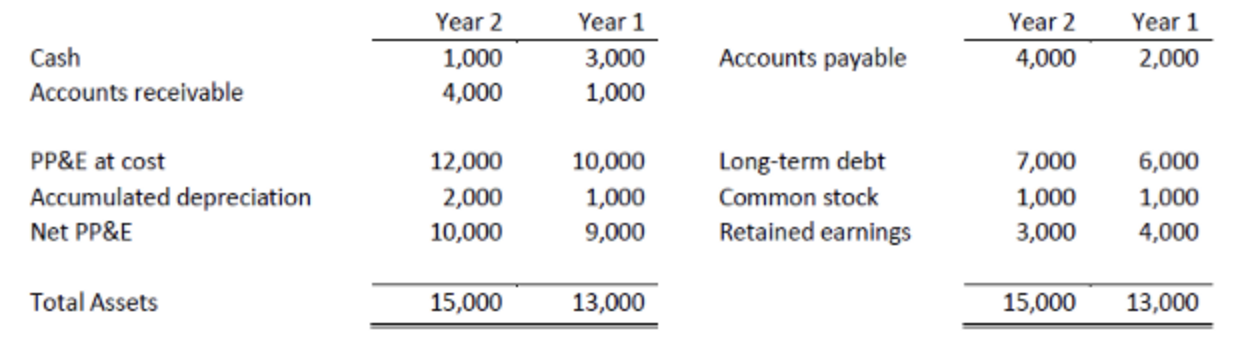
What are operating, investing, and financing cash flows, respectively, for Year 2?
a. 0, (1,000), 1,000
b. (2,000), (2,000), 1,000
c. 0, (2,000), 1,000
d. (1,000), (2,000), 1,000
(1,000), (2,000), 1,000
A company overstates revenues by €1.2 million by overstating accounts receivable. The best characterization of the effect of this misstatement is
a. overstated net income and no effect on operating cash flows.
b. overstated net income and overstated operating cash flows.
c. overstated net income and understated operating cash flows.
d. no effect on the statement of cash flows.
overstated net income and no effect on operating cash flows.
Which of the following is the correct formula for calculating cash collections from customers?
a. Sales for the period plus accounts receivable at the end of the period
b. Accounts receivable at the beginning of the period plus sales for the period minus accounts receivable at the end of the period
c. Sales for the period plus accounts receivable at the end of the period minus accounts receivable at the beginning of the period
d. Sales for the period plus accounts receivable at the beginning of the period
Accounts receivable at the beginning of the period plus sales for the period minus accounts receivable at the end of the period
Outback Corp. recorded sales of $1,400,000 during the year. In addition the company's accounts receivable balance grew from $130,000 at the beginning of the year to $165,000 at the end of the year. How much cash did Outback collect from customers during the year?
a. $1,345,000
b. $1,300,000
c. $1,135,000
d. $1,365,000
$1,365,000
Toro Company recognized $1,600,000 of cost of goods sold during the year, in addition its implementation of a just-in-time inventory system allowed it to reduce its inventory from $325,000 at the beginning of the year to $285,000 at the end of the year. How much cash did Toro spend for inventory during the year?
a. $1,560,000
b. $1,600,000
c. $1,655,000
d. $1,695,000
$1,560,000
Fizzzle Inc. sold a piece of equipment during the period for $230,000 and recorded a loss of $45,000 on the sale. How should this loss be treated when preparing the operating activities section of the statement of cash flows using the indirect method?
a. The loss is subtracted from net income in the operating activities section.
b. The loss is added back to net income in the operating activities section.
c. The entire sales price is subtracted from net income in the operating activities section.
d. A sale of equipment is an investing activity; the transaction will not affect the operating activities section.
The loss is added back to net income in the operating activities section.
Module Learning Objectives (MLOs)
Describe the mixed-attribute measurement model used for valuing assets and liabilities
Explain how changes in asset and liability values are reflected in earnings and comprehensive income
Distinguish between financial reporting and tax reporting
Apply an analytical framework to map economic transactions to the balance sheet and income statement
By the end of this chapter, you should be able to:
Objective. 1 Describe the mixed attribute measurement model for assets and
liabilities, and how it provides relevant and representationally faithful
information to financial statement users.
Objective. 2 Explain how changes in valuations of assets and liabilities on the
balance sheet are recognized on the income statement and
statement of comprehensive income.
Objective. 3 Understand that financial reporting and tax reporting are two different
systems, which are linked by timing differences and deferred tax
assets and liabilities.
Objective. 4 Utilize an analytical framework to map economic transactions and
events to the balance sheet and income statement.
The Mixed Attribute Measurement Model
(Learning Objective 1)
• The mixed attribute measurement model used by accounting standard
setters strives to optimize relevant information given various
constraints on the representational faithfulness of measurement.
• The income statement and statement of comprehensive income report
net changes in assets and liabilities as revenues, expenses, gains,
and losses.
• U.S. Generally Accepted Accounting Principles (GAAP) and
International Financial Reporting Standards (IFRS) require firms to use
a variety of approaches to value assets and liabilities in their financial
statements.
The Complementary Nature and Relative Usefulness of the Income Statement and Balance Sheet
There is an increase in the importance of performance measures
other than bottom line earnings (such as revenues, other
comprehensive income, and one-time items).
• Firm valuation is a complex and dynamic assessment of various
components of firms’ balance sheets and income statements.
• Standard setters strive to provide an optimal mix of relevant and
representationally faithful information in the financial statements,
which helps users better translate the information into assessments
of the risk, timing, and amounts of future cash flows.
Relevance and Representational Faithfulness (5)
Financial information is relevant if it can influence a user’s decision.
• Information is representationally faithful if it represents what it purports
to represent.
• Accounting standards require that some assets and liabilities be
measured based on more relevant information and others must be
based on more representationally faithful information.
• Under the mixed attribute measurement model, valuations of assets
and liabilities reflect various combinations of historical costs, fair
values, and present values of future cash flows
Primary Valuation Alternatives:
Historical Cost versus Fair Value
Historical cost is the cost originally incurred to acquire an asset or
the original (principal) amount of an incurred liability.
• Fair value reflects the value of the asset or liability based on current
market conditions.
• At the time of an arm’s-length transaction, the historical cost of
assets and the original amount of liabilities are equal to their fair
values.
• Historical cost is adjusted downward as those assets are consumed.
• If markets are not sufficiently active to provide reliable evidence of
fair value, firms can use the present value of expected cash flows to
approximate the fair value of assets and liabilities.
Market (or Fair) Value:
Fair value approaches to valuation for financial assets and liabilities
are commonplace within U.S. GAAP and IFRS.
• Reporting financial assets and liabilities at fair values is also referred
to as “mark-to-market” accounting.
• Obtaining fair value can require management to make estimates
when there is no quoted price in an active market for an asset or a
liability.
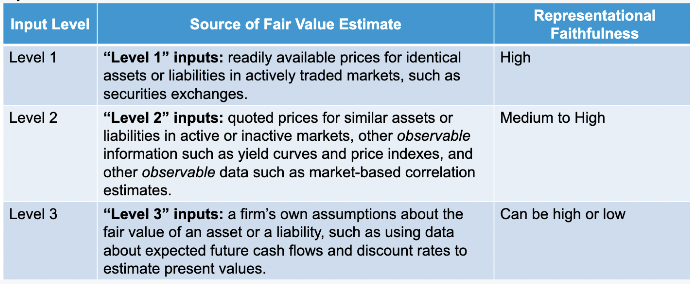
• There is a three-tiered hierarchy within U.S. GAAP and IFRS that distinguishes among different sources of fair value estimates.
Fair Value Estimates and Representational Faithfulness
Current Replacement Cost and Net Realizable Value
Current replacement is the amount a firm would have to pay
currently to acquire or produce an asset it now holds.
Current replacement cost generally applies to nonmonetary
assets.
Cost valuations generally reflect greater subjectivity than
acquisition cost valuations.
Net realizable value is the net amount a firm would receive if it
sold an asset.
Fair value reflects the value of the asset or liability based on:
a. Historical cost
b. Current market value
c. Assessors’ opinions
d. Management estimates
Current market value
Income Recognition
(Learning Objective 2)
Revenues, expenses, gains, and losses reported on the income statement
are determined by changes in values of assets and liabilities.
• Three approaches to income recognition have evolved:
• Approach 1. Recognize income effects changes in economic value income effects
on the balance sheet and income statement when they are realized in a market
transaction.
• Approach 2. Recognize changes in economic value on the balance sheet and
income statement when they occur, even though they are not yet realized in a
market transaction.
• Approach 3. Recognize changes in economic value on the balance sheet when the
value changes occur over time, but delay recognition in net income until the value
changes are realized in a market transaction
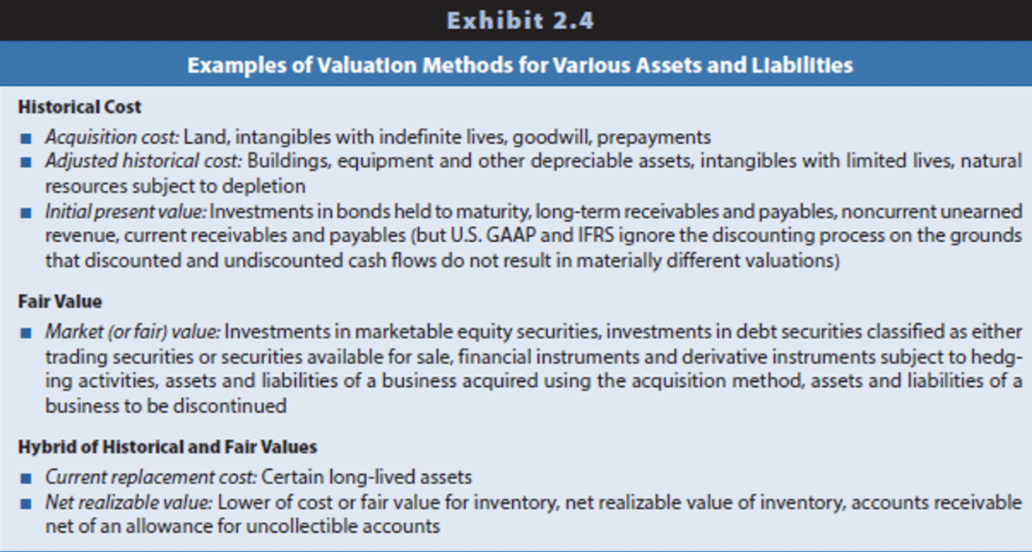
Valuation Methods for Various Assets and Liabilities
Approaches under Income Recognition
• Approach 1 realizes revenues either when a firm receives cash, a receivable,
or some other asset from a customer for goods sold or services performed,
or when the firm satisfies a liability to a customer by delivering goods or
services owed.
• Approach 2 compels a firm to revalue assets and liabilities to fair value each
period and recognize the unrealized gains and losses in net income in that
same period. This aligns well with the current value approach for assets and
liabilities because the changes in economic value are reflected on the income
statement even if they are not yet realized.
• Approach 3 is a hybrid of the others, as it measures the relevant economic
value changes on the balance sheet using the current value approach for
asset and liability valuation. Such changes appear as part of other
comprehensive income on the statement of comprehensive income
Evolution of the Mixed Attribute Measurement Model
• The mixed attribute measurement model does a good job of
capturing relevant information about economic events and
transactions in a way that maintains the overall representational
faithfulness of the financial statements.
• The FASB and IASB are actively overhauling the conceptual
frameworks upon which the accounting model is based.
• The ongoing evolution of the mixed attribute measurement model
reflects continuous improvement in financial reporting that adapts to
the evolving needs of financial statement users.
One valuation method that is a hybrid of historical and fair value is
the:
a. Adjusted historical cost method
b. Market (or fair) value method
c. Net realizable value method
d. Initial present value method
Net realizable value method
Income Taxes
(Learning Objective 3)
• Income taxes will impact the financial statements, as expenses under accrual
accounting do not necessarily equal income taxes owed.
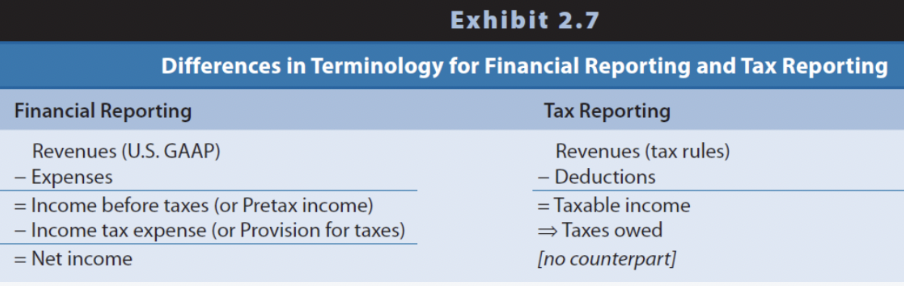
• The financial reporting of income is based on U.S. GAAP rules, while taxable
income is determined according to Internal Revenue Code rules.
Permanent and Temporary Differences
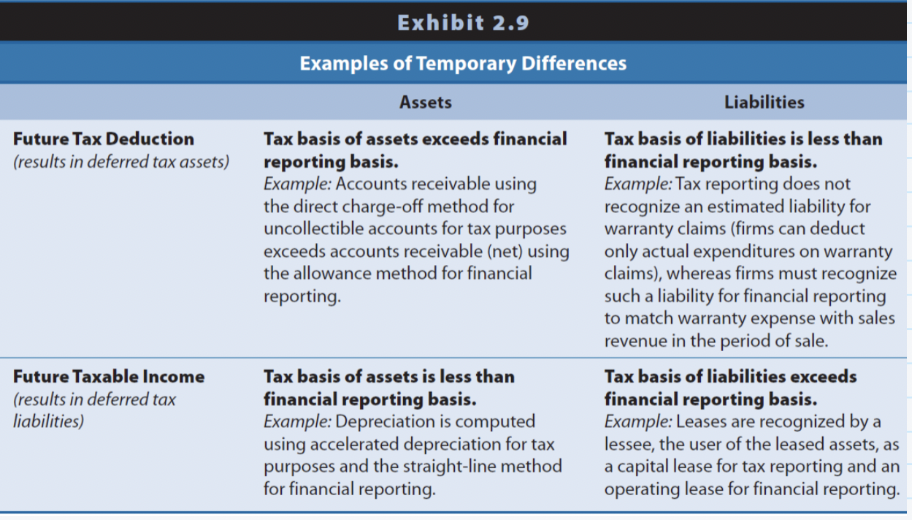
Income before taxes for financial reporting differs from taxable
income for the following principal reasons:
• Permanent Differences: Some revenues and expenses that are
part of net income for financial reporting never appear on the
income tax return.
• Temporary Differences: Some revenues and expenses are part
of both net income and taxable income, but in different periods.
These timing differences are “temporary” until they “reverse.”
Which of the following is an example of when the tax basis of assets is less than the financial reporting basis?
a. Depreciation
b. Estimated liability for warranty claims
c. Leases
d. Accounts receivable using the direct write-off method for uncollectible accounts
Depreciation
Reporting Income Taxes in the Financial Statements
Firms may not include all income taxes for a period on the line for income tax
expense on the income statement. Some amounts may appear elsewhere:
• Discontinued Operations: Under U.S. GAAP, firms report the results of
discontinued operations in a separate section of the income statement, net of
the income tax effects.
• Other Comprehensive Income: Certain items appear in other comprehensive
income, net of their tax effects:
• Unrealized changes in the market value of debt securities classified as “available for sale”
• Unrealized changes in the market value of hedged financial instruments and derivatives
classified as cash flow hedges
• Unrealized foreign currency translation adjustments
• Certain changes in pension and other post-employment benefit assets and liabilities
Summary
Now that the lesson has ended, you should have learned how to:
• Describe the mixed attribute measurement model for assets and
liabilities, and how it provides relevant and representationally
faithful information to financial statement users.
• Explain how changes in valuations of assets and liabilities on the
balance sheet are recognized on the income statement and
statement of comprehensive income.
• Understand that financial reporting and tax reporting are two
different systems, which are linked by timing differences and
deferred tax assets and liabilities.
• Utilize an analytical framework to map economic transactions
and events to the balance sheet and income statement.