Back
 Call Kai
 Learn
 Practice Test
 Spaced Repetition
 Match
 Flashcards
 Knowt Play
1/30

There's no tags or description
Looks like no tags are added yet.
31 Terms

what’s this part of a vertebrae?
vertebral body

what’s this part of a vertebrae?
transverse process
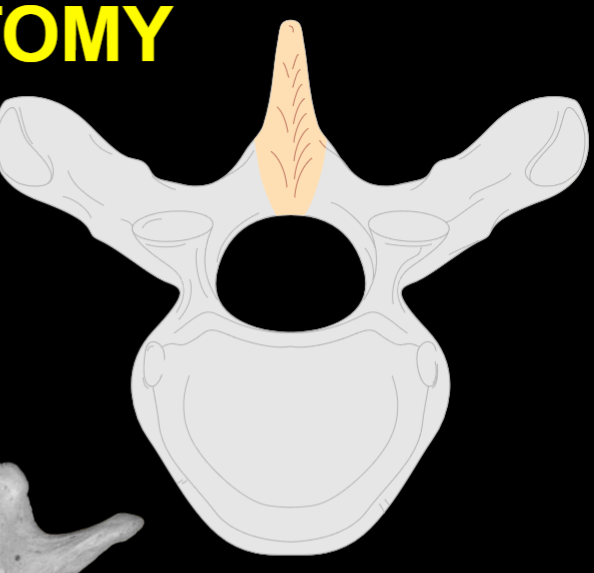
what’s this part of a vertebrae?
spinous process

what’s this part of a vertebrae?
lamina

what’s this part of a vertebrae?
pedicle

what’s this part of a vertebrae?
articular process

describe what this is
the vertebral development from the sclerotome
red - two vertebral arches and transverse processes
yellow - vertebral body
blue - two costal elements

what type of vertebrae is this (with its costal element)?
thoracic vertebrae

what type of vertebrae is this?
cervical
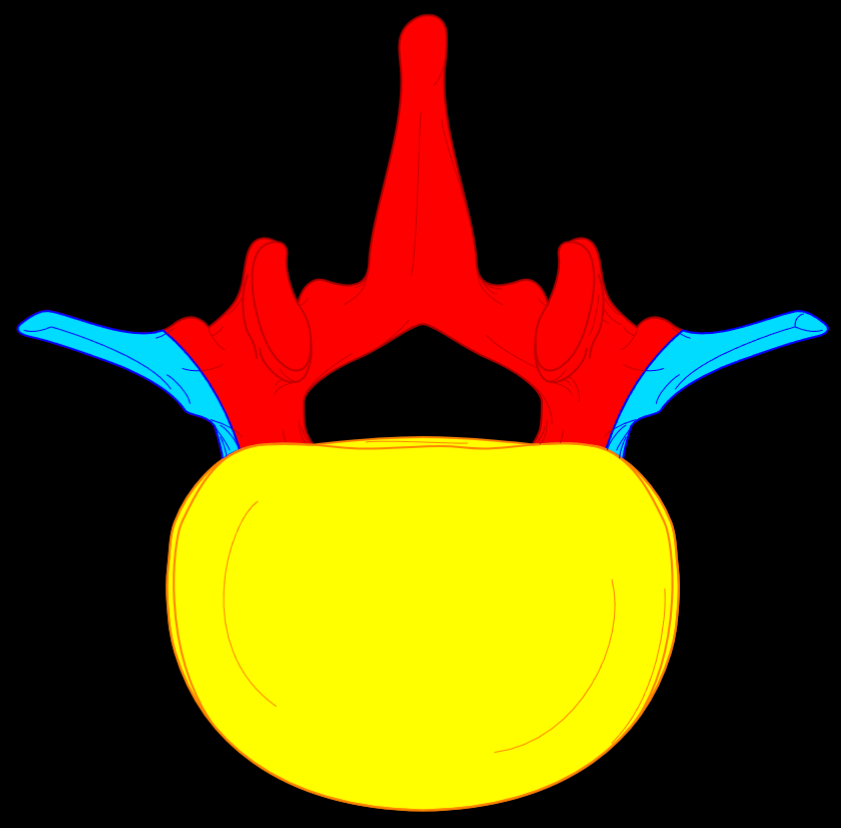
what type of vertebrae is this?
lumbar vertebrae

what type of vertebrae is this?
sacral
cartilaginous joints in the back
cartilaginous joints are used for strength and stability and found in the back as intervertebral discs
what are the two parts of an intervertebral disc?
anulus fibrosus - the collagen-heavy ring around the nucleus pulposus
nucleus pulposus - the gel-like core of the vertebral disc used for shock absorption
synovial joints in the back
are found between articular processes and are the most mobile type of joint, used here for spinal flexion and extension
what movements of the vertebral column happen in the sagittal plane?
flexion and extension

what movements of the vertebral column happen in the frontal plane?
lateral flexion (leaning left and right)
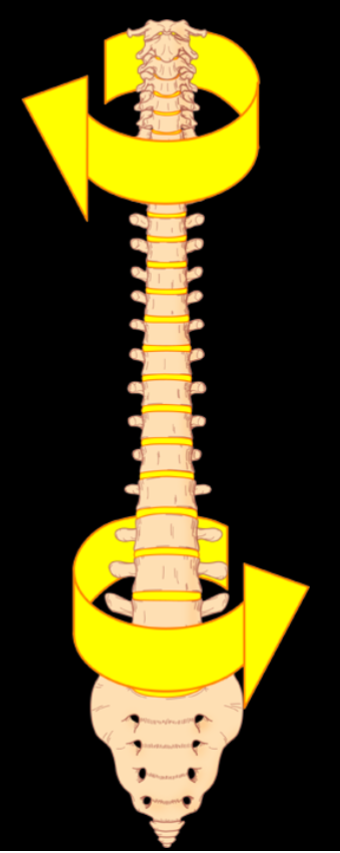
ipsilateral and contralateral rotation

what movements of the vertebral column happen in the transverse plane?
rotation
what are the three epaxial muscle groups of the back?
splenius muscles, erector spinae muscles, and transversospinalis muscles
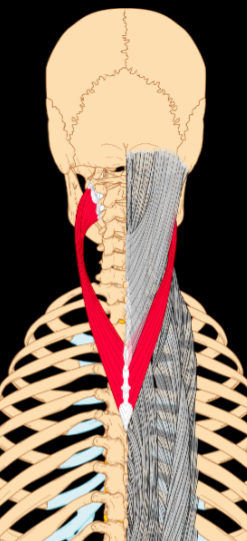
what are the two spinotransveralis muscles? (most superficial layer)
splenius capitis muscle and splenius cervicis muscle
structure and function (SF) of splenius capitis muscle
S - attaches from the occipital bone of the head to cervical and a couple thoracic vertebrae; flat and broad shaped
F - extension of cervical vertebrae and the head itself

SF of splenius cervicis muscle
S - attaches to the transverse processes of the cervical vertebrae to the spinous processes of the thoracic vertebrae
F - extends cervical vertebrae, not the head (the head will move as a result, but this muscle is not moving the head directly)
what are the three erector spinae muscles? (layer 2)
iliocostalis muscle, longissimus muscle, and spinalis muscle
SF of iliocostalis muscle
S - attaches to costal elements; depending on the region of the back, this muscle is classified as iliocostalis lumborum, thoracis, and cervicis
F - extension of L, T, and C; unilateral flexion (ex. tilting your head towards your shoulder)

SF of longissimus muscle
S - longest of all epaxial muscles; spans from lumbar region to head; depending on the region of the back, this muscle is classified as longissimus thoracis, longissimus cervicis, and longissimus capitis
F - extension of L, T, C, and head

SF of spinalis muscle
S - most medial; (there is a spinalis thoracis, cervicis, and capitis, but I don’t need to know that for the test apparently)
F - extends L, T, C, and head

what are the two transversospinalis muscles?
semispinalis and multifidus (third and fourth layers)
SF of semispinalis muscle
S - semispinalis thoracis, cervicis, and capitis; spans half the length of the vertebral column (hence the name)
F - extension of head and C

SF of multifidus muscle
S - lumborum, thoracis, and cervicis; DEEPEST epaxial muscle; attaches from transverse processes to spinous processes a couple levels above
F - most important muscle for spinal stabilization; extension of S, L, T, and C1 to C2

list the four muscle layers from most superficial to deepest
splenius muscles; erector spinae muscles, semispinalis muscle, multifidus muscle
what is the major functional similarity that all epaxial back muscles share?
extension
innervation of the epaxial muscles?
posterior rami woohoo!