Pre-1: Photosynthesis
 Call Kai
 Learn
 Practice Test
 Spaced Repetition
 Match
 Flashcards
 Knowt Play
1/60

There's no tags or description
Looks like no tags are added yet.
61 Terms
What is photosynthesis?
The conversion of light energy into chemical energy in the form of organic compounds. Performed in plants, algae (eukaryotic and prokaryotic), and some prokaryotes.
Where in plants does photosynthesis occur? What specific cell?
In plants primarily within the leaf, occurs within the chloroplasts, within specialized cells called mesophyll cells of leaf tissue. (found in the middle layer of the leaf)

What is the oxidizing agent and reducing agent in the process of photosynthesis?
Carbon dioxide: oxidizing agent because it becomes reduced
Water: reducing agent because it becomes oxidized.

what are chloroplasts?
They capture sunlight and convert it into chemical energy stored in sugars, such as glucose.
Important structures:
Thylakoids: Membrane sacs where the light-dependent reactions occur.
Grana: Stacks of thylakoids.
Stroma: Fluid surrounding the thylakoids where the Calvin cycle occurs.
and outer membrane.
Stroma
The fluid-filled space inside chloroplasts that surround the thylakoids.
Thylakoids
membrane compartments, consisting of the thylakoid membrane surrounding the thylakoid space.
Granum
stacks of thylakoid stacks
where are enzymes for light reactions found?
within the thylakoid membrane
where are enzymes for the Calvin Cycle?
in the stroma

what is this image?
chloroplast
What kind of reaction is photosynthesis?
endergonic because it requires constant energy continue, this energy comes from sunlight.
What is electromagnetic energy?
The form of energy that travels through space as waves and can be absorbed by substances. (consisting of disturbances of electric and magnetic fields known as electromagnetic waves.)
Electromagnetic spectrum
The entire range of electromagnetic energy
Photon
A discrete quantity of light with a specific quantity of energy Entire range of electromagnetic energy
What kind of light from the electromagnetic spectrum is used for photosynthesis?
Visible light, particularly red and blue wavelengths, is used for photosynthesis.
Wavelength
distance between the highest point known as the crest, of two subsequent waves. Light can act in waves but also like a discrete particle. (purple more than red)
The energy of a photon is determined by the wavelength of the light. - __________ the wavelength the higher the amount of energy of that photon
shorter
Pigments
are substances that absorb visible light in specific wavelengths. When we look at pigment, the colour that we see is the colour that is least absorbed by that pigment.

Absorption Spectrum
A graph showing the ability of pigment to absorb different wave lengths of light.

Photosynthetic Pigments: Chlorophyll a:
The primary light-capturing pigment
Photosynthetic Pigments: Chlorophyll b:
An accessory pigment working in conjunction with chlorophyll a
Photosynthetic Pigments: Carotenoids:
Accessory pigments that broaden the spectrum of light that can drive photosynthesis and play a role in photoprotection.
What are the two functions of Carotenoids?
Broaden the spectrum of light that can be captured by chloroplasts.
Play a role in photo protection – help absorb and dissipate excess energy from light that would otherwise harm cells.
Action Spectrum
shows how well different wavelengths of light support photosynthesis:

Why do leaves change colour in the autumn?
In part, because the chlorophyll pigments degrade, resulting in the carotenoids (orange and yellow) being the dominant pigments
Light Reactions
Stage of photosynthesis that occurs at the thylakoid membranes and converts solar energy into chemical energy. - directly dependent on sunlight It does this by transferring electrons and protons from water to NADP+ to create NADPH.
What are phtosystemss? (I & II)
Photosystems are complexes of chlorophyll and proteins located in the thylakoid membranes of chloroplasts that capture light energy and convert it into chemical energy during the light reactions of photosynthesis.

explain this diagram
Sunlight in form of photon → chlorophyll absorbs it → electron gets excited → energy is released in form of heat and photon (second photon has less energy than the first) → in a photosystem: energy is transferred from a pigment molecule to pigment molecule until the energy is eventually captured by the primary electron acceptor.
Ground state
electron is in its normal orbital
Excited state
when electron higher orbital – electrons have higher potential energy in this state & eventually this energy is lost from the electron.
Where does linear electron flow begin? What does sunlight do in PSII?
Photosystem II and sunlight excites an electron in a pigment molecule.
How does light energy reach P680?
Energy is passed from pigment to pigment until it reaches P680. (a special pair of chlorophyll molecules in Photosystem II)
What happens to the electron at P680?
Light excites it → the primary electron acceptor captures it
When P680 loses its electron to the primary electron acceptor. Where do replacement electrons for P680 come from?
Water is split to provide electrons and produces electrons, H⁺, and O₂.
Where are the H⁺ from the splitting of water released?
Into the thylakoid space
What happens to electrons captured from the primary electron acceptor
They travel through an electron transport chain (ETC) that creates a proton gradient/proton motive force.
How does the proton gradient make ATP?
H⁺ flows through ATP synthase → ATP by chemiosmosis.
What happens at Photosystem I (PSI)?
Light excites an electron at P700.(A special pair of chlorophyll molecules in photosystem 1)
Energy is passed from pigment to pigment until it reaches P700. What happens to the electron at P700?
The primary electron acceptor captures it.
How is P700's lost electron replaced?
It receives an electron from the first ETC.
What happens to the electron leaving PSI?
It travels through another electron transport chain. This process reduces NADP⁺ → NADPH, which is used in the Calvin cycle.
What enzyme makes NADPH?
NADP⁺ reductase
Does the second ETC pump H⁺?
No. It does not create a proton motive force.
What are the products of linear electron flow?
ATP + NADPH + 1/2O₂

explain what is happening in this diagram (light reactions)
Photosystem 2: The photon from light is absorbed by external pigment molecules on photosystem 2. The chlorophyll pigment molecules excites the electron (but it doesn’t want to stay excited) it returns to ground state releasing heat and a photon. This photon travels to another pigment molecule which repeats this process continuously losing energy in form of heat. The excited electron is transferred to a special pair of chlorophyll molecules (P680) which allows their electron to travel to the primary electron acceptor. - the cycle can’t continue until P680’s electrons are replenished, they are through the spitting of water which releases 2 H+ to be used later and ½ O2 molecule as a byproduct.
1st ETC: The first electron transport chain (ETC) receives the excited electrons from the primary electron acceptor of Photosystem 2. As these electrons move through the ETC, they pump H⁺ ions across the thylakoid membrane, creating a proton gradient and proton motive force. This allows ATP synthase to create ATP. - the ETC also replaces the electrons of P700 in photosystem 1.
Photosystem 1: The photon from light excites electrons in pigment molecules and go from pigment molecule to pigment molecule until it reaches the special pair of chlorophyll molecules (P700) , which are then transferred to the primary electron acceptor. The electrons from the first ETC replenish P700's electrons.
2nd ETC: The second electron transport chain (ETC) receives excited electrons from the primary electron acceptor in Photosystem 1. As electrons move through this chain, they are ultimately used to reduce NADP⁺ to form NADPH. Unlike the first ETC, it does not pump H⁺ ions, so it does not generate a proton motive force.
Creates 1.5 ATP per 1 NADPH molecule
1 H2O + 1.5 ADP + 1.5 phosphate + 1 NADP+ + light → 0.5 O2 + 1.5 ATP + 1 NADPH + H+
Explain the difference between photophosphorylation and oxidative phosphorylation
Photophosphorylation uses light energy to make ATP. Electrons come from water, and NADP⁺ is the final electron acceptor.
Oxidative phosphorylation uses energy from food to make ATP. Electrons come from NADH/FADH₂, and oxygen is the final electron acceptor.
What does the Calvin Cycle do?
Takes carbon dioxide converts it into organic molecules using energy
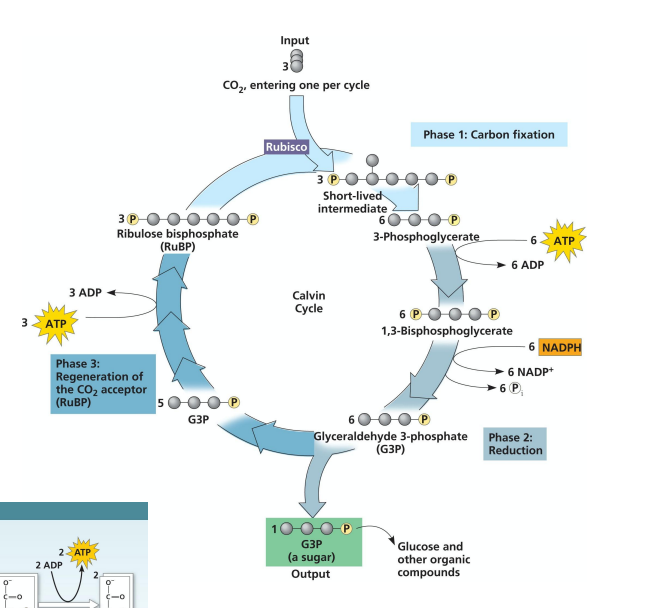
Briefly explain this diagram
The cycle starts with CO₂ entering.
Rubisco (kickstarts) attaches CO₂ to a 5-carbon molecule called RuBP.
This creates an unstable 6-carbon intermediate.
The 6-carbon molecule immediately splits into two
6 ATP + 6 NADPH (from light reactions) provide the energy and electrons needed to convert:
3-PGA → G3P (Only 1 out of 6 carbon leaves the cycle, the other 5 G3P stay in the cycle.)
The remaining 5 G3P are rearranged using 3 ATP.
To create the original 3 RuBP
Three turns of the cycle per one G3P molecule
9 ATP & 6 NADPH needed - therefore - 1.5 ATP for 1 NADPH
Light reactions produce the exact amount for the Calvin Cycle to function
What does the enzyme Rubisco do?
Its job is to attach CO₂ to a 5-carbon molecule (RuBP), starting the process of the Calvin Cycle.
to produce one G3P molecule involves ______ turns of the Calvin cycle.
three
what is Carbon Fixation?
1st phase of Calvin Cycle: process of taking CO₂ from the air and attaching it to an organic molecule using enzyme Rubisco.
What is Reduction?
2nd phase of Calvin Cycle: NADPH (from light reactions) provides electrons (and hydrogen) to help reduce molecules and turn them into G3P
What is the Regeneration of RuBP?
3rd phase of Calvin Cycle: After G3P is produced, some G3P molecules (5 stay in one leaves) are rearranged using ATP to remake RuBP. RuBP is then ready to bind more CO₂, so the Calvin cycle can start again.
Calvin Cycle reaction formula
3 CO2 + 6 NADPH + 9 ATP + 5 H2O → 1 G3P + 6 NADP+ + 9 ADP + 8 phosphate + 2 H+
Why is surface area important for both the mitochondria and chloroplasts?
Surface area is crucial because it increases the space available for proteins that allow processes such as ATP production in mitochondria and photosynthesis in chloroplasts, enhancing their overall efficiency and productivity.
Explain similarities and differences between Mitochondria(Cellular respiration) versus Chloroplasts (phtpsynthesis)
Electron transport chain of cellular respiration (exergonic):
Transfers electrons from NADH to O2 , producing NAD+ , H2O
Produces a proton-motive force that powers ATP production
Light reactions (endergonic):
Transfers electrons from H2O to NADP+ , producing NADPH and O2
Produces a proton-motive force that powers ATP production
What is Photorespiration?
Photorespiration is a process occurring in plants where oxygen is incorporated into the Calvin cycle instead of carbon dioxide, leading to the formation of a toxic two-carbon compound. it forces the cell to perform an energetically expensive process that reduces the efficiency of photosynthesis.
To identify the molecule that accepts CO2 (i.e., the molecule CO2 is added to), Calvin and Benson manipulated the carbon-fixation cycle by either cutting off CO2 or cutting off light from cultures of photosynthetic algae. They then measured the concentrations of various metabolites following the manipulation. How would these experiments help identify the CO2 acceptor?
explain why it is that answer

What are the two theories that there are for why plants don’t absorb green light?
Selection for consistency rather than maximal performance?
if a plant captured every wavelength it could lead to an inconsistent absorption of energy which could confuse the process of absorbing photons.
Competition with other organisms for a resource (sunlight)?
there are many species that need to absorb light if they are absorbed the same it would lead to competition with the other species to absorb the light can could cause some to suffer.
Competition Theory: Purple sulfur bacteria vs. cyanobacteria:
Purple sulfur bacteria are anoxygenic photosynthetic bacteria, meaning they use light for energy without producing O₂. Cyanobacteria (oxygenic) may have evolved to use different wavelengths of light, reducing competition for the same light resources. Later, some cyanobacteria were engulfed by early eukaryotic cells and became chloroplasts through endosymbiosis, likely because this provided a useful photosynthetic energy source.
Recall!!! what is Endosymbiosis
when one cell takes another cell inside it, and instead of destroying it, the two cells live together and benefit from each other.