anesthesia machines
 Call Kai
 Learn
Learn Practice Test
 Spaced Repetition
 Match
Match Flashcards
 Knowt Play
1/57

There's no tags or description
Looks like no tags are added yet.
Name | Mastery | Learn | Test | Matching | Spaced | Call with Kai | Chat |
|---|
No analytics yet
Send a link to your students to track their progress
58 Terms
Moduflex Elite
Anesthesia machine used in JSL.
American Society for Testing and Materials (ASTM)
Note: For machines used in humans; veterinary anesthesia machines are not required to meet similar standards.
Who sets the standards for anesthesia machine manufacture in the U.S.?
International Standards Organization (ISO)
Who sets the standards for anesthesia machine manufacture internationally?
1. Delivery oxygen
2. Deliver anesthetic gases
3. Remove exhaled carbon dioxide
4. Provide a means of intermittent positive pressure ventilation (IPPV; via squeezing rebreathing bag or ventilator attached to machine)
What are the different functions of the anesthesia machine?
1. Gas source (oxygen)
2. Pressure regulator
3. Flow meter
4. Vaporizer
5. Fresh gas outlet
Note: All anesthetic machines must have!
What are the five basic components of the anesthetic machine?
PSI (Pounds per square inch)
What units are used for compressed medical gases (such as O2)?
cmH2O (cm of water)
What units are used for airway pressure (ex. peak inspiration pressure during ventilation)?
mmHg (mm of mercury)
What units are used for blood pressure measurement?
2200 psi
Note: Converts to 154,682 cmH2O, 113,784 mmHg.
What is the pressure of a full oxygen cylinder?
1. High pressure: Up to 2200 psi
2. Intermediate pressure: 37-55 psi
3. Low pressure: Slightly above ambient pressure (
What are the different pressure areas within anesthetic machines?
High-Pressure Area
Pressure area of the anesthetic machine that accepts gases at cylinder pressure and reduces/ regulates this pressure.
1.Gas cylinders
2. Hangar yokes
3. Yoke blocks
4. High pressure hoses
5. Pressure gauges
6. Regulators
What components of the anesthetic machine are contained within the high-pressure area?
Intermediate-Pressure Area
Pressure area of the anesthetic machine that accepts gases from the central pipelines (wall outlet) or from the regulator of the anesthetic machine.
1. Pipeline outlet and inlets downstream of regulator up to flow meters
2. Oxygen flush valve
What components of the anesthetic machine are contained within the intermediate-pressure area?
Conduits and components after the flowmeter:
1. Vaporizers
2. Common gas outlet
3. Breathing circuit
What components of the anesthetic machine are contained within the low-pressure area?
1. Oxygen
2. Medical air
3. Nitrous oxide
What are the different types of gas sources (high pressure system)?
1. Green cylinder
2. Full = 2200 psi
3. Compressed gas
Describe oxygen as a high pressure system gas source.
1. Yellow cylinder
2. Full = 2200 psi
3. Compressed gas
Describe medical air as a high pressure system gas source.
1. Blue cylinder
2. Full = 745 psi (@ 21 degrees)
3. Liquid, gas interface
Note: Can't tell if near empty, as will be 745 psi until empty.
Describe nitrous oxide as a high pressure system gas source.
Note: Green top, silver bottom cylinders indicate they're made of aluminum (non-ferrous) = can use around an MRI.
Review the different sizes of high pressure medical gas cylinders.
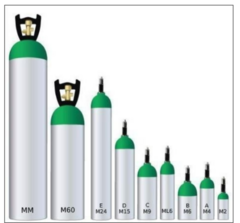
1. Liquid oxygen bulk tank
2. High pressure cylinders (more common)
What are the different sources of oxygen used in veterinary hospitals?
1. For high-use environments
2. Much more economic than compressed gas cylinders
3. Can be used in small hospitals via cylinder shaped carboys
What are the benefits to using liquid oxygen bulk tank systems?
1. Liquid systems attached to a pipeline system to distribute gas to the outlets in the hospital
2. Wall outlets and ceiling drops are placed strategically around the hospital
3. Piping system delivers gas in a preset, functional pressure range
Describe the medical gas piping system used with liquid gas bulk tank systems?
1. Pin Index Safety System (Small E cylinders)
2. Thread Diameter and Size Code System (Large G, H cylinders)
Note: Prevents misconnection of medical gas to the appropriate flowmeter or other medical gas devices.
What are the different noninterchangeable safety systems for medical gases?
Between the cylinder valve and regulator
Where are the different noninterchangeable safety systems for medical gases located on the anesthesia machine?
Valve Stem
Note: Where wrench is placed to turn on.
A?

T-Handle
B?

Cylinder Valve
C?

Gasket
Note: Creates a seal with the port (must have on machine!).
D?

To Anesthetic Machine
E?
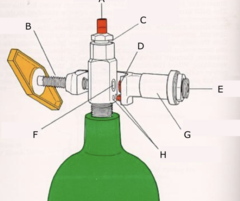
Gas Outlet
F?

Hanger Yoke Check Valve (Inside)
G?

"Pin-Indexed" Configuration
H?

1. Indicates current cylinder pressure
2. Reflects gas quantity with compressed gases (1100 psi = 50% full)
3. Does not indicate quantity in gases in a liquid state with gas interface (N2O)
What is the function of the pressure gauge for a high pressure system?
If taking a tank out to the field; can use the volume in the tank and the flow rate to calculate how long it'll last
What is a scenario when you might want to know how many liters of oxygen you will have from an oxygen cylinder?
true
(T/F) Oxygen tanks of varying sizes are all filled to approximately 2200 psi, but the volume of oxygen will vary with the size of the tank.
Decreases the pressure to 37-55 psi (depending on model)
What is the function of a pressure regulator?
Between the high pressure system and the intermediate pressure system
Where is the pressure regulator located on an anesthesia machine?
true
(T/F) Pressure at the wall outlet has already been reduced to intermediate pressure.
High pressure overrides that of the oxygen cylinder; prevents the need to turn of the oxygen cylinder when using a wall outlet
Regulatory pressure for a wall outlet will be set slightly higher than that of the anesthetic machine. Why?
Control, measure, and indicate the rate of flow of gas passing through it
What is the function of the flowmeter?
at the top
Where is then reading taken from a flowmeter with a float indicator?
in the middle
Where is then reading taken from a flowmeter with a ball indicator?
prior to
Oxygen flow should be turned off (prior to/ after) turning off the oxygen cylinde
1. Delivers a high flow of oxygen to the breathing circuit; 35-75 L/min. (intermediate pressure)
2. Bypasses the flow meter and vaporizer
3. Dilutes and flushes out anesthetic gases from the breathing circuit
Note: Rarely need to use.
What is the function of the oxygen flush valve.
1. Change a liquid anesthetic into a vapor
2. Add a precise, controlled amount of the anesthetic vapor to the flow of oxygen to the patient
What are the functions of a vaporizer?
1. Agent-specific (isoflurane = purple, sevoflurane = yellow) or multi-agent (cheap, but not recommended)
2. Precise (vaporizer puts out what is set on the dial)
3. Variable bypass (vs. measured flow)
4. "Flow over" vaporization with a wick
5. Out of the breathing circuit
6. Temperature compensated
7. Flow compensated
What are the properties of modern vaporizers?
Agent specific:
1. Isoflurane
2. Sevoflurane
3. or Desflurane ($$)
Multiple-agent:
1. Sevoflurane or isoflurane may be used separately in the same vaporizer
2. Do not have precise control of output; therefore not recommended
Compare and contrast agent-specific vs. multi-agent vaporizers
Variable bypass: Most common method in veterinary applications
Measured flow:
1. Old machines
2. Precise, but complex
3. Not recommended for professionals who are not dedicated anesthetists
Compare and contrast variable bypass vs. measured flow vaporizers.
Note: Variable bypass allows diluted concentration of vapor (vs. 30% at ambient pressure in a closed container, which is fatal); why cannot tip vaporizer on the side.
Review the variable bypass vaporizer (internal view).

1. Flow-over
2. Bubble-through (measured flow vaporizer)
What are the different methods of vaporization?
1. Gas flows over the liquid anesthetic
2. With a wick or without a wick
Describe flow-over vaporization.
1. Increases surface area for vaporization
2. Efficient in a broad range of temperature
3. Ensure complete saturation of gas passing through the vaporization chamber
What is the purpose of a wick in flow-over vaporization?
1. Outside the breathing circuit (more common)
2. Within the breathing circuit (not common)
What are the different locations of vaporizers in an anesthetic machine?
1. Carrier gas = fresh gas inflow
2. Not affected by patient ventilation
3. Safer for Intermittent Positive Pressure Ventilation (IPPV)
4. No water condensation
5. Requires a precision vaporizer
Describe vaporizers located outside the breathing circuit.
1. Located on the inspiratory arm of the breathing circuit
2. Carrier gas = inspiratory patient air flow
3. Increase in ventilation increases vaporization of the anesthetic, thus increasing the concentration in the circuit
4. Non-precise; anesthetic concentration is unknown
5. Water condenses in the vaporizer and into the liquid inhalant anesthetic (dilution)
Note: Used more often historically due to cheap cost; now uncommon.
Describe vaporizers located inside the breathing circuit.
1. If patient isn't ventilating, they will not vaporize anesthetic
2. If manually ventilating, cannot count on any vaporization occurring!
What are the major drawbacks with vaporizers located inside the breathing circuit?
fresh gas
Gas that exits from the common gas outlet following the flow meter and vaporizer; has not been inhaled or exhaled.