IB Psychology - Learning and Cognition 3.0
 Call Kai
 Learn
 Practice Test
 Spaced Repetition
 Match
 Flashcards
 Knowt Play
1/67

There's no tags or description
Looks like no tags are added yet.
68 Terms
Learnt behaviour
acquired through our experiences
Innate behaviour
genetic programs within us → harder to change (more rigid)
Classical conditioning
a type of learning, indirect, in which an initially neutral stimulus (NS) is paired with a stimulus that elicits a reflex response - an unconditioned stimulus (UCS). When this happens over time, the NS becomes a conditioned stimulus (CS). When the previously neutral stimulus is presented, there is a conditioned response (CR), as if the UCS were presented.
Unconditioned stimulus
A stimulus that prompts a natural, unlearned response
Neutral stimulus
A stimulus in the environment that does not lead to any natural response → NS becomes a CS after conditioning
Conditioned stimulus
A stimulus that used to be neutral → became associated with a response because it was connected to an unconditioned stimulus
Conditioned response
A response learned by pairing a neutral + an unconditioned stimulus
Extinction
when the conditioned response fades (as it is no longer pairing neutral stimulus + unconditioned stimulus together)
Example of classical conditioning

Study to pair with classical conditioning
Little Albert
Little Albert aim
how classical conditioning could be used to create fear response in a young child
Little Albert method and results
They paired a loud noise (unconditioned stimulus) with the presence of a white rat (neutral stimulus), causing Albert to fear the rat (conditioned response) without the noise
Aversion therapy (based on classical conditioning)
treatment based in classical conditioning, where an unpleasant stimulus is paired with an undesirable behaviour to reduce/eliminate behaviour
Example of aversion therapy
a person trying to quit nail biting might be given a nail polish that taste horrible every time they put their fingers in their mouth → over time, the negative association is intended to prevent behaviour
Operant conditioning
a type of learning in which behaviour is shaped by its consequences (rewards or punishment)
Thorndike’s law of effect
Response followed by satisfying consequences are more likely to be repeated → responses followed by unpleasant consequences are less likely to be repeated
Difference between operant and classical conditioning
Classical conditioning | Operant conditioning |
|
|
Reinforcement
increases behaviour
Positive reinforcement
A reward (giving something pleasant) to encourage the continuation of a behaviour → e.g. saying ‘good job’
Negative reinforcement
removal of an aversive stimulus (something negative) to encourage the continuation of a behaviour → e.g. removing dog’s leash
Punishment
decreases behaviour
Positive punishment
adding an aversive stimulus to discourage the continuation of a behaviour → e.g. receiving fines
Negative punishment
Taking away a reward to discourage the continuation of a behaviour → e.g. removing screen time
Types of scheduling for reinforcement
fixed scheduling
variable scheduling
Fixed scheduling
a reinforcement after a specific number of responses/specific amount of time → e.g. getting a free coffee after every 10 purchase
Variable scheduling
you expect a reward you don’t know when you will get it → e.g. you keep checking your social media with the hope that you will get “like”
How to answer a 1b Q that doesn’t come with a lengthy scenario
clear understanding of theory
an example of it
explanation why that particular strategy could work
An example of this type of Q1b
Chris is highly disruptive in class. He talks a lot with his friends, often making it difficult for others to focus on the teacher's presentation. Explain how operant conditioning could be used to change Chris's behaviour
Social learning theory (SLT)
emphasizes that learning (indirect) can occur without direct experience, relying instead on attention, retention, reproduction + motivation to guide the observational learning process
4 cognitive mechanism for SLT
attention
retention
reproduction
motivation
attention
learner must pay attention to the model to learn a behaviour
Several factors may influence our level of attention → e.g. attractiveness, relevance, other distractions, fatigue + observer’s cognitive abilities
retention
observer must be able to remember the behaviour that has been observed to produce it immediately/after some time
potential
individual must have the physical and/or mental ability to replicate the behaviour
Key aspect → self-efficacy; the individual has to feel that they are able to do this if they try
motivation
individual must want to replicate the behaviour that they have observed
Key aspect → vicarious reinforcement → if they see model rewarded for the behaviour, observer most likely to imitate it
Example of SLT
John paid attention to when his brother pushed another child (he noticed it because he looks up to him)
John then retained this information
John was potentially capable of reproducing the behaviour (pushing a classmate over)
John was motivated to show his aggressive behaviour because his brother had got sweets off the child he had pushed
Reciprocal determinism
individuals are influenced by the environment + also influence the environment themselves
Society + culture can influence an individual but individuals can also influence culture/society → results in new cultural + societal norms
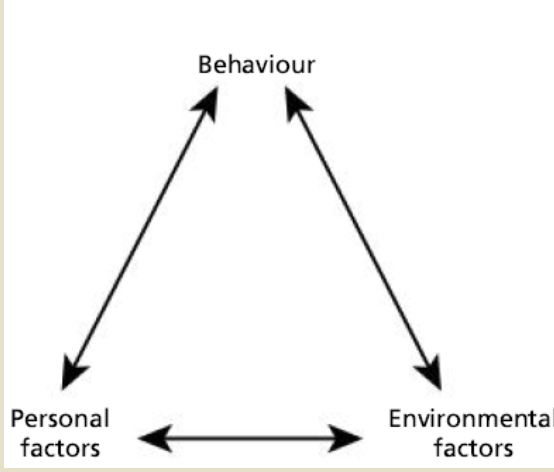
What to mention when writing about SLT
indirect learning
4 cognitive mechanisms
reciprocal determinism
Factors influencing limitation of models
consistency
identification with model
liking a model
behaviour is rewarded
consistency
If the model behaves consistently across situations, then the observer will be more likely to imitate it
identification with model
we show an in-group bias when deciding whether to imitate a model
liking a model
Warm + friendly models are more likely to be imitated
behaviour is rewarded
If the model's behaviour is rewarded, we are more likely to imitate the behaviour to receive same reward
Bandura et al (1961) aims
wanted to see if children would imitate aggression modeled by an adult
wanted to know if children were more likely to imitate same-sex models
Bandura et al (1961) IVs for first aim
agressive model
non-aggressive model
no model (control group)
Bandura et al (1961) IVs for second aim
male role model
female role model
Bandura et al (1961) results
children in the aggressive model condition displayed more aggressive responses than the children in the non-aggressive model condition
Cognitive mechanisms in Bandura et al
Attention – children had to pay attention to the model's behaviour → watched an adult act aggressively towards Bobo doll, making behaviour more engaging
Retention – children needed to remember what they saw → mentally stored aggressive actions → e.g. hitting walking so they could recall later
Reproduction – children must be able to replicate the behaviour → when given chance, physically imitated the aggressive actions towards Bobo doll
Motivation – must be reason/incentive to perform behaviour → kids more likely to imitate as role model was rewarded/least not punished
Strengths for SLT
the theory is robust → can be applied to explain a lot of different behaviours
several variables that may increase the likelihood that a behavior will be imitated → increases the theory's predictive power
Limitations for SLT
difficult to test under naturalistic conditions → difficult to control for extraneous variables
Several constructs → e.g. motivation + attention level are difficult to measure
has a strong bias toward the "nurture" side of the argument → today, psychologists argue that social learning interacts with our physiology, leading to behaviour → on its own, social learning cannot explain individual differences
Disinhibition
lack of inhibitory control (not able to stop/delay impulses) → e.g. when a child shows ‘naughty’ behaviour + adult disciplines them aggressively, so it teaches child more aggressive behaviour
Motivation
a person’s willingness to exert effort for their own goals
Types of motivation
intrinsic
extrinsic
Intrinsic motivation
an incentive to engage in a specific activity that derives from pleasure in the activity itself → e.g. genuine interest
Example of goals: passion, fun, purpose
Extrinsic motivation
to engage in a specific activity, especially motivation arising from the expectation of punishment/reward → e.g. job in exchange for salary
Example of goals: promotion, benefits
If someone is intrinsically motivated
enjoys learning for its own sake → more likely to see effort as valuable + reinforce a growth mindset → has a belief that improvement is possible + leads to even greater persistence
Growth mindset
believes abilities can be developed
If someone is extrinsically motivated
failure can feel like a sign of personal inadequacy rather than part of the learning process → reinforces a fixed mindset → makes someone less willing to push through difficulties/take risks
Fixed mindset
believes abilities are innate + unchangable
Bidirectional ambiguity in fixed minset
growth mindset fuels motivation + strong motivation reinforces a belief in growth
Mindset theory
explains how our beliefs about intelligence + ability influence levels of motivation in learning + how successful it is → motivation and mindset are intertwined
Growth mindset fosters intrinsic motivation
more likely to stay motivated since they believe in growth
Fixed mindset fosters extrinsic motivation
people rely on external rewards → e.g. grades, praise
Strengths of mindset theory
Simple + clear to apply in real world setting → e.g. school, workplace
Research shows that small shifts to growth mindset leads to better effort, greater resilience + improved achievement
Empowers individuals by showing abilities are not fixed → inspire people to take control of their own learning + growth
Limitations of mindset theory
Reductionist approach → oversimplification of motivation by reducing a complex process to 2 categories
Motivation is influenced by many other factors → e.g. emotions, social environment, self-esteem, cultural expectation + personal goals
Growth mindset can be interpreted in different ways → hard to measure consistently
Participant variables → personality, prior experiences + cultural background can affect how (or if) mindset influences behaviour
Not many research have replicated the findings successfully
Measurement of motivation
Self-report questionnaires - measures individuals’ agreement with statements involving growth vs fixed mindset statements in standardised assessments
Behavioural observations - observe how people react to challenges, failure + effort in learning tasks
Brain imaging techniques - e.g. fMRI + EEG help researchers explore how mindset affects learning + motivation at a neurological level → those with growth mindset show more brain activity in the ACC when making mistakes → suggesting they engage in more problem solving skills. Those with a fixed mindset show less neural activity → indicates they may ignore/avoid processing mistakes → amygdala activated (for emotions → e.g. frustration, fear of failure)
Limitations of measurements
Self-report questionnaires
Social desirability bias → people may respond in a way that seems positive rather than reflecting their true belief
Situational variation → someone may have a growth mindset in 1 area but a fixed mindset in another
Interpretation of the scale → may interpret the scale differently
Behavioural observations
Reactivity → Ps may act differently because they know that they are being observed
Brain imaging techniques
Expensive + difficult to use in large-scale studies → limits generalizability → low ecological validity
Not practical for everyday mindset assessments
Self - determination theory (SDT)
proposes that motivation depends on 3 basic psychological needs to satisfy
SDT - 3 psychological needs
Autonomy → feeling of choice + control over your actions
Competence → feeling that you are capable of performing an activity → leads to greater sense of self-confidence + increase in persistence
Relatedness → feeling connected to + supported by others → a sense of belonging