final -- oxidative phospho
 Call Kai
 Learn
 Practice Test
 Spaced Repetition
 Match
 Flashcards
 Knowt Play
1/15

There's no tags or description
Looks like no tags are added yet.
16 Terms
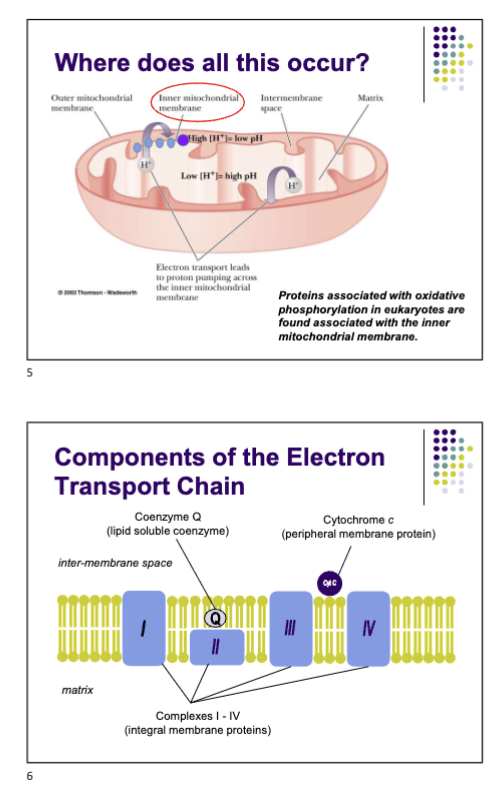
state subcellular location of oxidative phospho
inner mitochondrial membrane — all oxdative phosphorylation + proteins associated with OP. = all located in there :3
ஃ ETC = PRESENT AT INNER MITOCHONDRIAL MEMBRANE
ஃ PROTON PUMP = SURROUNDING THAT MEMBRANE
components of ETC
recall ETC = inbetween the INTERMEMBRANE SPACE + the MATRIX (think like mito cytosol)
INTERMEMBRANE SPACE ——— + cytochrome C (peripheral membrane)
phospholipid bilayer
complexes I-IV (1-4) = integral membrane proteins
coenzyme Q (lipid soluable coenzyme) = buried in the phospho tails
MATRIX ———
therefore 6 components = complex 1-4 + Q + Cyt C :)
Identify four distinct electron-carrying cofactors that play a role in re-oxidation of FADH2 and NADH by the electron transport chain:
PROSTHETIC GROUPS: 1-4
Flavin mononucleotide (FMN) FMN + 2H+ + 2e- ⇌ FMNH2 in complex 1
*similar to FAD/FADH but ≠ adenosine
Ion sulfur clusters → Fe3+ + e ⇌ Fe 2+ ஃ can only carry 1e- at a time
Copper Cu2+ = e- ⇌ Cu+ incomplex IV
Cytochrome heme groups (hemoproteins) — heme iron switches between reduced + oxidized states → Fe3+ + e ⇌ Fe 2+
* heme/myoglobin CANT switch out its iron state to oxidize/redyced
coenzyme Q → ubiquinol (RA) + ubiquinone (OA)
lipid soluable moelcule
function : complex I + II transfers e- → Q → complex III @ inner membrane
therefore cosidered a COSUBSTRATE for ALL THREE COMPLEXES
ஃ to facilitate transfer — must adopt temperorary reduced state (ubiquionol QH2) THEN convert to oxidized state (ubiquione Q + 2H+ e-) after transfer to complex III
*free energy comes = transfer from low potential + HIGH REDUCT ION potential = energy used to transport protons across membrane (primary active transport)
ஃ complex transfers = PROD. free energy = powers proton from intermembrane space → matrix in ETC
NADH → e → pathway in intermembrane space
1 nadh oxidized → NAD+ 2H+ + 2e-
*every 1NADH → moves 10 PROTONS (from matrix) into INTERMEMBRANE SPACE
2e- → transfer to coenzyme Q ஃ prod. ubiquionol ↴
ubiquinol ® → ubiquinone + 2e- → cytochrome C
*free energy = moves 4H+ from matrix → INTERMEMBRANE
cytochrome C transfers 2e- → complex III → transfers 2e- onto ½ O2
correct stoichiometry
*ஃ reducing 1 O2 = transports 4H+ into INTERMEMBRANE
*O2 has the GREATEST REDUCTION POTENTIAL ஃ that pathway w/ O2 being final releases enough energy to set gradient (intermembrane = LOTS of H+ → flow passive to gradient)
how does electron transport impact conformation of complexes
basically complex takes in H+ from matrix → UNDERGOES REDUCTION ஃ + e- → results in COMFORMATION so H+ present to iNTERMEMBRANE SPACE
when complex LOSES THIS e- → ஃ get oxidized ஃ reverts to conformation facing to matrix → cycle restarts
*this is a form of primary active transport → ie redox reaction provides energy)

complex II = succinate dehydrogenase (apart of citric acid cycle)
complex II = integral membrane protein + ALSO contains FAD (prosthetic group)
succinate ⤴ ⤷ fumerate (apart of citric acid cycle)
(oxidatative)
succinate → transitioning fumerate = LOSES electrons ஃ complex II → oxidative process
electrons gained = → onto creates ubiquinol
at complex II → no PROTONS ARE MOVED — i guess the reduction energy is too low
transition of succinate → e- → to form ubiquinol ≠ release lot of energy (0.03V)

activation of ATP synthase — oxidative phosphorylation
1 ATP → needs 3H+ + ATP synthase
ஃ 1NADH → 10 protons ஃ 3 ATP created (3 proton go into Fo x 3 ATP → 9H+ + 1H+)
1 ATP → needs H+ + Pi
ஃ for ATP to be made → 4HT ARE REQUIRED !! (3H+ comes from NADH/FADH + ATP SYNTHASE, H+ comes from Pi—H+ SYMPORTER to matrix
ATP synthase → composed of 2 components
Fo (transmembrane protein) → the part thats mechanically powered by protons → PMF triggers F1 conformational change
F1 (catalytic/synthesize portion) → converts ADP + Pi → ATP (in matrix)
*therefore rate of ATP synthesis = dependent on proton movement
proton movement = depends on OXYGEN BEING REPLENISHED!! ↴
recall that e- final reductive power = from o2 → ஃ reduced o2 = water !! ஃ we need to replenish O2 since its constantly being converted

adenine nucleotide translocase + pi-h+ symport
new ATP in matrix → transported into intermembrane ஃ → into cytosol
in cytosol = drive energy required proccess → ADP + PI BACK IN INTERMEMBRANE (passively go through back to matrix)
H+ transports Pi @ same time → into matrix for ATP synthesis @ F1
oxidation + phosphoylation = coupled - high + low reserves
rate of oxygen consumption = connected to rate of ATP synthesis ஃ its coupled !!
if o2 ↓ ஃ rate atp syn ↓ as well
O2 consumption ↑ if ADP concentrations rise in matrix → obviously so we can convert that into ATP
*ADP concentration = reflect energy consumption of cell → GOOD consumption = constantly HIGH ADP WASTE IN MATRIX THAT CAN BE CHURNED INTO ATP !!!
*rate of oxidative phosphoryaltion = determined by relative concentration of ADP
basically high ETC productivity = “ to small H+ in cytosol
P:O ratio - FIX PLEASE
P:O ratio = how much ATP (P) = produced from reduction of O2
P:O is not very stoichiometric btw = 1NADH → 2e → 2ATP
non stoichiometric ratio →
P:O ~2.5 for NADH reoxidized (math works in relation from 10H+/4H+ required for ATP)
P:O ~1.5 for FADH2 reoxidized (math works in relation from 6H+/4H+ required for ATP)
P:O ratio may vary with uncoupled rxns
low energy coupling in oxidative phosphorylation:
low energy use:
if theres no ADP in the matrix ஃ synthase literally cannot operate since it NEEDS ADP + P present to turn ஃ synthase DOWN + CANNOT OPERATE ↴
if synthase is down then H+ DOESNT GO TO MATRIX → gets concentrated in cytosol
too concentrated in intermembrane/cytosol = ETC slows down since reductive energy ≠ enough to overcome electrostatic/chemical gradient
complexes then shut down since they cannot pump protons ஃ cannot accept electron ↴ → proton + electron transport is COUPLED !! without one cant do with other
≠ accept electrons = O2 ≠ BEING CONSUMED
NADH ↑ FADH ↑ ஃ ↓ PDF + CAC (citric acid cycle)
ஃ ONE THING BACKS UP = EVERYTHING BACKS UP
rate of NADH reoxidation (lose e-) + rate of ETC + rate of oxygen consumption = CALL CONNECTED (via magnitude of H+) TO RATE OF CONSUMPTION + SYNTHESIS OF ATP
high energy coupling in oxidative phosphorylation
HIGH ADP + Pi → synthase activity ↑ஃ proton gradient = HIGH EXPORT TO MATRIX → therefore low proton % in cytosol→intermembrane space = HIGH ETC PRODUCTIVITY

oxygen consumption ↑ in isolated micro when ATP synthesis ↑
uncoupled systems
Uncoupled systems → allow proton to → into matrix without ATP SYNTHESIS
therefore lowk waste of protons
generates heat rather than ATP
*in this case → electrons don’t get backed up.. its used by uncouplers
ஃ since h+ is being transported — need to replenish so uncoupled ↑ = oxygen ↓
brown adipose tissue =
mammals = utilized uncouple oxidative phosphorylation → deliberate generate heat

2-4 ditntrophenol
2-4 dintrophenol → effective diet pill but looks fatal
certain poisons work by dissipating the proton electrochemical gradient
cytosol ≠ have proton since it’s replaced by 2-4 dinitrophenol (DNP) ஃ ATP ≠ do it’s thing
