Exam 2 Microbio Lecture 🍀🤞
 Call Kai
 Learn
 Practice Test
 Spaced Repetition
 Match
 Flashcards
 Knowt Play
1/50

There's no tags or description
Looks like no tags are added yet.
51 Terms
Endergonic reactions
absorb energy
Exergonic reactions
release energy
Synthesis Reactions
Atoms, ions, or molecules combine to form new, larger molecules Eg. Anabolism
Decomposition Reactions
A molecule is split into smaller molecules, ions, or atoms Eg. Catabolism
Exchange Reactions
Are part synthesis and part decomposition
Reversible Reactions
Can readily go in either direction. Each direction may need special conditions
Metabolism
The sum of the chemical reactions in an organism
Catabolism
Provides energy and building blocks for anabolism
Anabolism
Uses energy and building blocks to build large molecules
Role of ATP in Coupling Reactions
by linking a favorable, energy-releasing process (exergonic) with an unfavorable, energy-demanding process (endergonic) so that the overall reaction can proceed
Enzymes
Biological catalysts, Specific for a chemical reaction; not used up in that reaction
enzyme components
Apoenzyme- Protein
Cofactor- Nonprotein component
Coenzyme- organic cofactor
Holoenzyme- Apoenzyme plus cofactor
The Mechanism of Enzymatic Action

Enzyme Classification
Oxidoreductase: Oxidation-reduction reactions
Transferase: Transfer functional groups
Hydrolase: Hydrolysis
Lyase: Removal of atoms without hydrolysis
Isomerase: Rearrangement of atoms
Ligase: Joining of molecules, uses ATP
Factors Influencing Enzyme Activity
Temperature, pH, Substrate concentration, Inhibitors
Enzyme Inhibitors
Competition and Noncompetitive Inhibition
electron reactions
Oxidation- removal of electrons
Reduction- gain of electrons
Redox reaction- An oxidation reaction paired with a reduction reaction
how is atp generated
by the phosphorylation of ADP
Substrate-Level Phosphorylation
Energy from the transfer of a high-energy PO4– to ADP generates ATP

Carbohydrate Catabolism- 3 Steps
Glycolysis
Krebs cycle
Oxidative phosphorylation
Glycolysis 1
The oxidation of glucose to pyruvic acid produces 4 ATP and NADH
Preparatory Stage of Glycolysis 1.1
• 2 ATP are used
• Glucose is split to form 2 glucose-3-phosphate
Energy-Conserving Stage of Glycolysis 1.2
2 glucose-3-phosphate oxidized to 2 pyruvic acid
4 ATP produced
2 NADH produced
Alternatives to Glycolysis 1.3
Pentose phosphate pathway- Uses pentoses and NADPH, Operates with glycolysis Eg. B. subtilis, E. coli
Entner-Doudoroff pathway- Produces NADPH and ATP, Does not involve glycolysis Eg. Pseudomonas, Rhizobium, Agrobacterium
Intermediate Step 2
Pyruvic acid forms Acetyl CoA
Krebs Cycle (TCA or Citric Acid Cycle) 3
Oxidation of acetyl CoA produces 2 ATP and NADH and FADH2
Oxidative Phosphorylation
Electron Transport Chain - series of carrier molecules oxidized & reduced as electrons pass down the chain
Chemiosmosis - energy released used to produce ATP

******Know the following for each step of Carbohydrate Catabolism- # of ATP, O2 requirement,
input, output, Location

fermentation
Does not require oxygen, Does not use the Krebs cycle or ETC, Uses an organic molecule as the final electron acceptor
Two types:
Alcohol fermentation: Produces ethanol + CO2
Lactic acid fermentation: Produces lactic acid
Heterolactic fermentation: Produces lactic acid and other compounds
Homolactic fermentation: Produces lactic acid only
Requirements for Growth
• Physical requirements:
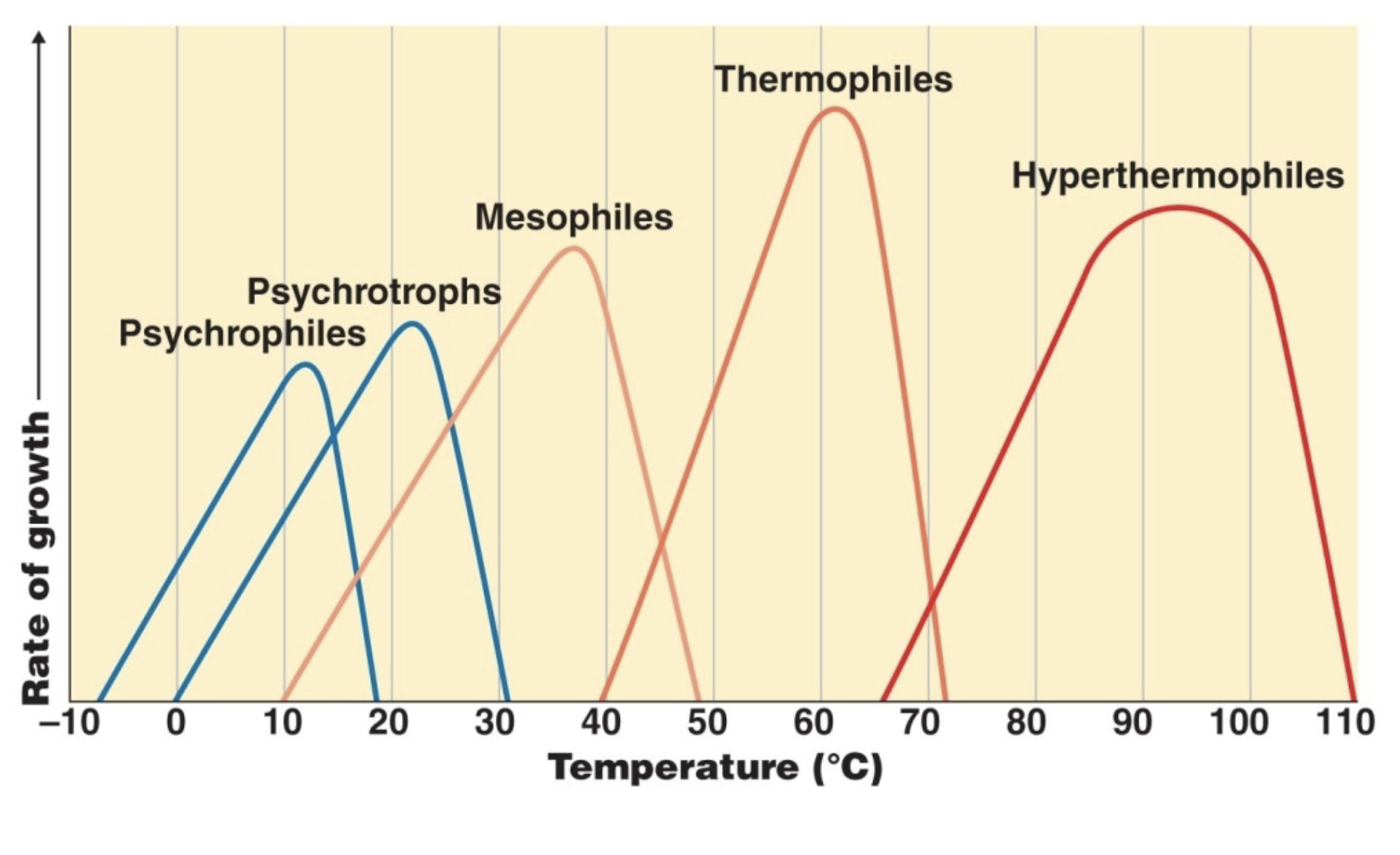
Temperature
pH
Osmotic pressure
• Chemical requirements
Carbon
Nitrogen, sulfur, and phosphorous
Trace elements
Oxygen
Organic growth factor
classification according to physical requirements
Acidophiles grow in acidic environments
extreme/obligate halophiles require high osmotic pressure
Facultative halophiles tolerate high osmotic pressure
Barophiles – can survive under extreme pressure and will rupture if exposed to normal atmospheric pressure
The Effect of Oxygen (O2) on Growth
Toxic Oxygen, Singlet oxygen, Superoxide free radical, Peroxide anion, Hydroxyl radical
Organic Growth Factors
• Vitamins
• Amino acids
• Purines
• Pyrimidines
biofilms
Microbial communities, Form slime or hydrogels, Bacteria attracted by chemicals via quorum sensing
biofilm safety levels
1: No special precautions
2: Lab coat, gloves, eye protection
3: Biosafety cabinets to prevent airborne transmission
4: Sealed, negative pressure, Exhaust air is filtered twice
Reproduction in Prokaryotes
• Binary fission
• Budding
• Conidiospores (actinomycetes)
• Fragmentation of filaments
Phases of Growth
1. Lag phase
2. Exponential growth phase
3. Stationary phase
4. Death phase
Measuring Microbial Growth
Direct Methods
• Plate counts
• Filtration
• Direct microscopic count
Indirect Methods
• Turbidity
Transcription
DNA is transcribed to make RNA. Can be divided into 3 steps-
A)Initiation- RNA polymerase binds to the promoter sequence
B)Elongation – RNA synthesized by addition of complementary bases on DNA template
C)Termination - Stops when RNA pol reaches the terminator sequence
translation
mRNA is translated into protein
Translation of mRNA begins at start codon: AUG
Translation ends at nonsense codons: UAA, UAG, UGA
The Genetic Code
64 codons, 61- sense codons on mRNA encode the 20 amino acids
The genetic code is degenerate
tRNA carries anticodon, single RNA strand (80 nucleotides), L-shaped (like a cloverleaf)
Ribosomes
Facilitate coupling of tRNA anticodons with mRNA codons
The two ribosomal subunits (large & small)
ribosomes binding sites
P site holds the tRNA that carries the growing polypeptide chain
A site holds the tRNA that carries the next amino acid to be added to the chain
E site is the exit site, where discharged tRNAs leave the ribosome
step 1 in protein synthesis - initiation
-Brings together mRNA, tRNA with the first amino acid, two ribosomal subunit
Small ribosomal subunit binds with mRNA
AUG (start) codon signals interaction of ribosome w/ mRNA & tRNA with anticodons (UAC)
Anticodon: 3’ UAC 5’
Codon: 5’ AUG 3’
Methionine is attached to the tRNA - initiates protein synthesis
step 2 in protein synthesis - elongation
a) Codon recognition -Different tRNA continue to read the next codon
b) Peptide bond formation - Matching with anticodons , forms a peptide bond with extending peptide chain
c) Translocation - tRNA is hydrolysed to join another amino acid
step 3 in protein synthesis - termination
Ribosome hits STOP codon (UAA, UGA, UAG); Release of the amino acid chain
Regulation of Gene Expression
Constitutive genes- expressed at a fixed rate
Repressible genes, Inducible genes, Catabolite repression- expressed as needed