Matching Common Names to Taxonomy (Picture First)
 Call Kai
 Learn
 Practice Test
 Spaced Repetition
 Match
 Flashcards
 Knowt Play
1/26

There's no tags or description
Looks like no tags are added yet.
27 Terms
Shrews, Moles, Desmans, Hedgehogs, and Gymnures belong to the Order Eulipotyphyla.
High diversity (564 Species)
North America, Eurasia, & Africa
Odd traits - venom, unicuspids, echolocation, iron teeth for durability etc...
Shrews, Solenodons, Moles/Desmans, Hedgehogs, and Gymnures belong to the Order _______________________ within the superorder Luarasiatheria.

ALL Bats are a part of the Order Chiroptera.
ALL Bats are a part of the Order __________________________ within the super order Laurasiatheria.

The Suborder of Chiroptera that was formally known as the "Megabats" (which now contains all of the Megabat species and 5 of the Microbat species) and contains many "Fruit-bats" is Yinpterochiroptera.
Yin = Mega/Slow
The Suborder of Chiroptera that was formally known as the "Megabats" (which now contains all of the Megabat species and 5 of the Microbat species) and contains many "Fruit-bats" is _______________________ .

The Suborder of Chiroptera that contains most of the Microbat Species (small, use more echolocation, mostly insectivorous)
Specifically: Vesper bats, Leaf-nosed bats, and Vampire bats is Yangochiroptera.
Yang = Micro
The Suborder of Chiroptera that contains most of the Microbat Species (small, use more echolocation, mostly insectivorous)
Specifically: Vesper bats, Leaf-nosed bats, and Vampire bats Burrowing Bats is _______________________ .

Megabats, including flying foxes (fruit bats) belong to the Family Pteropodidae within the Suborder Yinpterochiroptera. The MIcrobats within Yinpochiroptera are Non-Pteropodidae and have laryngeal echolocation with tragus in their ears.
Pteropodidae (Flying Foxes) is the largest family in Yinpterochiroptera. They only use simple echolocation (tongue clicks) or none at all. They have large eyes for echolocation. They are also known for being seed dispersers.
Non-Pteropodidae in Yinpterochiroptera include microbats, horseshoe bats, and false vampire bats.
Megabats, including flying foxes (fruit bats) belong to the Family ___________________________ within the Suborder Yinpterochiroptera. The MIcrobats within Yinpochiroptera are _____________________ and have laryngeal echolocation with tragus in their ears.

Traits :
- Microbats have Laryngeal echolocation (from the larynx/vocal cords, not tongue)
- Ears have a tragus
- Often complex nose and face folds
- Around 1,030 species
- Cosmopolitan except in polar regions
- Mostly insectivorous
What are the traits of Microbats in Yangochiroptera?

Euarchontoglires is the Superorder that contains Eurachonnta: (Scandentia, Dermoptera, Primates), and Glires: (Lagomorpha and Rodentia).
_______________________ is the Superorder that contains Eurachonnta: (Scandentia, Dermoptera, Primates), and Glires: (Lagomorpha and Rodentia).

The grandorder Euarchonta contains orders Scandentia, Dermoptera, and Primates.
The grandorder Euarchonta contains orders _____________________, ____________________ , and ___________________.

Scandentia, Dermoptera, and Primates belong to the grandorder Euarchonta within the Superorder Euarchontoglires.
Scandentia, Dermoptera, and Primates belong to the grandorder ___________________ within the Superorder Euarchontoglires.

Tree Shrews belong to the Order Scandentia.
Scandentia is within the grandorder Euarchonta and the superorder Euarchontoglires.
Tree Shrews belong to the Order ___________________.

Colugos belong to the Order Dermoptera.
Dermoptera is within the grandorder Euarchonta and the superorder Euarchontoglires.
Low diversity (2 species)
Rival bats for most extensive patagium of any mammal
Glide (no active flight)
Colugos belong to the Order ___________________ .

The order Primates (within Euarchonta) contains the suborders Strepsirrhini and Haplorrhini.
The order Primates (within Euarchonta) contains the suborders __________________ and __________________ .

Lorises, Bushbabies, and Lemurs belong to the Suborder Strepsirrhini.
They have a Wet Nose (rhinarium) and curved/twisted nostrils
Euarchontoglires -> Euarchonta -> Primates -> Strepsirrhini
Lorises, Bushbabies, and Lemurs belong to the Suborder _________________ within the order Primates.

Tarsiers, New world Monkeys, Old World Monkeys, Great Apes, and Gibbons belong to the Suborder Haplorrhini.
They have dry noses
Euarchontoglires -> Euarchonta -> Primates -> Happlorrhini
Tarsiers, New world Monkeys, Old World Monkeys, Great Apes, and Gibbons belong to the Suborder ______________________ within the order Primates.

Marmosets, capuchins, squirrel monkeys, and tamarins are New-World Monkeys.
Their noses point to the side
Marmosets, capuchins, squirrel monkeys, and tamarins are ______________ -World Monkeys.

Baboons, macaques, mandrills, and proboscis monkeys are Old-World Monkeys.
Their noses point down
Baboons, macaques, mandrills, and proboscis monkeys are _______________ -World Monkeys.

Lagomorpha and Rodentia belong to the grandorder Gires within the Superorder Euarchontoglires.
Lagomorpha and Rodentia belong to the grandorder ___________________ within the Superorder Euarchontoglires.

The grandorder GIlres contains the orders Lagomorpha and Rodentia.
The grandorder GIlres contains the orders _________________ and ___________________ .
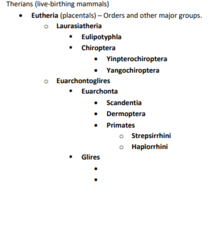
Hares, Rabbits, and Pikas belong to the order Lagomorpha.
Lagomorpha belongs to the grandorder Glires.
Hares, Rabbits, and Pikas belong to the order _______________________ .
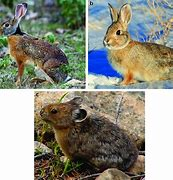
Porcupines, Capybaras, Chinchillas, Guinea Pigs, Naked Mole-Rats, Squirrels, Groundhogs, Mountain Beavers, Springhares, Scaley-tailed Squirrels, Beavers, Gophers, Kangaroo Rats, Most Mice, Rates, Voles, Gerbils, etc... belong to the Order Rodentia.
Rodentia belongs to the grandorder Glires. And have everrowing teeth.
Porcupines, Capybaras, Chinchillas, Guinea Pigs, Naked Mole-Rats, Squirrels, Groundhogs, Mountain Beavers, Springhares, Scaley-tailed Squirrels, Beavers, Gophers, Kangaroo Rats, Most Mice, Rates, Voles, Gerbils, etc... belong to the Order ________________________ .
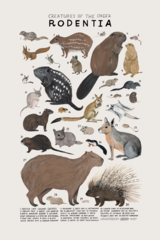
What are the 5 Major Groups of Rodentia?
1) Hystricomorpha (porcupines, naked mole-rats, etc...)
2) Sciuromorpha (Squirrels, Groundhogs, etc...)
3) Anomalomorpha (Springhares and Scaley-tailed Squirrels)
4) Castorimorpha (Beavers, Gofers, Kangaroo Rats)
5) Myomorpha (Most Mice, Rats, Voles, Muskrats, etc...)
The order Rodentia contains 5 Groups, What are they?
(you will need to know these)

Porcupines, Naked Mole-Rats, Capybaras, Chinchillas, and Guinea Pigs belong to the Suborder Hystricomorpha.
Hystricomorpha blongs to the Order Rodentia and the grandorder Glires.
Traits:
- They have large infraorbital foramen
- Found mainly in South Am, Africa, and Southeast Asia
- Naked Mole Rats are Weird
Porcupines, Naked Mole-Rats, Capybaras, Chinchillas, and Guinea Pigs belong to the Suborder _________________________ .

Squirrels, groundhogs, and Mountain beavers belong to the Suborder Sciuromorpha.
Sciuromorpha belongs to the Order Rodentia and the grandorder Glires.
"Squirrels" (Sciuridae) incudes ground (marmots, chipmunks, groundhogs/woodchucks, prairie dogs), tree, and flying squirrels.
Many (not all) hibernate over winter.
Squirrels, groundhogs, and Mountain beavers belong to the Suborder ____________________ .

Springhares and Scaley-tailed squirrels belong to the Suborder Anomalomorpha.
Anomalomorpha belongs to the Order Rodentia and the grandorder Glires.
"Anomalous" rodents because they have a hystricomorph-like cranium and a sciuromorph-like mandible (Grouped based on DNA, but still under debate - we need more data).
They live in Africa
Springhares and Scaley-tailed squirrels belong to the Suborder ____________________ .

Beavers, Gophers, and Kangaroo Rats belong to the Suborder Castorimorpha.
Castorimorpha belongs to the Order Rodentia and the grandorder Glires.
Mostly North Am, some range into South Am (Three very distinct families (all in MT))
- Beavers
- Pocket Gofers
- Kangaroo Rats
Beavers, Gophers, and Kangaroo Rats belong to the Suborder __________________________ .
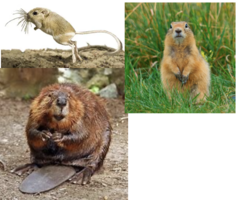
Most Mice, Rats, Voles, Gerbils, and Muskrats belong to the Order Myomorpha.
Myomorpha belongs to the Order Rodentia and the grandorder Glires.
¼ of all mammals are myomorphs
Part of the masseter passes through the eye socket - unique for mammals
Most Mice, Rats, Voles, Gerbils, and Muskrats belong to the Order _____________________________ .

Give at least three taxa with species that have independently evolved a patagium:
1) Chiroptera (Bats)
2) Sciuromorpha (Flying Squirrels)
3) Dermoptera (Colugos/Flying Lemurs)
Give at least three taxa with species that have independently evolved a patagium: