Information Theory Weeks 1-2
 Call Kai
 Learn
 Practice Test
 Spaced Repetition
 Match
 Flashcards
 Knowt Play
1/37

There's no tags or description
Looks like no tags are added yet.
38 Terms
Shannon's two limits: Entropy and Capacity
Entropy H(X): The limit of lossless compression; How few bits can represent information?
Capacity C: The limit of reliable communication; How fast can information be transmitted?
Entropy: Definition and Meaning
Entropy measures the average uncertainty of a random variable.
Entropy formula

Binary Entropy
A binary random variable has two possible outcomes, 0 and 1.

Uniform Distribution
Every possible outcome has the same probability

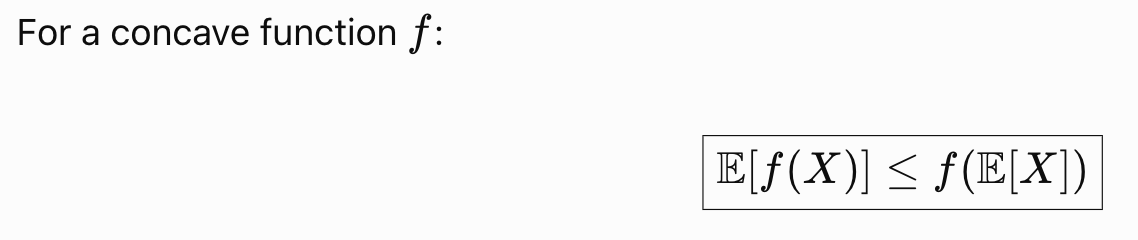
Jensen's Inequality (Concave Form)
A function is concave if it curves downward, like an upside-down bowl.
The average of a concave function's outputs is less than or equal to the function evaluated at the average input.
Bounds on Entropy

|X| means the number of possible outcomes
When does maximum entropy occur?
When all possible outcomes are equally likely.
Entropy as the Average Number of Yes/No Questions
Imagine I secretly select one of eight equally likely numbers.
You need to figure out which number I chose by asking yes/no questions.
A good strategy is to eliminate half the remaining possibilities with each question.
ex: takes 3 questions (bits) find one of eight equally likely numbers
Joint entropy
Measures the uncertainty of two random variables considered together

Joint entropy when X and Y are independent

Joint entropy when Y = X
H(X,Y) = 1 bit
Because once you know X, you automatically know Y.
The chain rule

Total uncertainty = uncertainty of the first variable + uncertainty remaining about the second after learning the first.
Conditional Entropy
How much uncertainty remains about Y after we observe X?
Conditional Entropy Formula


Find the entropy of Y for each possible value of X.
Weight each conditional entropy by the probability of that X.
Add them together.
Condition ___ entropy
Reduces

Conditional Entropy cases

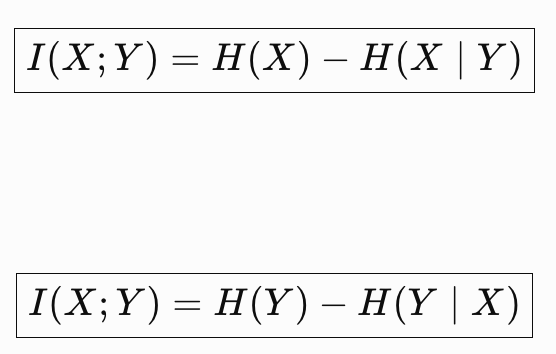
Mutual Information: Definition
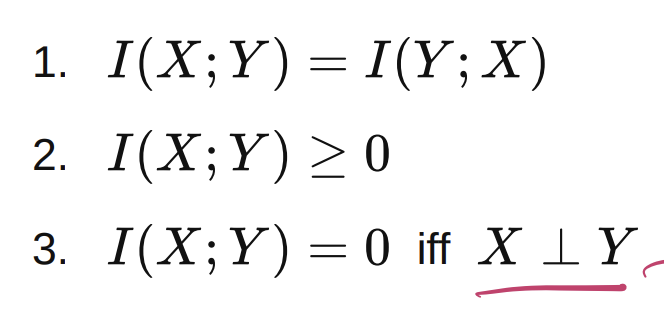
Mutual information measures how much knowing one random variable reduces uncertainty about another.

Three properties of mutual information
Deterministic Processing
What happens when you transform a random variable using a deterministic function (which always gives the same output for the same input)
Deterministic Processing Property

Applying a deterministic function cannot increase the entropy of a discrete random variable.
The function can combine different input values into the same output, potentially losing information.

Conditional Mutual Information
How much does Y tell us about X when we already know Z?

Conditioning ____ mutual information
does not necessarily reduce

Chain Rule for Mutual Information

Markov Chains
X → Y → Z
p(z | x, y) = p(z | y)
Once we know Y, knowing X provides no additional information about Z.
Data Processing Inequality

Processing information cannot create additional information about the original source.
Fano's Inequality

If there's still a lot of uncertainty about X after observing Y, it's impossible to predict X with extremely low error.
KL divergence
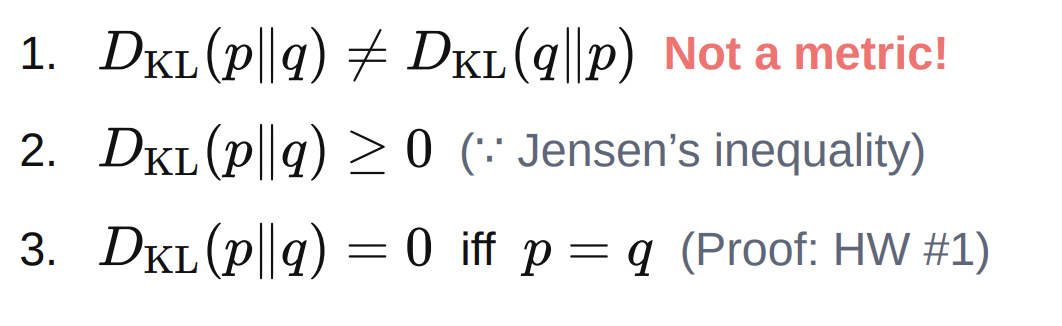
KL divergence, also called relative entropy, measures how different one probability distribution is from another.
Imagine two distributions:
p(x): the true probability distribution.
q(x): your model's estimated distribution.
KL divergence measures the penalty associated with using q when the truth is p.
KL divergence formula

Properties of Relative Entropy
Mutual Information as KL Divergence

p(X, Y) = the actual joint distribution of X and Y.
p(X)p(Y) = what the joint distribution would be if X and Y were independent
KL Example: Bernoulli

KL Example: Gaussian

Forward KL vs Reverse KL

Cross-Entropy
Measures the average surprise when data comes from the true distribution p, but we predict using another distribution q.

Cross entropy relationship

Cross-entropy = inherent uncertainty + penalty for using an imperfect model

Cross-entropy is minimized when q matches p.
Classification loss

Perplexity
