Marketing 3000 Loomer Test 2
 Call Kai
 Learn
 Practice Test
 Spaced Repetition
 Match
 Flashcards
 Knowt Play
1/150

There's no tags or description
Looks like no tags are added yet.
151 Terms
What is Marketing Research?
•Marketing research refers to the collecting, recoding, analyzing, and interpreting of data to aid in decision making related to selling goods and services
•Research often addresses business problems, and seeks to answer questions critical to business growth and reduce risk
•Business needs inform our research objectives
What are the five steps in the Marketing Research Process?
-Step 1: Define the Research objectives and needs
-Step 2: Design the Research
-Step 3: Collect the Data
-Step 4: Analyze data and develop insights.
-Step 5: Develop and implement action plan.

Regarding the Marketing Research Process what happens in Step 1: Define the Research Objectives and Needs?
To determine whether or not to conduct research, two questions must be answered:
•What information is needed to answer specific research questions?
•How should that information be obtained?
Regarding the Marketing Research Process what happens in Step 2: Design the Research?
•Next, researchers identify the type of data needed and determine the type of research necessary to collect it
•The objectives of the project drive the type of data needed
Regarding the Marketing Research Process what happens in Step 3: Collect the Data?
•Now that researchers have identified the types of information they need, they need to determine where to get it
•This is where we differentiate between:
Secondary Data
•Collected prior to the start of the research project
•Sourced both internally and externally
•Gaps identified can be addressed with primary data
Primary Data
•Collected to address specific research needs through methods such as focus groups, in-depth interviews, surveys, etc.
•Sample chosen to represent target customers.
•A marketing research project often begins with a review of relevant secondary data
•Secondary data might come from free or low-cost external sources such as the census, trade associations, and published reports
Pro: Readily accessible
Con: May not be specific or timely enough to meet the firm's research objectives
Regarding the Marketing Research Process what happens in Step 4: Analyze Data and Develop Insights?
•Analyzing and interpreting the data should be both thorough and methodical
•Raw numbers on their own have limited value
•However, a story told with data, which comes from organizing, analyzing, and interpreting data is useful to marketing decision makers
Don't tell me the weather report, tell me if I need a jacket!
Regarding the Marketing Research Process what happens in Step 5: Develop and Implement Action Plan?
•A typical marketing research report would start with a two-page executive summary highlighting the objectives, methodology, and key insights
•The body of the report would go through the methodology, analysis, results, and insights in greater detail
•Managerial implications, conclusions and any limitations or caveats would be summarized in closing
What is Syndicated Scanner Data?
-Data collected from checkout scanner reading or UPC labels.
-Retailers partner with syndicated firms such as IRi and Nielsen to provide and sell this data to consumer brands.
Examples:
Retailer: Name, format, location, geography served
Product: Category, manufacturer, brand, SKU, attributes
Purchase: Date, time, number of units, amount spent, promotions applied
Household: Age, income, location, HH composition
What is Syndicated Panel Data?
•Research panels consist of groups of consumers organized by some shared characteristic that participate in studies over a prolonged period of time
•Data collected from panelists often include:
•Records of what they have purchased (images, scans)
•Consumption "diaries"
•Responses to survey-type questions
What is Quantitative Research and Data?
Quantitative vs. Qualitative Data
•Quantitative research involves structured responses that can be statistically tested
•Results of quantitative studies can be summarized numerically (ex: 68% of respondents preferred Brand A)
•Quantitative research provides information needed to confirm insights and hypotheses
What is Qualitative Research and Data?
Quantitative vs. Qualitative Data
•Qualitative research uses broad, open-ended questions to understand the phenomenon of interest
•Qualitative research is more informal than quantitative research methods and includes observation, following social media sites, in-depth interviews, and focus groups
What is Data Collection via Observation?
Observation entails examining purchase and consumption behaviors through:
•Personal or video camera recordings
•Tracking customers' movements electronically as they move through a store or online experience.
Ex: Retail heatmaps show where consumers travel most frequently in the store.
Red represents the hot zones where shoppers are the most, yellow less, and blue least.

What is Survey Research?
•The use of surveys or questionnaires is the most popular type of quantitative primary data collection method
•Involves a set of questions designed to gather information from an often large sample size of respondents about a certain topic
•The research students participate in as a part of this course is often survey-based
How do you develop good Survey Research?
•Developing a good survey is part art and part science
•The questions must be care-fully designed to address the specific set of research questions to produce meaningful results
•The questions cannot be misleading in any way (e.g., open to multiple interpretations), and must address one issue at a time
Ex: Unstructured questions are open ended and allow respondents to answer in their own words

What is Experimental Research?
•Experimental research is a type of quantitative research that systematically manipulates one or more variables to determine which have a causal effect on the outcome
•Is frequently used to test ad messages or social media posts (A/B testing)
What are In-Depth Interviews?
•In an in-depth interview, trained researchers ask and record the answers to pre-planned questions, with the freedom to pose additional questions to clarify or expand on a particular issue
•In-depth interviews provide insights that help managers more deeply understand consumer preferences
•However, in-depth interviews are relatively expensive and time-consuming
What are Focus Group Interviews?
•In focus group interview settings, a small group of 8-12 people come together for a moderated, in-depth discussion about a particular topic
•Focus groups gather qualitative data about:
•Initial reactions to a new or existing product or service
•Opinions about different competitive offerings
•Reactions to marketing stimuli, such as ad campaigns or point-of-purchase materials
What is "Bid Data"?
•"Big data" refers to data sets too large and complex to analyze with conventional data management and data mining software
Big data has changed the field of marketing research due to:
•The amount of data to which retailers, service providers, and manufacturers now have access
•The ability to collect data from transactions, CRM systems, websites, and social media platforms
•The ease of collecting and storing data
•The computing power available to manipulate data
What are the 5 Vs of Big Data?
•Volume is inherent to big data
•Big data comes in a variety of forms, including numeric and textual data, and formats
•Velocity refers to how quickly the data can be gathered and used
•Veracity of big data refers to the different levels of accuracy and reliability firms must be aware of
•And the value of big data stems from the insights it provides
What is Marketing Analytics?
•Marketing analytics broadly refers to research and analytics methods (qualitative and quantitative) employed to answer marketing questions
•In discussing marketing analytics, the marketing decisions that need to be made will determine which analytics tools and methods to use
What are the four broad categories of Marketing Analytics?
•Marketing analytics methods come from a wide range of source domains, such as psychology, statistics, econometrics, management information systems, and computer science
Across domains, these tools and methods can be classified into four broad categories:
•Descriptive-Help firms organize, tabulate, and depict their available data, usually in easy-to-understand reports, tables, and charts.
•Predictive-Rely on historically available data to forecast the future, such as what is predicted to happen to a firm's product sales in the next month, next quarter, next year, and so on.
•Prescriptive
•Active
What is The Marketing Mix?
-Represents the set of decisions that the firm uses to respond to the wants of its consumers

How do the 4 P's of the Marketing mix show value?
-Product: Creates Value
-Price: Captures Value
-Promotion: Communicates Value
-Place: Delivers Value
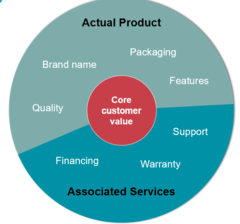
What is Product Complexity?
Products consist of more than their physical properties or basic functionality
Core value, or the problem being solved by the product, is made up of both actual product attributes and related, nonphysical aspects
What are Consumer Products?
•Consumer products are used by people for their personal use (versus commercial use)
•Marketers classify these based on the way they are purchased and used:
-Specialty
-Shopping
-Convenience
-Unsought

Regarding Types of Consumer Products what are Specialty Products?
Specialty products are those for which customers express a strong, often subjective, preference
•Products for which consumers will expend considerable effort seeking out the "right" one
•Often have unique characteristics or brand identifiers
•Many luxury goods fall into specialty category
Ex: Louis Vuitton Bags and Specialty Coffee
Regarding Types of Consumer Products what are Shopping Products?
Shopping products are those for which consumers will spend time "shopping around"
•Will compare alternatives on objective measures such as price, features
•Often prefer to evaluate differences in quality and style in person when possible
Ex: Colognes or Perfumes
Regarding Types of Consumer Products what are Convenience Products?
Convenience products are those for which the consumer is not willing to expend significant effort to
•Items that are purchased frequently, no need to evaluate alternatives prior to purchase
•Items to be used immediately
•Minimal perceived risk associated with purchase
Ex: Water bottles, gum, fast food.
Regarding Types of Consumer Products what are Unsought Products?
Unsought products are those that consumers either do not normally think of buying or do not know exist
•Not top of mind because they do not address a current unmet need
•Breakthrough innovations may initial fall into unsought category
•Could be unusual or novelty items
Ex: Insurance
Can Consumer Products fall into more than one of these four categories?
Yes!
-Ex: BMW can be Specialty and Shopping
What are Product Mix Decisions?
•The product mix refers to the complete set of all products and services offered by a firm
•We also refer to this as a portfolio of products
•The product mix typically consists of multiple product lines, which are groups of associated items
Ex: Haagen-Dazs

What is The Product Mix Breadth?
•The product mix reflects the breadth and depth of the company's product lines
•Product mix breadth refers to the number of product lines offered by the firm.
Cons: May be costly or inefficient to maintain multiple products lines.
Ex: Haagen Dazs

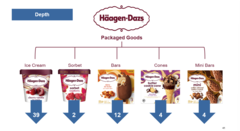
What is The Product Mix Depth?
•The product mix reflects the breadth and depth of the company's product lines
•Product line depth refers to the number of products within the product line
Cons: If offerings address similar needs, cannibalization may occur.
Ex: Haagen Dazs
Why would you potentially want to increase product breadth?
-New Product lines can capture growth from new or evolving categories.
Ex: Developing new line of non-dairy products to attract health-conscious consumers.

Why would you potentially want to decrease product breadth?
Why decrease breadth?
Poor sales, increased competition, shifting internal priorities, or manufacturing inefficiencies are all reasons to discontinue a product line
Example: Facing increased competition from Talenti and others, Haagen-Dazs stopped producing gelato

Why would you potentially want to increase product depth?
Why increase depth?
Adding new items can help maintain share while addressing changing consumer preferences
Can also be a way to preempt competitors
Example: Adding Chocolate Peanut Butter Pretzel to appeal to variety seekers

Why would you potentially want to decrease product depth?
Why decrease depth?
Firms periodically review performance and delete products that are poor performing or an inefficient use of resources; sometimes referred to as a SKU rationalization
Example: Removing a flavor with low sales and unique ingredients
Why is Packaging a key brand element?
Packaging has more tangible benefits than other brand elements:
•Attracts the consumers' attention
•Provides information the consumer needs
•Enables products to stand out from their competitors
•Allows for the same product to appeal to different markets through different sizes and formats
What is Primary Packaging?
•The primary package is the one the consumer uses, for example:
•Toothpaste tube
•Can of soda (Poppi)
•From the primary package, consumers typically seek convenience in terms of storage, use, and consumption
What is Secondary Packaging?
•The secondary package is the exterior that contains the primary package and provides the UPC label used by retail scanners
•Often provides information not available on the primary package
Ex: Design of Poppi Can Pack

How can Packaging be an Identifier?
-Product packaging can become synonymous with brand identity:
How is Product Labeling regulated and what is required?
•Label information is determined by regulations, and labeling rules vary from country to country
•To use terms such as "natural," "organic," "made in the USA," products must meet specific tests or thresholds
Why is branding important?
•Effective branding increases awareness of goods and services
•Brands serve as symbols of quality
•Brands act as points of differentiation

What makes a brand? (Six Elements)
1. Brand Name
2. URLs & Domains
3. Logos & Symbols
4. Characters
5. Slogans
6. Jingles or Sounds
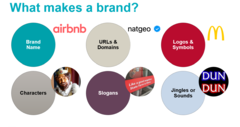
Regarding making a brand how does the Brand Name contribute?
The name of the brand can either:
(a)describe or allude to the product offering (Ex: Chick-Fil-A)
(b)leverage a word or term that has nothing to do with the product (Ex: Apple)
(c)be an invented term (Ex: Zillow)
Regarding making a brand how do URLs & Domains contribute?
Owning the web properties and social media handles associated with your brand is critical
•Consumers need to be able to easily find information about your brand or product online
•Squatting on brand account names and requiring payment to release them is a common problem

Regarding making a brand how do Logos & Symbols contribute?
Visual branding elements help to quickly and memorably identify a brand to consumers
•Logos are typically a mix of words and iconography
•Symbols are icons or logos without words
(Ex: Iconic Pepsi and Coke Logos)
Regarding making a brand how do Characters contribute>
-Characters are brand symbols that seek to exemplify or personify characteristics or attributes about the brand.
Ex: Flo for Progressive, Tiger for Frosted Flakes, or Mr. Clean

Regarding making a brand how do Slogans contribute?
Slogans are short, memorable phrases that are used to describe elements of the brand offering or persuade consumers to consider the brand
Ex: McDonald's - "I'm Lovin it"

Regarding making a brand how do Jingle or Sounds contribute?
Memorable and distinctive audio clips comprised of music, messages, or both
Why are brands valuable to firms?
Brand equity, or value derived from the brands itself, can:
ü Facilitate purchases through awareness and associations
ü Establish loyalty from consumers
ü Protect from price competition through perceived value
ü Serve as assets to the firm
ü Impact the market value of the firm
Why is Brand Equity: Awareness so important to companies?
"A company lives on dies based on brand awareness."
•The more consumers are aware of a brand, the higher the likelihood of purchase
•Awareness is critical for convenience products that are bought without much evaluation (snacks, gum)
•But is also important for infrequently purchased items or those the consumer has never purchased before
Why are Brand Equity: Associations so important to companies?
•Brand associations reflect the mental and emotional links that consumers make between a brand and its key attributes
•Often the result of a firm's advertising and promotional efforts
•Brands can develop personalities through their marketing efforts.
Ex: Abercrombie & Fitch has undergone a massive repositioning effort to distance itself from past brand associations
Why is Brand Equity: Loyalty so important to companies and consumers?
•Brand loyalty occurs when a consumer buys the same brand's product or service repeatedly instead of buying from multiple suppliers within the same category
•Brand-loyal customers are an important source of value
•Loyal consumers are less sensitive to price
•Marketing costs to loyal consumers are much lower
•A base of loyal consumers can help insulate firms from competitive pressure
What is Brand Equity: Value?
•The perceived value of a brand is the relationship between a product's benefits and its costs
•Value is typically evaluated relative to a comparable set of competitors
What is Brand Equity: Market Value?
The value of a brand contributes to a firm's worth in terms of assets

What are five specific Branding Strategies that companies create to manage their brands?
-Private Labels
-Brand Families
-Line Extensions
-Co-Branding & Licensing
-Repositioning

Regarding National vs. Private Label Brands what is a National Brand?
•National brands are owned and managed by manufacturers
•By owning the production and marketing of their brands, these manufacturers can maintain control over the quality of their products and brand image
•The majority of consumer brands in the U.S. are national manufacturer brands
Ex: Kraft, Coke
Regarding National vs. Private Labels what are Private Label Brands?
•Private label, or retail or store brands, are products developed by and sold by retailers
•In some cases, retailers manufacturer their own products, but in most cases private label products are produced by the same manufacturers who produce national brand products
Ex: Target specific food items

What is a Brand Family?
•Firms can choose to use their corporate name across all product lines, marketing products as a brand family
•If the corporate brand reputation is strong, the individual products can benefit from awareness and quality perceptions
Ex: Heinz Ketchup

What are Individual Brands?
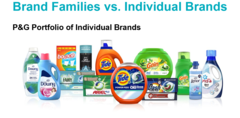
•Firms can also opt to give each product line individual brand names to establish unique identities
•A firm like P&G offers many products across a wide variety of categories, including brands consumers may believe to be competitors
•This strategy can allow the firm to capture greater market share.
Ex: P & G individual detergent brands
Regarding Line vs. Brand Extensions what is a Line Extension?
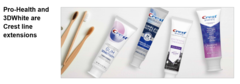
-A line extension refers to a new product under the same brand name within the same product line (same category)
Ex: Pro-Health, 3D white, and charcoal are crest line extensions.
Regarding Line vs. Brand Extensions what is a Brand Extension?
-A brand extension is a new product under the brand name but in different product lines (Product Category)
•Potential benefits of a brand extension are the ability to leverage existing brand awareness
•But consumer acceptance of the brand name in a different product category will only spread if a relationship between the two products makes sense
•Otherwise, we might not give the brand "permission" in our minds to enter a new category
Ex: Mouthwash, whitening strips, etc. are crest brand extensions.

Regarding marketing brands what is Co-Branding?
•Co-branding refers to marketing two or more brands together
•Potentially beneficial to the participating brands by attracting the consumers of one brand to the others
•Can enhance perceptions of quality through links between brands.
Ex: Linked KFC and Taco Bells

Regarding marketing brands what is Brand Licensing?
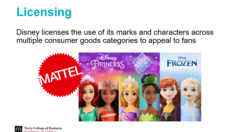
•Brand licensing refers to a contractual agreement between firms allowing each other to leverage rights and marks for some mutual benefit
•Common for toys, apparel, accessories, and entertainment products such as video games
•Licensing can help increase brand visibility and attract consumers from each property to one another
Ex: Disney
Regarding marketing brands what is Repositioning?
•Brand repositioning, or rebranding, refers to a strategy in which marketers change a brand's focus
•Can be done to target new markets or realign the brand's core emphasis with changing market preferences
•Can boost vitality of brands seen as "dated" or irrelevant, or be required for brands seen as culturally insensitive
•Is a high-cost, high-risk strategy not entered lightly
Ex: Aunt Jenima

What is the Spectrum of Innovation?
Incremental: Line Extensions
Breakthrough: New Product Categories

Why Innovate?
Innovation refers to the process by which firms transform ideas into new product and service offerings, and can be used to address the following challenges:
-Changing Consumer Needs
-Market Saturation
-Diversification of Risk
-Trend Cycles

How is Innovation: Changing Consumer Needs?
-Consumer needs, preferences and habits change over time.
-Consumers grow bored of existing offerings.
Ex: Think of demand for wireless tech accessories, including headphones and chargers. Consumers have gotten used to a certain level of convenience.
Regarding the process of innovation what is Market Saturation?
•Market saturation occurs when a product or service has reached its maximum potential within in a marketplace
•In other words, everyone who is going to buy one has already bought one
•At saturation, the firm can only grow through new product introductions
Ex: Apple- almost everyone has an iphone.
Regarding Innovation what is Diversification of Risk?
•Having a broad portfolio of products can help insulate a company from performance risk
•"Don't have all your eggs in one basket."
•Especially relevant for product categories that satisfy "wants" more than "needs"
Regarding innovation what are Trend Cycles?
•Firms seek to capitalize on trends for incremental sales
•Certain categories of consumer goods, such as apparel and entertainment, are more reliant on trend cycles
•To succeed, the trend needs to align with the brand image and firm's core competencies
Ex: Health kicks like keto.
What are the six steps of the Product Development Process?
1. Idea Generation
2. Concept Testing
3. Product Development
4. Market Testing
5. Product Launch
6. Evaluation of results
What happens in the Product Development Process Step 1: Idea Generation?
•Firms constantly scan the environment to generate new product ideas
•Depending on the resources and structure of the company, they leverage different sources for idea generation
Internal R&D: •Large firms often maintain their own internal research and development (R&D) department to generate new products that will lead the market
•These internal units are associated with high product development costs, but are often the source of breakthrough products
R&D Consortia: •R&D consortia bring together manufacturers, small and medium businesses, researchers, and state and local governments to facilitate idea generation regarding a specific topic of interest
•Participation in these groups lowers costs and risks, while benefits spread to all firms
Licensing: •Firms may purchase licenses to use technology or ideas from other research-intensive firms
•Small biotech firms frequently license their inventions to larger pharmaceutical firms
•University research centers are also a common source of such licenses
Brainstorms: Brainstorming is a semi-structured, group approach for rapid idea generation, often to solve a problem
•Brainstorms are meant to be expansive and open, no idea should be immediately accepted or dismissed
•The best brainstorms are structured and moderated
Outsourcing: •Firms can hire outside consultants to help generate ideas and develop new products and services
•Design firms help clients generate new product and service ideas across a wide variety of industries
•Firms such as IDEO specialize in design thinking and creative ways to generate ideas
Competitor Products: It's not uncommon for firms to be "fast followers," copying the innovations of a competitive firm
•Reverse engineering involves taking apart a product, analyzing it, and trying to recreate it with your own resources
Customer Input

What happen in the Product Development Process Step 2: Concept Testing?
•A concept is a brief written description of the product, often with accompanying images or models
•Product concepts are presented to potential buyers or users to gauge their reactions
•Consumer responses to the various concepts trigger the marketing research process discussed in Chapter 10

What happen in the Product Development Process Step 3: Product Development?
•At this stage an engineering team develops a product prototype based on consumer feedback from concept testing
•Product designers align consumer needs and wants for the product with their own knowledge about available materials and manufacturing capabilities and technology
•Product development or product design is a cross-functional effort, balancing considerations across:
•Supply chain engineering
•Manufacturing
•Marketing
•Finance
•Innovation commercialization teams bring together representatives from each necessary department.
Prototypes: allow consumers to interact physically with the product concept before it goes into production.
3D Printing: has increased speed in which firms can create prototypes
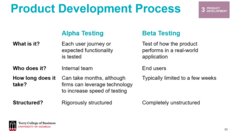
Regarding Step 3: Product Development what is Alpha Testing?
•In alpha testing, the firm determines whether the product will perform according to its design and whether it satisfies the need for which it was intended
Regarding Step 3: Product Development what is Beta Testing?
•In beta testing, potential consumers examine the product prototype in a real-use setting to determine its functionality and performance, and to identify potential issues specific to its use
Differences between Alpha and Beta Testing (Diagram)
What happen in the Product Development Process Step 4: Market Testing?
•In premarket tests, consumers are exposed to the product and surveyed on its various attributes
•Based on these results, the firm will decide if and how to move forward with the product launch
•It is estimated that roughly 50% of new product concepts are premarket tested using Nielsen's BASES test
With BASES, concepts are scored based on four criteria:
•Value rating: Degree to which consumers are convinced that the product better satisfies a need for a fixed price
•Purchase intent: Expected probability a first purchase is made
•Purchase frequency: Expected frequency with which a product will be purchased
•Purchase volume: Expected number of items per purchase
•In contrast, test marketing is a mini product launch used to estimate demand
•Test marketing is higher risk than premarketing testing
•It can be resource intensive in terms of costs and labor
•It can also reveal the new product to competitors
What happen in the Product Development Process Step 5: Product Launch?
•If the market testing returns with positive results, the firm is ready to introduce the product to the entire market
•This is the most critical step in the product development process and requires tremendous financial resources and coordination of the marketing mix
•The firm confirms its target market(s), positioning, and budget
•Timing of the launch is critical
What happen in the Product Development Process Step 6: Evaluation of Results?
•Firms measure success of new products using sales data to determine:
•Satisfaction of technical requirements
•Degree of customer acceptance
•Satisfaction of firm's financial requirements
•In other words:
•Is it working as expected?
•Do consumers like it?
•Is it profitable?
What is Diffusion of Innovation?
•Diffusion of innovation refers to the process by which the use of an innovation spreads throughout a market group
•Diffusion of innovation happens over time and across various categories of adopters
•This diffusion follows a bell-shaped curve, where a few people buy the product or service at first, then more buy until a product becomes widely adopted
•Diffusion follows the same pattern whether the innovation is a good, a service, or a process
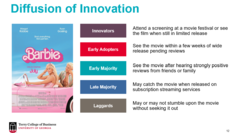
•Consumers can be divided into five groups according to how quickly they adopt an innovative after it has been introduced:
•Innovators
•Early adopters
•Early majority
•Late majority
•Laggards
Regarding the Diffusion of Innovation what are the five groups of consumers?
•Consumers can be divided into five groups according to how quickly they adopt an innovative after it has been introduced:
-Innovators: First to adopt a new product and are willing to take risks, young in age, and have high risk tolerance.
-Early Adopters: are second fastest individuals to adopt a new product. More financial resources than late adopters.
-Early Majority: Group of consumers for whom time of adoption is significantly longer than for innovators or early adopters.
-Late Majority: group of consumers who adopt an innovation after average member of society. Have higher skepticism for new products and fewer financials.
-Laggards: last to adopt an innovation. Adverse to change and older in age.
What are the four factors that are impacting Diffusion?
Different products diffuse, or become widely adopted, at different rates based largely on the following factors:
-Relative Advantage
-Compatibility
-Observability
-Complexity & Trialability

Regarding Factors Impacting Diffusion what is Relative Advantage?
•Relative advantage refers to the degree to which the new product or service innovation is superior to existing market offerings
•The greater the perceived advantage, the faster diffusion will take place
Regarding Factors Impacting Diffusion what is Compatibility?
•How compatible a product's features are with the needs and culture of consumers impacts the speed of diffusion
•For example, large appliances are less likely to be adopted by city dwellers living in small homes
Regarding Factors Impacting Diffusion what is Observability?
•If the benefits of the innovative product are easy to observe or understand through effective communication, diffusion will move more quickly
•Infomercials or tutorials are common promotional techniques used to explain the benefits of new products
Regarding Factors Impacting Diffusion what is Complexity & Trialability?
•Relative or perceived complexity will impact consumers' willingness to try a new product
•Showrooms, floor models, and sampling opportunities are all tactics used to reduce the perceived risk associated with complex innovations
What are Innovation Pioneers?
•Pioneers, or breakthrough innovations, establish completely new markets or radically change competition and consumer preferences
•Pioneers have the advantage of being first movers and can sometimes command a greater market share over a longer period of time period than later entrants
•However, not all pioneers succeed
•In some cases, the market simply isn't ready to accept a product or service so different from existing offerings, and diffusion never moves past innovators
•In other cases, imitators capitalize on the weaknesses or learn from the missteps of pioneers and subsequently gain advantage in the market
Why do product launches fail?
#1: The firm is not structured to support rapid growth.
Ex: Mosquito Magnet was an innovative pest control solution that became increasingly popular during a West Nile outbreak, But as the firm scaled up and moved production offshore, quality decreased and negative consumer feedback hurt sales
#2: The Product falls short of claims and pre-launch expectation.
Ex: Microsoft spent an estimated $500 million on marketing its operating system Windows Vista. The software had so many compatibility issues even loyal users starting switching to Mac
#3: The product exists in a value "Limbo".
Ex: C2 was a beverage launch from Coca-Cola to attract men who wanted full flavor but fewer calories. C2 was launched with half the calories of Coke, but few consumers actually wanted the "hybrid" product
#4: Product is so confusing, people don't get it.
Ex: P&G launched a home scent device called Scentstories, where scented discs spun in a CD player like device. Scents changed every 30 minutes to create a mood, but did not play music
#5: Product is so revolutionary, there is no market for it.
Ex: The inventor of the Segway promoted it for almost a year before launch as a replacement for the automobile. At $5,000 each, only 24,000 models sold in the first five years after launch
What is The Product Life Cycle?
•The product life cycle defines the stages that products move through as they enter, get established in, and ultimately leave the marketplace
•The predictable stages of the life cycle can be used by marketers as a starting point for strategic planning
•At each stage of the life cycle, the marketing mix elements change in response

What happens in Product Life Cycle: Introduction?
•The introduction stage is characterized by:
•Initial losses to the firm due to its high start-up costs
•Low levels of sales revenues as the product begins to take off
•However, there are few competitors with whom to battle for market share

What happens in Product Life Cycle: Growth?
•The growth stage is marked by:
-Increasing number of product adopters
-Rapid growth in sales
-Increased in the number of competitors and the number of available product versions
•The growth stage is also considered a key "tipping point," or point of transition between introduction and raid growth
•At this point, the product either gains market acceptance or must exit the market
•The majority of new products failures will occur at this point
What happens in Product Life Cycle: Maturity?
•During maturity, the product life cycle is characterized by the adoption of the product by the late majority
•At this point there is intense competition for market share among firms
•Firms also face increasing price pressure as the average price of the product falls substantially compared with the previous two stages of the life cycle
•Lower prices and increased marketing costs begin to erode the profit margins for many firms
•In the later phases of the maturity stage, the market has become quite saturated, and practically all potential customers for the product have already adopted the product
•Firms must pursue various growth strategies during this stage to increase their customer base and/or defend their market share

What happens in Product Life Cycle: Decline?
•Firms with products in the decline stage must either position themselves to go after a niche segment of loyal consumers, adopt a strategy of specialization, or completely exit the market
•The few laggards who have not yet tried the product or service may enter the market at this stage, although trial is uncertain
What are the four basic Growth Strategies when entering markets?
-Market Penetration: (Ex: Chick-Fil-A launces a promotion "Buy One, Get One Free" deal on their spicy chicken sandwich. They are encouraging customers to consumer more of their current product)
-Product Development: (Dove's expansion into deodorants, shampoos, body washes).
-Market Development: For example, Pedialyte expanding beyond target of parents and advertising its benefits to endurance athletes, or Starbucks opening stores in Japan.)
-Diversification: (Ex: McDonald's adding a cafe area as they usually specialize in fast food but wants to expand into a new market with a new product)

What is a Service?
•A service is any intangible offering that involves a deed, performance, or effort that cannot be physically possessed
•Customer service specifically refers to human or automated activities firms perform to satisfy customer needs
•By providing high quality services, firms can enhance the value of existing products
The Service-Product Continuum (Diagram)

What are the Three factors that lead developed economies to become increasingly service-oriented:
-Production is cheaper in other countries
-High value placed on convenience and leisure.
-People are demanding more specialized services.