PSYCH 3M03 Midterm 3
 Call Kai
 Learn
 Practice Test
 Spaced Repetition
 Match
 Flashcards
 Knowt Play
1/53

There's no tags or description
Looks like no tags are added yet.
54 Terms
Summary of Importance of Research on sensitive topics
the mental hygiene movement has produced “the spun glass theory of mind”; however, we are much more resilient than we give ourselves credit for
the sex trauma questionnaire study on undergraduate students found that both conditions reported a decrease in negative affect + participants thought answering the questions were better than minor stressful events
in fact, not asking about abuse contributes to people staying quiet about their experiences
we need to consider social context; today’s college students grew up watching vulgar material on tv (Dr.Phil, South Park) so it is unlikely doing this type of research will cause harm
asking highschool students about suicide reduced distress and being in the experimental group reduced ideation

true or false: reason and emotion have separateW influences on human behaviour
false
greek philosophers thought that reason and emotion were separate
William Paley main argument and issue with his logic
William Paley argued that organisms are well adapted to their environments through natural processes
Ex: the woodpecker, who has a shark beak to pry open wood and a long tounge to pierce insects
However, two examples were challenging to explain using his argument:
the spinal column
the eye
These two examples couldn’t have logically arisen gradually
Thus, he argued they must have occurred per saltum from a supernatural entity
Darwin’s Voyage
Darwin took a voyage between 1831 and 1836 on the HMS Beagle
One of his most iconic destinations was the Galapagos Islands; he collected multiple species → such as his famous finches
Left the islands looking for an explanation for speciation and adaptation
Key steps in Darwin’s intellectual struggle
He engaged in analytical thinking and answered several questions:
Does nature generate new species per saltum?
There are no gaps between species
He believed there was a mechanism that caused organisms to slowly adapt to their environments
How do humans create new breeds of domesticated animals
He wrote there were two types of traits, those aquired from nature and monstrosities “picked” by breeders (artifical selection)
He studied pamphlets by cow breeders that explained this process and how selected species over generations could look different than the original stock
This caused him to realize that a similar process of selection in nature could generate new species and adaptation through a slow, gradual process
How can highly adaptive traits evolve from a slow process?
He read that “nature does not make jumps”
He noted that different species of mollusks show variation in their eyes, and concluded they evolved from simpler forms
How can natural selection explain the structure and functioning of adaptive organs?
Organs such as the spinal column, the kidney, the eye, and the tongue evolved because they had indirect effects on reproduction, such as helping the organism survive in its environment long enough to reproduce
Darwin’s emotional distress
Darwin’s work caused him severe emotional distress; he experienced cardiac palpitations, gastric problems, and headaches
His emotional distress emerged due to a problem in the environment; he was solving one of life’s greatest unsolved problems
His emotions had a psychological trigger → negative emotions = harm avoidance; the systems of the body and goals change while avoiding harm and this was apparent in Darwin… he was initially only interested in his question and later became interested in marriage
Darwin’s analytical thinking style reflected the body’s systems coordinating to find an adaptive response to his problem
He had focused attention and depressed mood to think analytically
Inclusive fitness theory
Helps us understand that natural selection doesn’t maximize “survival of the fittest” or even personal reproduction → we see in nature there is social insects which cannot be explained using these ideas
Inclusive fitness = direct + indirect fitness
i.e, the recipient is able to produce offspring due to the actions of some other
Indirect fitness
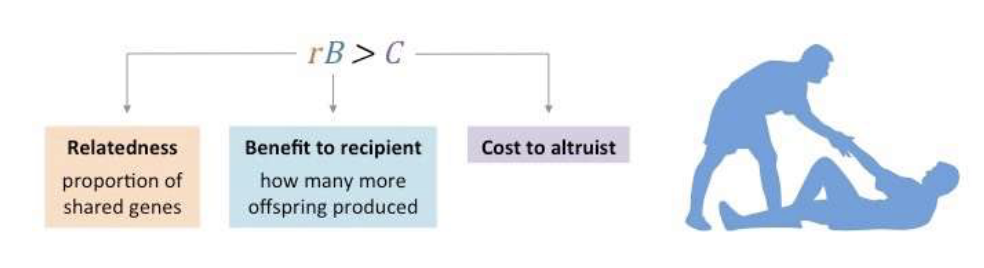
Indirect fitness: the effects of one's actions on the reproduction of close relatives, discounted by the coefficient of relatedness, r
The coefficient of relatedness is the probability that two individuals share genes in common through common descent
Between parent + kid = 0.5; siblings = 0.5; cousins = 0.12
Requires the ability to recognize kin
We rely on cues of relatedness → visual, auditory, and olfactory stimuli
We get these cues through cohabitation
Hamilton’s rule → basic ideas and process
rB>C
Bill Hamilton worked on his concept as a grad student; he had a difficult time and experienced a similar motivational/emotional state as Darwin
i.e, distress, ahedonia, withdrawal, guilt and worthlessness, and difficulty concentrating on anything else
Why is it puzzling to see order/organization in nature?
The second law of thermodynamics states that systems tend towards more probable states (with greater disorder) over time
Order can only be maintained or increased by expanding energy, which is then dissipated as heat
By expending energy, the system as a whole tends towards disorder, but within it there can be localized increases in order
Organisms maintain their order by expending massive amounts of energy
Adaptations
traits that have been shaped over time by natural selection for some gene-propogating effect
the effect is the “function” of the trait
can be identified by their high degree of organization / coordination
natural selection is the only process in nature that can generate highly organized traits
Explain → not all traits are adaptations with functions
a trait = exaptation if it fails to show evidence of non-random organization for the beneficial effect
a trait = constraint if it deviates from a clearly more optimal design
a trait = a byproduct if it fails to show signs of non-random organization or lacks any beneficial effect
reverse engineering
the process for recognizing adaptations and identifying their functions
the process:
determine as many of the trait’s components as possible
figure out how the components interact with each other
does it show evidence of organization?
is the trait organized towards promoting a unique effect?
is there enough proof?
the febrile system
the immune system is a byproduct of a co-evolutionary arms race; fevers are evolutionarily ancient
there are two types of fever:
physiological → immune system is triggered and starts to burn fat to increase temperature
behavioural → forces you to move to warmer environments to increase temperature
reverse engineering the febrile system
the febrile system is very complex and there is numerous components
fever is energetically expensive; it takes a lot of energy to increase body heat (which is needed to fight of infection; there is numerous benefits of heat for fever)
the studies on physiological fever shows us we have cells (phagocytes) designed to be activated within the febrile range, some innate immune processes are up regulated or modified in the febrile range (fever staggers the expression of cytokines), and promotes migration + binding of immune system cells
the study on behavioural fever showed the fish injected with dsRNA preferred to be in warmer water to increase their core body temperature
antipyretics are harmful overall
they increase pathogen load and infection time
they increase spread in population
they increase risk of fatality → study showed giving antipyretics increased death
evolutionary approach to emotions
different situations in the environment require an organism to make an adaptive response; this adaptive response involves the coordination of multiple systems
when some systems are upregulated, there becomes a trade off with other systems that are not as useful during the situation
emotions represent these coordinated responses
emotions are highly organized and are thus evolved adaptations
why did positive emotions evolve?
to coordinate whole body responses that pursue fitness enhancing opportunities
why did negative emotions evolve?
Aversive feelings evolved to coordinate whole body responses that avoid fitness reducing harms and risks
criteria for pain in non-human animals
a coordinated whole-body response
long-term motivational changes
Interestingly, the whole body response is needed to promote avoidance learning → thus, we believe learning is increased during stressors, but it is selective
animal studies on pain and learning
in the conditioning study on fish + shocks, the fish without lidocane (pain reliver) learned to associate the presentation of the light with the shock while those with lidocane did not; thus, pain is necessary for this kind of learning
in the study on squid and sea bass, the injured squids were more alert, more likely to escape, less likely to be pursued, and initiated defensive moves faster; overall the bass were more likely to capture the anesthetized squids
as electric shocks increased in one section of a fishtank, the fish spent less time feeding there (the pain caused other goals to have lower priority)
however, if hungry enough, they will face shock
what is the function of pain?
to coordinate the trade-offs between competing goals
when there multiple pain sources, they are adaptively coordinated
achieved through stress-induced analgesia
pain is downregulated when there is more presssing concerns
pain is a response to ancestrally recurrent situations
i.e, we have no pain mechanisms to protect us against harms that never occured in the evolutionary pain
the learned helplessness hypothesis
the belief that nothing one does matters
basic assumptions:
a sense of control is the default state
this produces a deficit in motivation
there is an apparent deficit in learning
this generates a depressive-like state
evidence for the LHH comes from the study on rats → two rats endure a shock on day 1 and on day 2 are placed in a mechanism where they must escape (one has an escape and the other does not) ; 90% of the rats in the ESC condition learned to escape 2/3 of the INESC rats did not learn how to escape
the rats going through INESC learn that nothing they do matters do they give up trying to control their environment
Sneddon’s features of pain response (as examined through the rat study)
whole organism response
INESC shock had a series of effects
more than a simple reflex
the passivity produced by the INESC condition lasted multiple days
must have neurocircutry for detecting noxious stimulus and producing pain
both ESC and INESC cause the stress response
when the rat gains control, the vmPFC sends signals to the DRN to dampen stress response
must be aversive
INESC rats took longer to learn the task in a food-shock paradigm; the pain deprioritized eating
increased preference for analgesia
increased preference to alcohol and analagesia is proof of a change in motivation (helps us understand the whole body is coordinated)
motivation is not lost, but rather altered
promotes avoidance learning
INESC rats are better at learning cues associated with a shock
however, learning isn’t always impaired
hypothesis testing about the causes of shocks is useful

type 1 thinking style
default style used for a broad range of problems
fast, erorr prone
uses heuristics, intuition, and impulses that work automatically
type 2 thinking style
used when facing complex problems that cannot be solved with type 1 thinking
involves an analytical approach to problem solving
uses working memory
it’s time consuming and attentionally demanding
WM systems are ancient
INESC shock produces changes in hippocampus similar to those found in WM
Energy reallocation during sickness depression
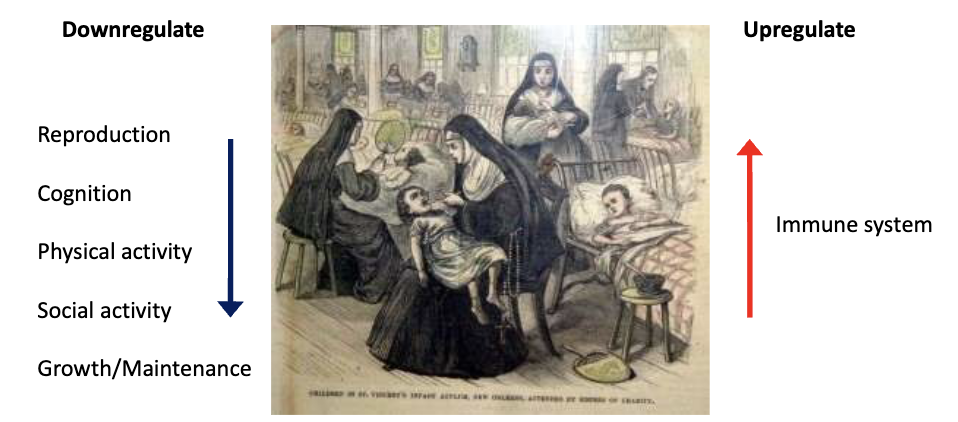
During infection, limited energy resources must be reallocated to the immune system
The reallocation of energy requires the coordination of different body systems, with some being upregulated and others being downregulated
There is an energy trade off; increased energy spent by the immune systems requires taking it away from other system
The immune response requires a massive amount of energy
White blood cells are the first defenders
They engulf and ingest pathogens
Recall that every 1C increase in core body temperature involves a 10-12% increase in metabolism
in sickness depression, why does the oranism eat less when energy expenditure goes up?
In evolutionary times, it cost a large amount of energy upfront to even find food
So, when you are sick, your body forces you to not spend energy on that
We have physiology that is much older
Your body starts to catabolize it's resources; you can lose muscle through this process
In sickness depression, how is energy directed specifically to immune tissues?
Insulin resistence
Insulin resistence in sickness depression
We see IR in non-immune tissues and IS in immune tissues
Insulin resistance helps reallocate energy as the situation demands
You want the energy to be preferentially directed to the immune tissues
This is facilitated by insulin resistance
Selective IR is an adaptive thing that happens in many conditions that humans and mammals are exposed to
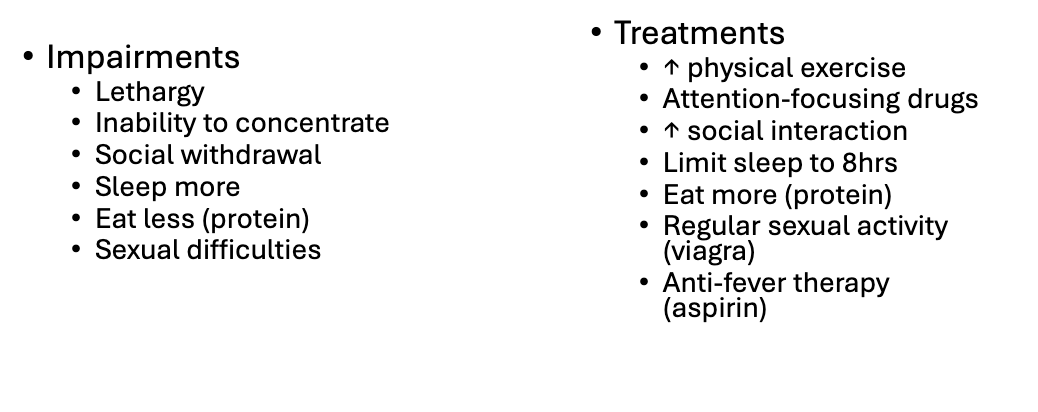
Symptoms of sickness depression that facilitate energy reallocation
selective anhedonia
fatigue
eating less
sleep more
social withdrawl
less cognitive effort
increase in core body temperature
Symptoms of sickness depression that facilitate energy reallocation → selective ahedonia
A loss of interest in sex and food
An increased interest in resting
Symptoms of sickness depression that facilitate energy reallocation → eating less
Less interest in iron-rich foods
Iron is a limiting resource for pathogens
Our cells do better under high levels of iron
Thus, iron can also help pathogens replicate
We do not have a controlled excretion process for iron; during infection, our organs can hold iron hostage so pathogens don't replicate
Increased preference for carbs
Body preferentially runs on carbohydrates
Symptoms of sickness depression that facilitate energy reallocation → sleeping more
Increase in slow-wave sleep (promotes growth and healing)
Less REM sleep
clinical relevance of sickness depression
Some infections produce these depressed states (which may be misdiagnosed by clinicians) and are difficult to detect
Ex: Epstien Barr, cytomegalovirus
"fever of unknown origin" vs "endogenous depression"
When a depression happens out of the blue for seemingly no reason, a psychiatrist may declare it an endogenous depression
A physician would pursue all pathways to determine what the fever is
Important because it informs treatment
Understanding etiology is crucial to developing appropriate treatments
What if we treated sickness behaviour as if it were a mental disorder and tried to suppress its symptoms?
This would force the body to divert resources AWAY from the immune response
History/Background of Starvation Depression
Famine has been a recurrent feature of human evolutionary history
We see a variety of behavioural coping strategies that range from early responses (ex: sale of possessions) to desperate measures (ex: slavery, prostitution, and begging)
In the old testament, there is a passage that describes how people can eat children when they are desperate; however, they eat other people’s kids so they don’t have to eat their own

Selection pressures of famine
Differential mortality by famine
Differential fertility during famine
Female reproductive physiology is dependent on the ability of resource
Sexual selection for fertility related cues
Possible adaptations of famine
More fat deposits in humans than other primates
Development of insulin-resistance during starvation
The suppression of other energetically expensive processes (immune function, growth, and reproduction)
Energy reallocation in starvation depression
During true starvation, limited energy resources must be reallocated to the brain and foraging (finding food)
The organism cannot suppress the brain (as it coordinates all body responses) and motor movements( as it helps the organism move to find food)
Under starvation, the brain doesn't loose weight as muscles are metabolized but the heart can
Semi-starvation diets in humans
Has a few interesting benefits:
Increases longevity
Decreases risk of cancer
Slows cancer
Could impact reproductive success
Forces you to pay less attention to things that are more energetically expensive and focus on other things
Studies have found that oxygen consumption and core body temperature decreases under semi-starvation
Insulin resistence in starvation depression
under starvation, IR occurs in selective tissues
motor muscles and brain are spared so foraging can still happen
tissues and skeletal muscles experience IR
the muscle and organs switch to a fat-fuel economy
Ancel Keys
The first person to suggest that (nutritional) fat was bad for you
Also well known for his research on starvation:
He did work during WW2 on behalf of major world power countries because he knew as they travelled the world, their soldiers would encounter starving people and need to know how to handle them
Conducted the Minnesota starvation study
He saw that locomotor activity increased during starvation
What was the important takeaway from the Minnesota starvation study?
locomotor activity increases during starvation
beyond this study, there is evidence of this from insects to animals
this is presumably to promote foraging behaviour
Leptin
a hormone that regulates food intake and energy expenditure
Reduced leptin promotes physical activity
It circulates at levels directly proportionate to body fat
Under homeostasis control
Suppresses semi-starvation hyperactivity
In a study on mice, when mice experiencing starvation are given leption, hyperactivity is suppressed
Starvation increases motivation for physical exercise
The psychological effects of starvation
Fatigue
Apathy
Irritability
Neurological deficits
Anhedonia
Loss of interest in sex
Loss of humour
Thoughts preoccupied with finding food
Desire to acquire food
Preference for protein
Symptoms of starvation depression that facilitate energy reallocation
selective ahedonia
loss of interest in sex and humour
interest in food is retained
appetite changes
preference for protein
lower core body temperature
tired but physically active
cognitive and motor activity promote forgaing
suppressed immune system
Why is it so hard to feed a starving organism without killing it?
Refeeding syndrome
Carbohydrate meal causes insulin spike
Production of ADP and other phosphate compounds
Sudden depletion of phosphate from bloodstream causes many problems, including cardiac arrest
Sickness depression v.s anorexia nervosa
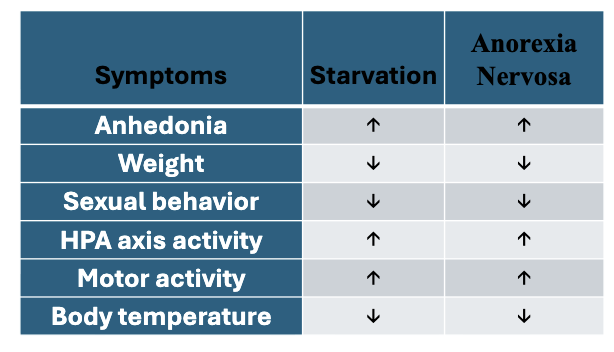
Symptomatically, starvation depression is almost identical to anorexia nervosa
However. they are different because anorexia is based in a culturally based desire to loose weight (which eventually becomes starvation)
Psychotherapies and pharmacologies are ineffective treatments for AN
Depression and anxiety are NOT causes of AN; they develop as products of AN
Example of how AN can occur naturally → the vulnerabilities of women athletes
Similarities between melancholic depression, sickness depression, and starvation depression
Anhedonia is increased
Sad mood
HPA activity is increased
Differences between melancholic depression, sickness depression, and starvation depression
Sick behaviour has increase in sleep but decrease in REM; melancholic depression has decrease in sleep but increase in REM
Increased preference for carbs in sickness behaviour and melancholic depression; NOT starvation
Decreased cognition for sickness behaviour, but selective increased cognition for starvation and melancholic depression
Basic explanation for why we have three depression phenotypes?
The human body is capable of all three types of depression
Natural selection has made these three phenotypes similar because it builds on existing structures; that’s why symptomology heavily overlaps
Starvation + sickness are evolutionarily ancient; melancholic depression is socially caused but shares the same neural circuitry as these phenotypes
Energy reallocation hypothesis
depressive phenotypes evolve in response to situations that require the body to make prolonged reallocations of limited energy resources
How is working memory valuable for melancholic depression?
A working memory system where information is kept in an active state because it is useful in ongoing processing
This is known as 'type 2' or 'system 2' processing
It is attentionally demanding, time consuming, and energetically expensive
Type 1 is fast, intuitive, and not attentionally demanding
Behavioural and psychological components of melancholic depression