Chapter 11: Theories of Covalent Bonding
 Call Kai
 Learn
 Practice Test
 Spaced Repetition
 Match
 Flashcards
 Knowt Play
1/24

25 Terms
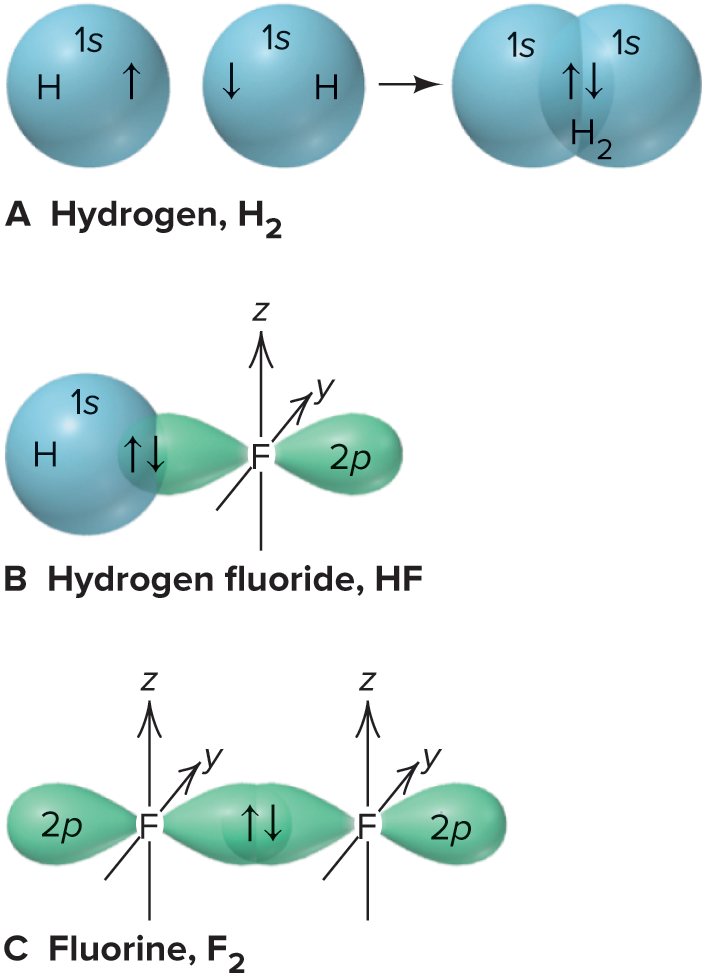
Valence bond theory (VB theory)
A model that relates molecular shapes to orbital shapes through orbital overlap and hybridization
Covalent bonds form in constructively interfering orbital overlaps, where electrons reside
Overlapping regions are bound by the Pauli exclusion principle, with opposing spins
Orbitals are reoriented to maximize overlap and strength, seen in p and d orbitals’ shapes
Orbitals hybridize and form new hybrid orbitals to account for new behavior and properties
Hybridization
The formation of new hybrid orbitals from the combination of different valence orbitals, where:
The number of orbitals formed is equal to the number of orbitals mixed
The types of orbitals formed varies with the types of orbitals mixed
The shape and orientation of hybrid orbitals maximizes its overlap between its composites
The resultant orbitals have an energy level between the original composites
Serves best as a mathematical concept rather than a literal translation

sp Hybridization
The creation of new sp orbitals from electrons in an s orbital with a p orbital for linear shapes, through:
An electron from an s orbital being promoted to a higher-energy p orbital
The now-separate s and p orbitals hybridizing (mixing) to form new, half-filled sp orbitals
The unused p orbitals remain empty and in place
The presentation of these new orbitals to other atoms, now correctly shaped and available

sp2 Hybridization
The creation of new sp2 orbitals from electrons in s and p orbitals, explaining trigonal planar shapes
For atoms that bond with three other atoms, an s electron is promoted to a higher-energy p orbital alongside another half-filled p orbital, creating three hybridized sp2 orbitals to bond
For molecules that need a lone pair, an entire s pair and two half-filled p orbitals are hybridized into three sp2 orbitals (with one fully paired)
Unused p orbitals remain empty and in place

sp3 Hybridization
The creation of new sp3 orbitals from electrons in s and p orbitals, explaining tetrahedral shapes
For atoms that bond with four other atoms, an s electron is promoted to a higher-energy p orbital alongside two half-filled p orbitals, creating four hybridized sp3 orbitals to bond
For atoms that require one or two lone pairs, an entire s pair alongside three p orbitals (one of which may be complete) is hybridized into four sp3 orbitals (with one or two fully paired)

sp3d Hybridization
The creation of new sp3d orbitals from electrons in s and p orbitals utilizing a d orbital as another promotion level, explaining trigonal bipyramidal shapes
For atoms that bond with five other atoms, an s electron is promoted to a higher-energy d orbital above three half-filled p orbitals, creating five hybridized sp3d orbitals to bond
For molecules that require a lone pair, a full p orbital promotes an electron to a higher-energy d orbital, allowing for a full s orbital and any remaining full p orbitals to be hybridized into five sp3d orbitals

sp3d2 Hybridization
The creation of new sp3d2 orbitals from electrons in s and p orbitals, utilizing 2 d orbitals as promotion levels to explain octahedral shapes
For atoms that bond with six other atoms, two full lone pairs from the s and p levels each promote one electron to a d orbital, which then has all orbitals hybridize into sp3d2 orbitals to bond
For square pyramidal and square planar molecules, lone pairs also exist in these sp3d2 orbitals after promotion

Draw the Lewis structure and determine the electron group arrangement and shape. Then, determine the hybrid orbital type from the specified arrangement.
How do I determine the type of hybrid orbitals present in a molecule?
Large nonmetal hydrides (like H2S) due to longer bonds, and molecules with expanded valence shells due to d orbital instability.
Which two categories of molecules have limitations when examining them under VB theory?

Sigma bond (σ bond)
A bond formed by the end-to-end overlap of orbitals, with highest density along the bond axis
Includes all single bonds
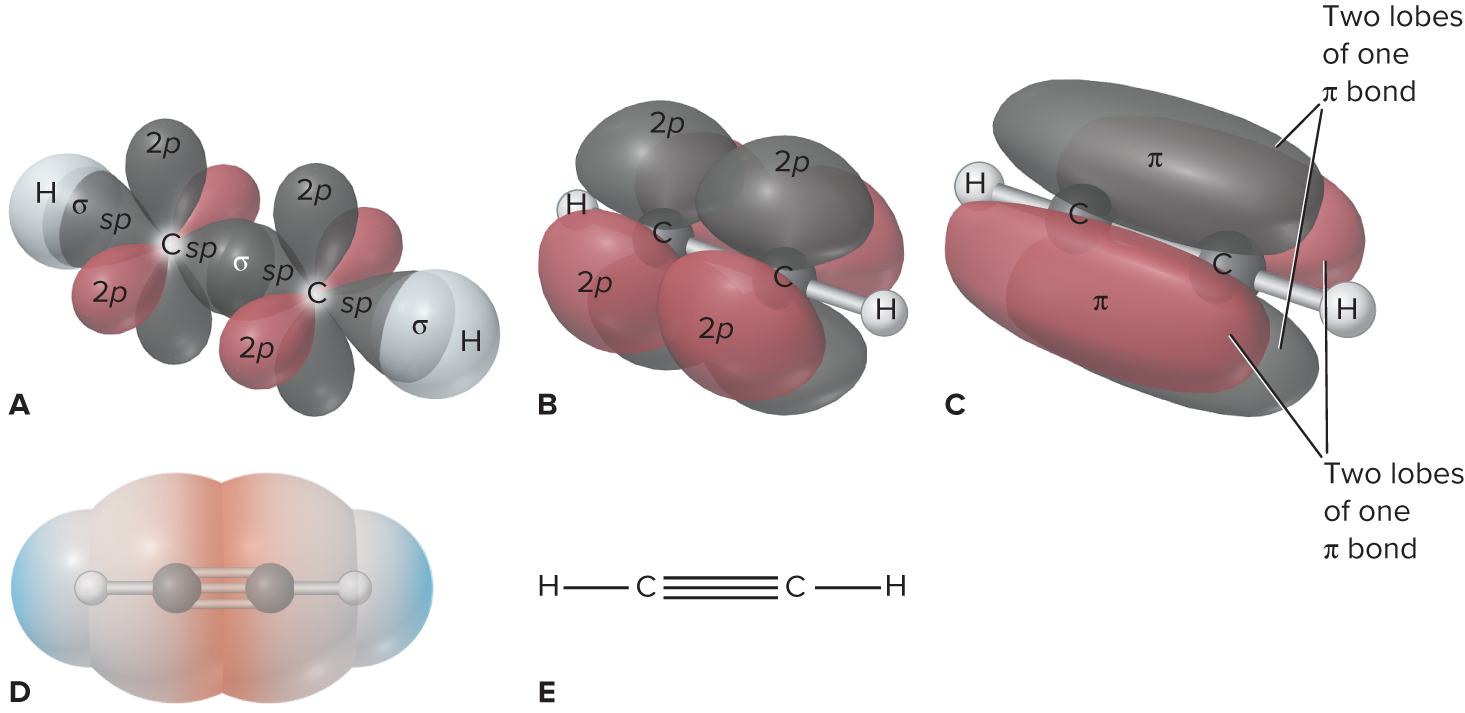
Pi bond (π bond)
A bond formed by the side-to-side overlap of orbitals, increasing electron density between two nuclei
Includes the bonds formed after a single σ bond, such as double and triple bonds
Has two equally-occupied lobes of electron density, above and below the σ bond axis
Utilizes the unhybridized p orbitals, but is weaker due to less overlap
Free rotation
This is permitted in σ bonds due to overlap not being affected

Restricted rotation
This occurs in π bonds (if trying to rotate just one atom) due to overlap being reduced
Results in the creation of distinct isomeric structures for certain molecules

Molecular orbital theory (MO theory)
A model of bonding to explain each molecule’s properties through the use of delocalized electrons in molecular orbitals of given energies and shapes that extend over the whole molecule
Creates a number of bonding and antibonding orbitals equal to the number of atomic orbitals
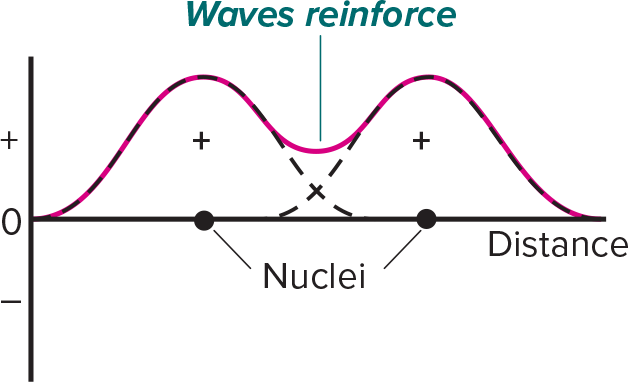
Bonding molecular orbital (bonding MO)
This is formed through the overlap of two electron clouds, increasing density between nuclei
Acts through the amplification of two atomic orbital wave functions, adding two functions
Lower in energy due to density spread between nuclei across larger volumes, lowering repulsions for a more stable state
Always coexists with an antibonding MO

Antibonding molecular orbital (antibonding MO)
This is seen in nodes, or regions of zero electron density between the nuclei
Acts through the cancellation of two atomic orbital wave functions, subtracting one function
Higher in energy due to greater nuclear repulsions and a lack of separating electrons via a node, lowering stability
Always coexists with a bonding MO

Sigma molecular orbital (σ MO)
A molecular orbital that is cylindrically symmetrical about the nuclei, formed through similar energy and orientation
Denoted by a σ with a subscript listing the derived atomic orbital, such as σ1s
Antibonding molecular orbitals are denoted with a star, such a σ*1s

Molecular orbital diagram (MO diagram)
A diagram showing the atomic orbitals that compose each MO, following normal diagram rules
Fills lower-energy bonding before higher-energy antibonding forms
Each level is written in parentheses; for H2, this is (σ1s)2

Molecular orbital bond order (MO bond order)
Calculated by taking:
½ (number of bonding electrons - number of antibonding electrons)
Greater than 0 indicates more stability and formation, increasing with strength
Equal to 0 indicates no difference in stability, resulting in no formation
Correlates with greater bond energy and shorter bond length
Homonuclear diatomic molecule
A molecule composed of two identical atoms; these only use outer atomic orbitals to determine molecular orbitals
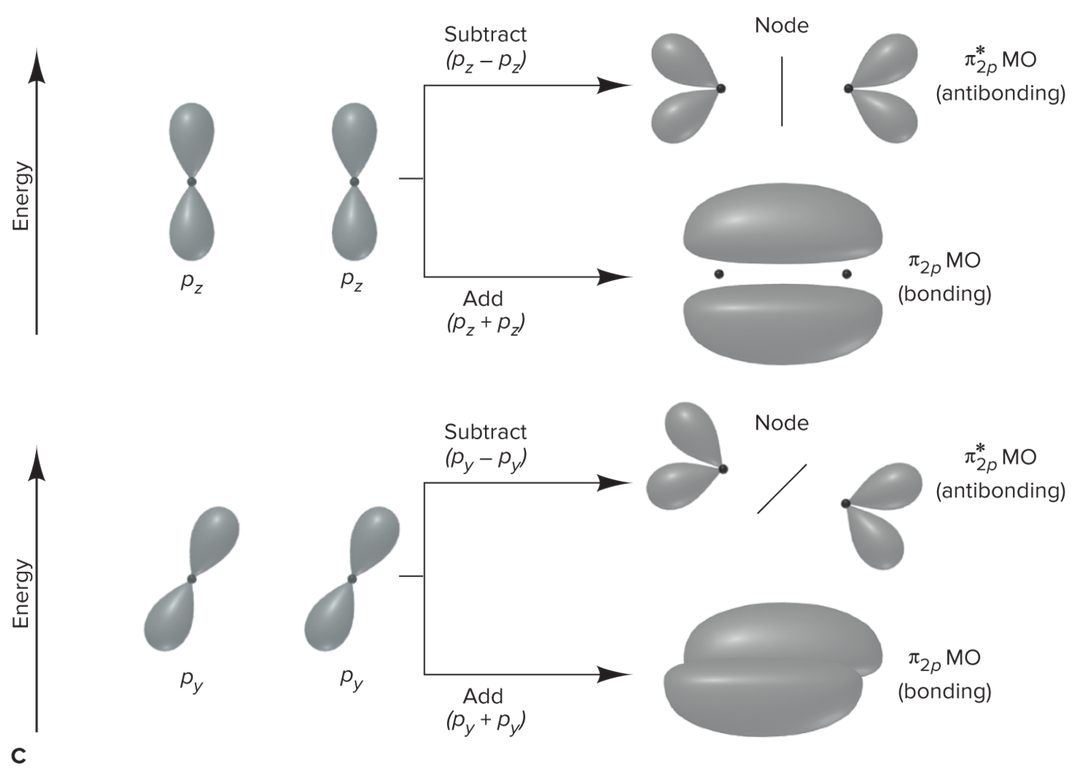
Pi molecular orbital (π MO)
A molecular orbital formed through the side combination of two p orbitals with orientations perpendicular to the internuclear axis
Noted in pairs like π2p and π*2p
Expected to have a σ2p < π2p < π*2p < σ*2p energy order for the smaller O2, F2 and Ne2
Expected to have a π2p < σ2p < π*2p < σ*2p energy order for the larger B2, C2, and N2 due to sp mixing raising the energy of the σ2p and σ*2p orbitals

sp Mixing
This occurs for the larger homonuclear diatomic molecules B2, C2, and N2, with energies being lowered on the σ2s and σ*2s and raised on the σ2p and σ*2p orbitals due to less repulsion
Deviates from the expected non-mixing of two orbitals for normally large energy differences, as seen in O2, F2, and Ne2
Results in molecular bond energy being listed as π2p < σ2p < π*2p < σ*2p
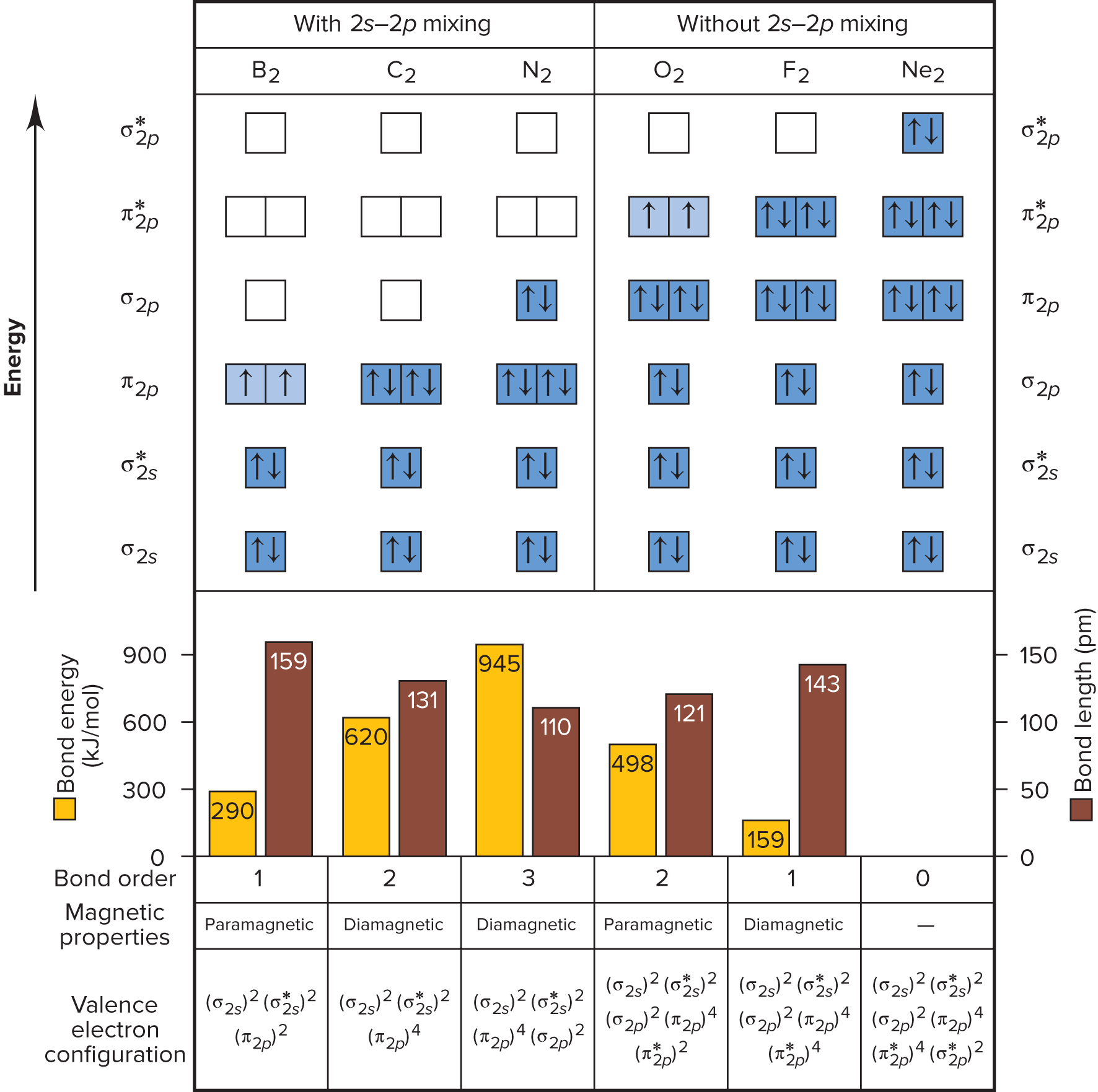
Magnetism
This can be observed in a molecular orbital diagram, determining if any unpaired electrons are present in a molecular orbital while avoiding the shortcomings of Lewis structures

Heteronuclear diatomic molecules
These have asymmetric MO diagrams due to unequal atomic energies and nuclear charges, with greater charges resulting in more stable forms

Nonbonding molecular orbital (nonbonding MO)
A molecular orbital that is not involved in bonding, with the same energy as the isolated orbital
Seen with the two filled pairs in F not interacting with H in HF