3.4 Cost, Access, and Quality
 Call Kai
 Learn
 Practice Test
 Spaced Repetition
 Match
 Flashcards
 Knowt Play
1/16

There's no tags or description
Looks like no tags are added yet.
17 Terms
Why these 3 belong together?
Cost
Affects what patients can afford and what services health systems can provide
Access
Determines whether patients can get the care they need, when and where they need it
Quality
determines whether that care is safe, effective, and improves health
The three are interconnected. For example, expanding access to preventive care requires upfront investment but can improve health and reduce avoidable hospital visits
What does “cost” actually mean?
The meaning of health care cost depends on whose perspective we are considering —> Same word. Different perspective.
Patient perspective:
When patients pay in insurance premiums and out-of-pocket costs, such as deductibles and copayments
National perspective:
What the country spends on health care, measured in total dollars, per person, or as a share of GDP
Provider perspective:
What it costs to deliver care, including staff, equipment, supplies, medications, and facilities
One visit, three perspectives:
A patient may pay a copay, the clinic uses staff time and supplies, and spending on the visit contributes to national health expenditures
The basic cost equation
Health care spending equals the price paid per service multiplied by the number of services ued
Price is the amount paid for each visit, test, procedure, or prescription
Quantity is how many of those service patients use
Spending can rise even when use stays the same. For example, 100 visits at $150 each cost $15000. If the price rises to $180, those same 100 visits cost $18000
Where does the money come from and go?
Where does money COME from:
Private health insurance
Medicare
Medicaid
Out-of-pocket spending
Other third-party payers, programs, and public health activity
Where the money WENT:
Hospital care
Physician and clinical service
Prescription drugs
The U.S. is an International Outlier
The US spends more on health care than peer countries
Access is weaker, with patients facing barriers to getting needed care
Equity is weaker, with access to care and care experiences varying by income
Health outcomes are comparatively worse on several measures
The Commonwealth Fund’s 2024 report ranked the U.S. last overall among 10 countries
Why is U.S. Health Care so expensive?
Prices and payment shape how much insurers, public programs, and patients pay for care
New technology can improve diagnosis and treatment while adding to spending
Population needs grow as people age and more patients require ongoing care for chronic conditions
Administrative complexity add cost through billing, insurance paperwork, and other administrative tasks
Practice patterns and waste can increase spending through unnecessary tests, defensive medicine, duplicate services, low-value care, and fraud
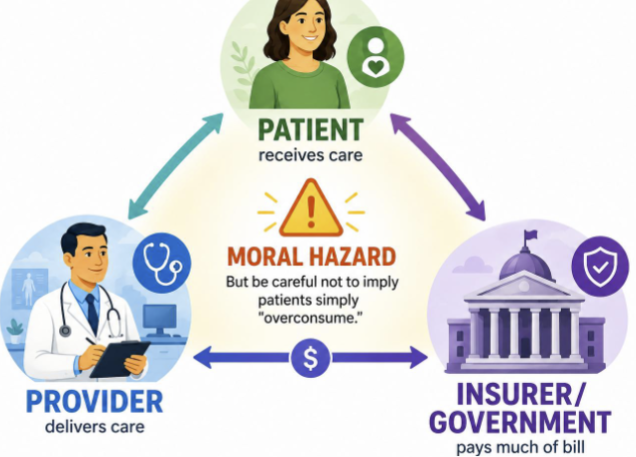
Third-Party Payment Changes Incentives (graphic)
Technology: Better Care, higher spending?
Examples include robotic surgery, advanced imaging, biologic drugs, genomic testing, and AI-assisted diagnosis
Better outcomes can come from earlier detection or more targeted treatment
More treatment options become available for conditions that were once difficult to manage
Use can increase as more patients become eligible for new tests and treatments
Total spending can rise when new technologies cost more per service, when more patients use them, or both
The U.S. Multipayer system in action (graphic)

Practice variation: More care =/ Better Care
Variation may reflect clinical need, but unexplained variation can signal inefficiency
Practice variation occurs when patients with similar symptoms receive different tests or treatments
Patient A undergoes imaging and cardiac testing, followed by an angiogram and stent placement
Patient B receives medications, lifestyle counseling, and risk factor management. Both patients receive follow-up care
Differences can be appropriate when patients have different risk levels, test results, or treatment preferences
Unexplained variation can signal inefficiency when additional tests or procedures increase cost without improving outcomes
Many Tools, One goal: Contain costs
Health planning aligns the supply and location of health care resources with community needs
Price controls and competition address spending through payment limits and market incentives for efficiency
Peer review and utilization controls assess whether services are necessary and appropriate, helping reduce unnecessary care
Value-based payment ties reimbursement to both the cost and quality of care
Chronic disease prevention and management can reduce complications and avoid costly hospital visits
So how do we contain costs?
Pay differently by rewarding providers for quality, patient outcomes, and efficient care
Use care differently by helping patients get the right service at the right time and in the right setting
Prevent costly complications through routine preventive care, healthy habits, and early management of chronic condition
Strategy 1: Change how we pay
Fee-for-service pays for each service delivered, so providing more services generates more revenue
Diagnosis-related groups (DRGs) set a payment for a hospital stay based on the type and complexity of the case
Bundled payments cover a group of related services for an entire episode of care
Accountable care organizations (ACOs) can earn a share of savings when spending falls below a benchmark and quality standards are met
Value-based payment ties reimbursement to quality and cost. Value reflects the health outcomes achieved relative to the resources used
Strategy 2: Prevent the expensive event
Prevention promotes healthy behaviors and reduces risk factors before disease develops
Early detection can identify conditions when treatment may be more effective and less costly
Chronic disease management helps keep existing conditions from worsening
Fewer complications can mean fewer emergency visits and hospitalizations
Better health is the primary benefit. Costs savings depend on the intervention and the care it helps avoid
Tradeoffs
Higher deductible can reduce spending and lead patients to skip needed care
Narrow provider networks can lower negotiated prices and limit patients’ choice of doctors and hospitals
Prior authorization can reduce unnecessary services and delay needed treatment
Provider payment cuts can lower spending and discourage providers from participating in a health plan
The tradeoff is whether savings come at the expense of timely access to needed care
What is access?
The ability of an individual to obtain health care services when needed
Coverage depends on whether you have insurance, qualify for a plan or program, and have the service included in your benefits
Affordability depends on what you pay in premiums, deductible, copays, and other-out-of pocket costs
Availability depend on whether providers, facilities, and appointments are within reach when you need them
Usability depends on practical factors such as transportation, clinic hour, language support, and ease of navigating the sy
Containing costs while protecting access to care