Immunodiagnostic assays (17 and 18)
 Call Kai
 Learn
 Practice Test
 Spaced Repetition
 Match
 Flashcards
 Knowt Play
1/32

There's no tags or description
Looks like no tags are added yet.
33 Terms
Tests for antibodies
determine whether and animal has been exposed to a pathogen, and sometimes whether an animal has been vaccinated for a pathogen.
- Because antibodies can persist after the infectious agent is no longer present, antibody detection indicates exposure to the agent ot vaccine some time prior to the test
Tests for antigens
detect antigens of infectious agents and blood group antigens. Also measure levels of hormones and pahrmaceuticals
Antiglobulins
antibodies that react with immunoglobulins of a different species
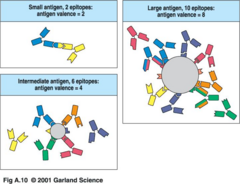
Antigen epitopes
One antigen may contain several different epitopes.
Precipitates
Large lattices formed by insoluble antigen-antibody complexes.

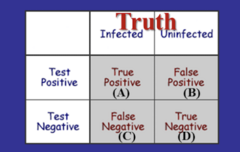
False positive
A positive test result when the animal is not infected by the pathogen.
False negative
A negative test result when the animal is infected by the pathogen.
Positive predictive value
Probability that a positive test result is a true positive.
- true positive/(true pos+false pos)
- A/(a+B)

Negative predictive value
Probability that a negative test result is a true negative.
- true negative/(True neg+false neg)
- D/(D+C)
Agar Gel Immunodiffusion (AGID)
- formation of large Ag:Ab complexes that precipitate out of solution
- detects antibody
EX: Coggin's test for equine infectious anemia
Single radial immunodiffusion assay (SRID)
- used to measure serum immunoglobulin concentrations
Agglutination reactions
visible clumping of particulate antigens (RBCs, bacteria, or latex particles) by antibodies
- detects antibodies
Hemagglutination assays
used in blood typing and the detection of antibodies to RBCs
Direct Coombs test
Detects presence of antibodies on the red blood cell surface
-Ex: IMHA
Coombs reagent
mixture of antibodies to the patient's species IgG and IgM
- Mixed with RBCs of IMHA patient to see if agglutination occurs, which would indicate the presence of antibodies on the cell surface
Indirect Coombs test
- Used for cross-matching blood types
Recipient's serum and donor's RBC mixed and then Coombs reagent is added to mixture
- Agglutination = presence of antibodies in the recipient's serum to the donor's RBCs
Hemagglutination inhibition tests (HI)
Some viruses are capable of binding to and agglutinating erythrocytes
- positive serum has anti-virus Ab, they will bind virus and virus cannot bind and agglutinate RBCs
- Negative serum: virus is free to bind and agglutinate RBCs
- detects antibodies
Enzyme-linked immunosorbent assay (ELISA)
antigen or antibody is labeled with an enzyme; enzymatic reaction occurs if there is Ag:Ab binding, causes formation of colored product
- detects both antigen and antibodies
ELISA and equine infectious anemia
- can be used to detect antibodies to EIA
- more sensitive, results in hours
- can see false positives
Complement Fixation (CF)
Activation of complement by Ag+Ab complex in positive sample = complement fixed before RBCs added and RBCs are NOT lysed
- Negative test causes lysis of RBCs when Ab and RBCs are added
- detects antibodies
Serum or virus neutralization (SN or VN)
Neutralization of virus infectivity or toxin infectivity by specific Abs.
- Positive sample that has virus + specific Ab. will inhibit viral replication and there will be no damage to cells
- Negative sample that has virus but no antiviral Abs. will see viral replication and damage to cells
- detects antibody
Fluorescent antibody (FA)
Antibody is labeled with fluorescent molecule; presence of immunofluorescence indicates Ag+Ab reaction
- Indirect detects Ab
- Direct detects Ag
Immunoblot or western blot
Antigens are separated by MW via electrophoresis prior to reacting with antibody; detection is similar to ELISA
- detects antibody
Immunohistochemistry (IHC)
Similar to ELISA, except antigens are on a glass slide (tissue section or cytology)
- detects antigen
Lateral flow immunoassay
Antigen or antibody is labeled with gold particles that migrate across a filter; capture of the gold-labeled Ag+Ab complex leaves a visible line or spot on the filter
- Can detect Ab or Ag
Ex: pregnancy test
Flow cytometry
Rapid way to measure cells tagged with fluorescent molecules in suspension; used to measure different T cell population (CD4+ or CD8+) sin blood
- does not detect Ab or Ag
Diagnostic sensitivity
Proportion of infected animals the test classifies as positive
- indicates the ability of the test to detect the presence of infection, when infection is present
- True positive/infected
- A/(A+C)
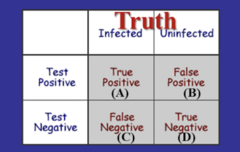
Diagnostic specificity
Proportion of uninfected animals the test classifies as negative
- indicates the ability of the test to indicate the absence of infection, when infection is absent
- True negative/uninfected
- D/(B+D)
Reasons for false positive - antigen
- recently vaccinated with agent (antigens are still present in tested specimen)
- infected with agent that cross-reacts
False negative - antigen
- low level of antigen present in specimen (below limit of detection for test)
- early in infection
- late in infection
False positive - antibody
- cross-reactive antibodies being detected
- previous vaccination
- previous infection
- subclinical infection that is not the cause of disease
False negative - antibody
- low level of antibody present in the serum
- early in infection
- poor immune response to infection
Using titers to detect infection
- Take two serum samples ~2 weeks apart
- at least 4-fold increase in titer = ongoing infection