Ap US History period 3
 Call Kai
 Learn
 Practice Test
 Spaced Repetition
 Match
 Flashcards
 Knowt Play
1/64

There's no tags or description
Looks like no tags are added yet.
65 Terms
The French and Indian War
1754-1763
War between French and British in American colonies part of 7 years

The Proclamation of 1763
Line drawn by British Parliament, colonists not allowed to settle past Appalachian mountains

Stamp Act
1765 direct tax on a stamp that must be put on paper, office documents, etc.

The Coercive Acts
1774 intolerable acts

Common Sense
1776 pamphlet written by Thomas Paine to get people to want independence

The Declaration Of Independence
1776 document written by colonist elites to British King and Parliament stating independence and what all was wrong with British rule and the King

Battle of Saratoga
Head to head battle between the British and Americans in country side, Americans win by a lot and show they have a chance
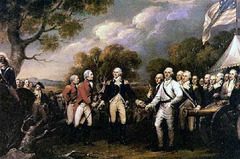
French American Alliance
Formed after battle of Saratoga when Americans proved to French they can win and French are allies because they want to damage an age old enemy

Treaty of Paris
1783 ended the American Revolutionary War
Granted the land British gave Indians as American land
now American colonies recognized as their own independent country

Articles of confederation
First form of government
A lot of weaknesses
No strong central government
Strong state governments
Causes economical problems and failure

The Northwest Ordinance of 1787
Land in Northwest is divided into 5 states (Michigan, Illinois, Ohio, Wisconsin, Indiana) they are all seen as equal to the 13 original states
Reach a certain pop you can apply for statehood and be part of congress and slavery was outlawed

Shays' Rebellion
1786 farmers debt rebellion agriculture depression, economical failure and 2 out of 3 were being sued
The Constitution
New format of government focuses more on a central national power and less on states 3 branch government that limit each other

Federalism
A system in which power is divided between the national and state governments

Connecticut Compromise (Great Compromise)
New Jersey and Virginia plans together and create the senate and House of Representatives senate equal vote house of rep by population

The Three-Fifths compromise
Slaves count as population for vote in congress
3 slaves for every 5 white were counted

The Bill of rights
First ten amendments of the constitution

George Washington's presidency
1st president formed the cabinets 2nd term strictly followed constitution left office to tell everyone they needed to be unified established framework of Supreme Court and how they will be decided judiciary

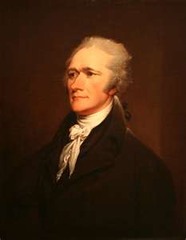
Hamilton
Tackle debt- grant money back to people, national bank create national government, manufacturing establish tax revenue
Enlightenment
A movement in the 18th century that advocated the use of reason in the reappraisal of accepted ideas and social institutions.

John Locke
English philosopher who advocated the idea of a "social contract" in which government powers are derived from the consent of the governed and in which the government serves the people; also said people have natural rights to life, liberty and property.

George Whitefield
Credited with starting the Great Awakening, also a leader of the "New Lights."

Great Awakening
a religious movement that became widespread in the American colonies in the 1730s and 1740s

Ben Franklin
A delegate from Pennsylvania and proposed the "Albany Plan of the Union" as a way to strengthen colonies.

Abolition
The movement to make slavery and the slave trade illegal. Begun by Quakers in England in the 1780s.

representation
A basic principle of traditional democratic theory that describes the relationship between the few leaders and the many followers.

Sugar Act of 1764
An act that raised tax revenue in the colonies for the crown. It also increased the duty on foreign sugar imported from the West Indies.

Virtual Representation
The political theory that a class of persons is represented in a lawmaking body without direct vote.

Quartering Act of 1765
Act forcing colonists to house and supply British forces in the colonies; created more resentment; seen as assault on liberties.

English Common Law
The centuries-old body of legal rules and procedures that protected the lives and property of the British monarch's subjects.

Declaratory Act
Act passed in 1766 after the repeal of the stamp act; stated that Parliament had authority over the the colonies and the right to tax and pass legislation "in all cases whatsoever."

Townshend Acts
A tax that the British Parliament passed in 1767 that was placed on leads, glass, paint and tea

Popular Sovereignty
A belief that ultimate power resides in the people.
Thomas Jefferson
Wrote the Declaration of Independence, Leader of the Democratic-Republican Party

Second Continental Congress (1775)
Managed the colonial war effort, and moved incrementally towards independence - finally adopting the *Declaration of Independence* in 1776.

Sons of Liberty
A radical political organization for colonial independence which formed in 1765 after the passage of the Stamp Act. They incited riots and burned the customs houses where the stamped British paper was kept. After the repeal of the Stamp Act, many of the local chapters formed the Committees of Correspondence which continued to promote opposition to British policies towards the colonies. The Sons leaders included Samuel Adams and Paul Revere.

Patriots
(also known as Revolutionaries, Continentals, Rebels, or American Whigs) were those colonists of the Thirteen Colonies who rejected British rule during the American Revolution and declared the United States of America as an independent nation in July 1776.

Tories/Loyalists
Colonists who favored remaining under British control

Constitutional Convention
A meeting in Philadelphia in 1787 that produced a new constitution

Articles of Confederation
(1777) the document that created the first central government for the United States; was repealed by the Constitution in 1789
POPULAR SOVEREIGNTY
Constitutional principle stating that the people hold the power in our government. People hold this power with the ability to vote
LIMITED GOVERNMENT
In this type of government everyone, including all authority figures, must obey laws. Constitutions, statements of rights, or other laws define the limits of those in power so they cannot take advantage of the elected, appointed, or inherited positions
FEDERALISM
A system of government in which a written constitution divides power between a central, or national, government and state governments
Legislative Branch
-function: to pass laws, gotta pass both chambers by majority vote before it can become a law; can declare war
Executive Branch
The president and his cabinet. The president cannot legislate but can pass executive orders under certain defined circumstances.
Judicial Branch
A branch of government that interprets Congressional laws
House of Representatives
the lower legislative house of the United States Congress. The number of people per state is determined by population of the state
Living document
The Constitution of the United States is referred to as a "living document" because the architects of the document intended for it to be adapted by future generations. It is adaptable - amendments could be ratified, or added to it.
Marbury v Madison
Court case that established judicial review
whiskey rebellion
In 1794, farmers in Pennsylvania rebelled against Hamilton's excise tax on whiskey, and several federal officers were killed in the riots caused by their attempts to serve arrest warrants on the offenders. In October, 1794, the army, led by Washington, put down the rebellion. The incident showed that the new government under the Constitution could react swiftly and effectively to such a problem, in contrast to the inability of the government under the Articles of Confederation to deal with Shay's Rebellion.
Jay's treaty
1794- British and US agreed- British trade w/ Americans and the British leave northwest territory
Pinckney Treaty (Treaty of San Lorenzo)
1795 - Treaty between the U.S. and Spain which gave the U.S. the right to transport goods on the Mississippi river and to store goods in the Spanish port of New Orleans
Proclamation of Neutrality
A proclamation issued by President George Washington in 1793, allowing U.S. citizens to trade with all belligerents in the war between France and Great Britain.
Washington's Farewell Address, 1796
Urged Americans to avoid excessive political party spirit and geographical distinctions. In foreign affairs, warned against long-term alliances with other nations -
XYZ Affair (1797)
Diplomatic conflict between France and the United States when American envoys to France were asked to pay a hefty bribe for the privilege of meeting with the French foreign minister. Many in the U.S. called for war against France, while American sailors and privateers waged an undeclared war against French merchants in the Caribbean.
Alien and Sedition Acts
Series of four laws enacted in 1798 to reduce the political power of recent immigrants
Kentucky and Virginia Resolutions, 1798-99
Written by Jefferson and Madison, in response to the Alien and Sedition Acts; argued states had the power to declare federal acts unconstitutional. States Rights
Republican Motherhood/Cult of Domesticity
This idea refers to the idealization of women in their roles as wives and mothers. The concept of republican motherhood suggested that women would be responsible for raising their children to be virtuous citizens of the new American republic.
Pinckney's Treaty (1795)
This treaty between the U.S. and Spain which gave the U.S. the right to transport goods on the Mississippi River and to store goods in the Spanish port of New Orleans
Quasi War (1798-1800)
undeclared war fought mostly at sea between the French Republic and the United States, caused by the signing of Jay's Treaty between the UK and the US
Revolution of 1800
Jefferson's election changed the direction of the government from Federalist to Democratic- Republican, so it was called a "revolution."
Federalist Papers
A collection of 85 articles written by Alexander Hamilton, John Jay, and James Madison under the name "Publius" to defend the Constitution in detail.
Federalists and Anti-Federalists
Those favoring ratification of the Constitution and adoption of a strong federal government vs those opposed, feared the power of the national government
Federalist vs Democratic-Republican
A supporter of a strong national government. Vs. A supporter of state liberties
political party
a group that seeks to elect candidates to public office