3.3.4 Alkenes
 Call Kai
 Learn
 Practice Test
 Spaced Repetition
 Match
 Flashcards
 Knowt Play
1/14

There's no tags or description
Looks like no tags are added yet.
15 Terms
Alkenes
General formula CnH2n+2
Classified by the carbon carbon double bond, making them unsaturated
Cyclic alkenes have CnH2n+2
Geometry of alkenes
Trigonal planar geometry:
The carBon carbon double bond is a region of high density
These regions are arranged in a trigonal planar shape due to equal repulsion between them
Bond angle 120
The pi bond forms overlapping P orbitals above and below the C-C bond, preventing rotation
-There are two pairs of electrons in the C-C double bond therefore it has high electron density
-This makes alkenes more reactive than alkanes as the region of high electron density around the C=C bond allow it to take part in electron addition reactions and readily react with electrophiles, which is formed by heterolytic fission
-The double bond consists of a sigma bond and a pi bond
-The pi bond is weaker than the sigma bond so breaks first in a reaction

Explain why there is an attraction between the C=C double bond and Br2
-There is a region of high electron density around the C=C
-This induces a dipole in bromine as the C=C electrons repel the Br bond, polarising it to create partial negative and partial positive charges
-The partially positive Br is attracted to the electron rich C=C bond
Electrophillic addition mechanisms
Halogens
Hydrogen halides
Concentrated sulphuric acid and steam
Addition of halogens
Bromine water is an example of this
The alkene reacts with bromine via Electrophilic addition
This reaction removes orange colour as the bromine is consumed
The product is colourless dibromoalkane solution
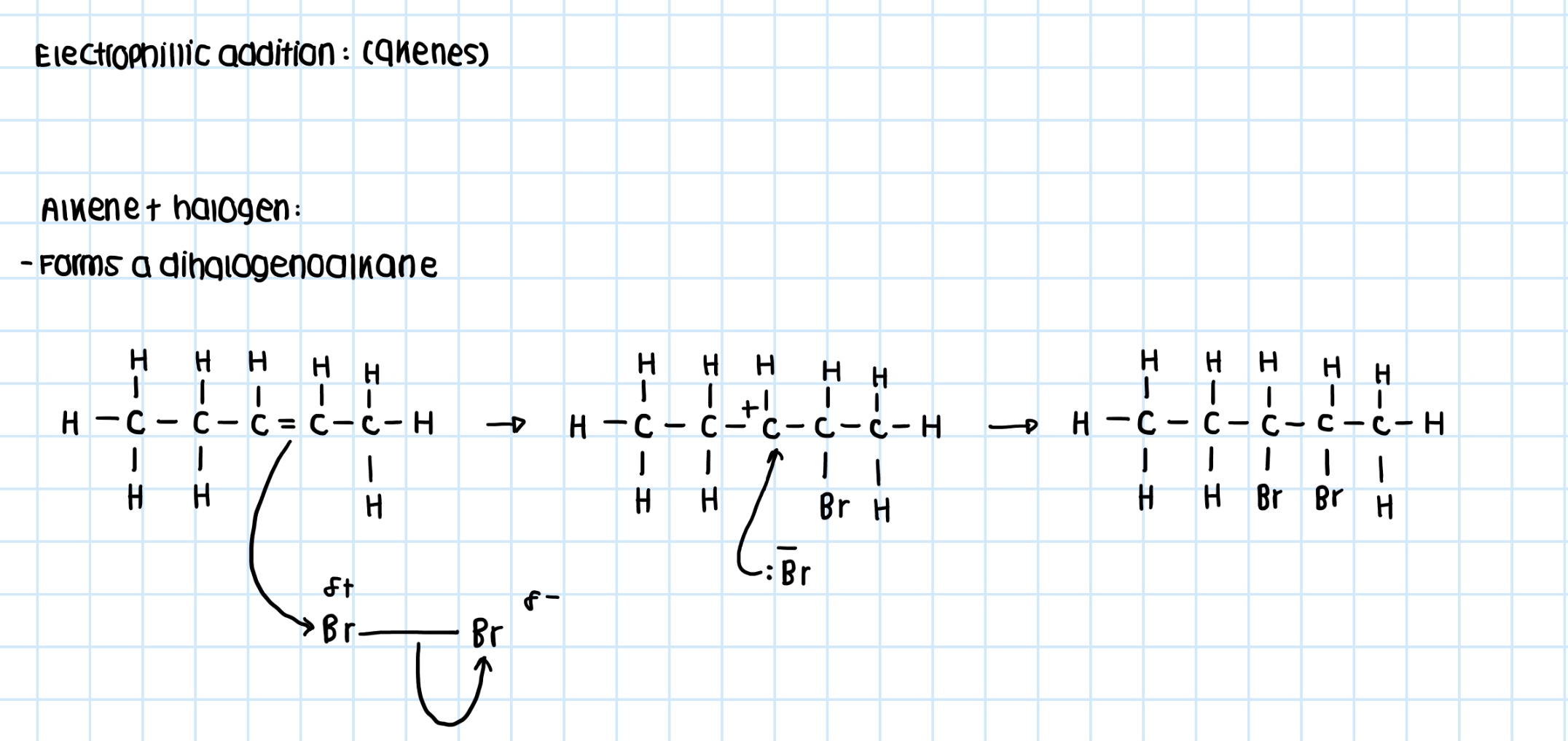
Addition of hydrogen halides
Produces haloalkanes

Addition of concentrated sulphuric acid and steam:
Sulphuric acid acts as a catalyst
Produces an alcohol

Stability of carbocation
The reaction generates a positively charged carbocation intermediate:
Primary carbocations - These have one alkyl group attached to the positively charged carbon and are the least stable.
Secondary carbocations - These have two alkyl groups at the carbocation centre and offer moderate stability.
Tertiary carbocations - These have three alkyl groups and are the most stable.
So the major product will always be more stable, e.g. the secondary carbocation or the tertiary
The more alkyl groups present, which are electron releasing groups, the greater the positive inductive effect, so the more stable the carbocation intermediate
Addition polymers
Alkenes polymerise by opening up their double bond
Individual alkene molecules are called monomers
Joining many monomers together is called polymerisation
Addition polymers are un reactive as strong, non polar bonds are formed
Repeating units must be drawn in square brackets with the subscript n outside the bracket
The IUPAC name is the name of the monomer inside brackets, with ‘poly’ on the outside

Intermolecular forces in polyalkenes
Experience induced dipole dipole forces act between separate polymer molecules, the chain itself is covalent
Factor affecting properties of polyalkenes: chain length
Longer chains allow more surface contact between neighbouring chains
This strengthens intermolecular forces
Fewer branches pack closer together resulting in strong intermolecular forces
Factor affecting properties of polyalkenes: branching
Straight chains can pack closely together maximising the strength of intermolecular forces
Branched chains cannot pack as tightly, reducing the surface contacts
Large branches have weaker intermolecular forces and so are more flexible
Effect of electronegative side groups
An example of this is polychloroethane
As chlorine is more electronegative than carbon, a permanent dipole is formed
-The partially negative chlorine is attracted to partially positive carbon in the next polymer molecule
PVC uses
This stands for polychloroethane, and is rigid with limited mobility
This means that the chains cannot easily move past one another
This rigidity if suitable for:
Pipes
Window frames
Plasticisers
modify polymer properties:
-Plasticisers are small molecules that can be added to polymers to increase flexibility:
-Plasticiser molecules position themselves between polymer chains.
-This pushes the chains apart, weakening intermolecular forces between polymer chains.
-The chains can now slide over each other more easily when bent.
-For example, polyvinyl chloride (PVC)
Unplasticised PVC has long, closely packed chains making it rigid but brittle. It is used in applications such as pipes, window frames, and floor coverings
Plasticised PVC has much greater flexibility, allowing uses like cable insulation, shower curtains, and clothing.