Chapter 1: Introduction to Anatomy & Physiology
 Call Kai
 Learn
 Practice Test
 Spaced Repetition
 Match
 Flashcards
 Knowt Play
1/58

Earn XP
Description and Tags
59 Terms
Anatomy
The study of body structure and the relationships between body parts
Physiology
The study of how the body and its structures function
Renal physiology
Concerns kidney function and urine production
Neurophysiology
Explains the workings of the nervous system
Cardiovascular physiology
Examines the operation of the heart and blood vessels
Principle of complementarity
Function always reflects structure
What a structure can do depends on its
specific form
Gross anatomy
Study of body structures visible to the naked eye
Microscopic anatomy
The study of body structures that are too small to be seen with the naked eye
Regional anatomy
All structures in one part of the body
Systemic anatomy
Gross anatomy of the body studied by system
Surface anatomy
Study of internal structures in relation to the skin
Cytology
The study of cells
Histology
The study of tissues
Developmental anatomy
Traces structural changes throughout life
Embryology
The study of developmental changes of the body before birth
Pathological anatomy
The study of structural changes caused by disease
Radiographic anatomy
The study of internal structures visualized by specialized scanning such as X-ray, MRI, and CT scans
Molecular biology
Study of anatomical structures at a subcellular level
Levels of structural organization
Chemical, cellular, tissue, organ, organ system, organismal
Chemical
Atoms combined to form molecules
Cellular
Cells are made of molecules
Tissue
Groups of cells working to perform a specific function
Organ
Group of tissues working to perform a specific function
Organ System
Group of organs working together to perform a specific function
Organismal
Made up of the organ systems
Integumentary system
Forms external body covering
Composed of skin, sweat glands, oil glands, hair, and nails

Integumentary system functions
• Protects deep tissues from injury and synthesizes vitamin D
Skeletal system
Composed of bone, cartilage, and ligament
Skeletal system functions
•Protects and supports organs
•Provided framework for muscle
•Site of blood formation
•Stores minerals
Muscular system
Composed of muscles and tendons
Muscular system functions
•Allows locomotion and facial expression
•Maintains posture
•Produces heat
Nervous system
Composed of the brain, spinal column, and nerves

Nervous system functions
•Fast acting control system of the body
•Responds to stimuli by activating muscles and glands
Endocrine system
•Secretes hormones
•Influences metabolic changes thru hormones
Endocrine glands
Pituitary, thyroid, parathyroid, adrenal, pineal, and thymus glands
Cardiovascular system
Composed of heart and blood vessels
Cardiovascular system functions
•The heart pumps blood
•Blood vessels transport blood throughout the body
Lymphatic system
Composed of red bone marrow, thymus, spleen, lymph nodes, and lymphatic vessels

Lymphatic system functions
•Picks up fluid leaked from blood vessels and returns it to blood
•Disposes of debris in the lymphatic stream
•Houses WBC
Respiratory system
Composed of the nasal, cavity, pharynx, trachea, bronchi, and lungs

Respiratory system functions
•Keeps blood supplied with O2
•Removes CO2
Digestive system
Composed of the oral cavity, esophagus, small intestine, large intestine, rectum, anus, and liver

Digestive system functions
•Breaks down food that enter the blood
•Eliminates indigestible foodstuffs as feces
Urinary system
Composed of kidneys, ureters, urinary bladder, and urethra

Urinary system functions
•Eliminates nitrogenous waste
•Regulates water, electrolyte, and pH balance of the blood
Male reproductive system
Composed of prostate gland, penis, testes, scrotum, and ductus deferens

Male reproductive system functions
Production of offspring
Testes produce sperm and make sex hormones
Ducts and glands deliver sperm to the female reproductive tract
Female reproductive system
Composed of mammary glands, ovaries, uterine tubes, uterus, and vagina

Female reproductive system functions
Production of offspring
Ovaries produce eggs and females sex hormones
Site for fertilization and development of fetus
Mammary glands produce milk
Necessary life functions
Metabolism
Responsiveness
Excretion
Movement
Maintaining boundaries
Digestion
Reproduction
Growth

Survival needs
Nutrients
Oxygen
Water
Normal body temperature
Atmospheric pressure

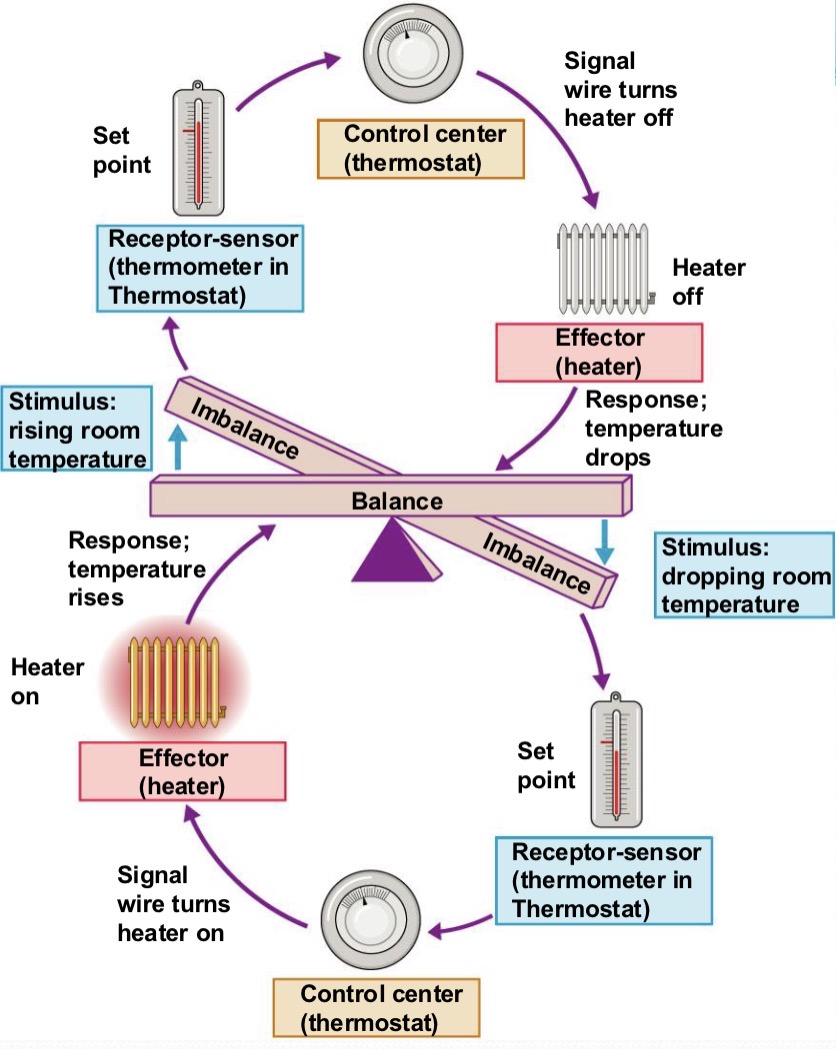
Homeostasis
Ability to maintain a stable internal environment
Homeostatic control mechanisms
•Receptor
•Control center
•Effector

Receptor
Monitors the environments and responds to changes (stimuli)
Input information sent along the afferent pathway
Control center
Determines the set point at which the variable is maintained
Sends information via an efferent pathway to the effector
Effector
Provides the means to respond to stimuli
Negative feedback
The output shuts off the original stimulus
Ex. Body temp and blood sugar levels
Positive feedback
The output enhances or exaggerates the original stimulus
Ex. Labor contractions and blood clotting

Homeostatic imbalance
•Positive feedback takes over negative feedback
•Occurs during disease
