a&p exam 2
 Call Kai
 Learn
Learn Practice Test
 Spaced Repetition
 Match
Match Flashcards
 Knowt Play
1/233

There's no tags or description
Looks like no tags are added yet.
Name | Mastery | Learn | Test | Matching | Spaced | Call with Kai | Chat |
|---|
No analytics yet
Send a link to your students to track their progress
234 Terms
tissues
Cells are organized into __
tight junction
__ allows membranes to cover and fuse
desmosomes
__ bind cells by forming “spot welds” between cell membranes
gap junctions
__ link the cytoplasm of adjacent cells and allow ions and nutrients to move
Epithelial Tissues
cover organs and body surfaces, line cavities and hollow organs, and make up the glands
free surface (apical) ; underside (basal)
epithelial tissues have __ on the outside and __ anchored by connective tissue by a thin, non-living layer called the basement membrane
simple squamous epithelium tissue
fits tightly together like floor tiles, nuclei are broad and thin, and make up the walls of air sacs (alveoli), capillaries and lines blood and lymphatic
(FOUND IN DIFFUSION AND FILTRATION SITES)
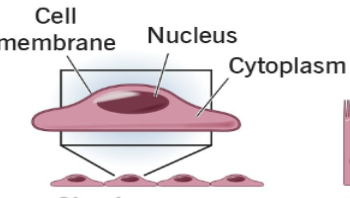
Simple Cuboidal Epithelium Tissue
A single layer of cube-shaped cells with centrally located nuclei and lines kidney tubules, thyroid follicles, ducts of some glands
(SECRETION AND ABSORPTION)

Simple Columnar Epithelial Tissue
is when the nuclei are usually at the same level, near the basement membrane (taller)
^^ secretion and absorption & protection ^^
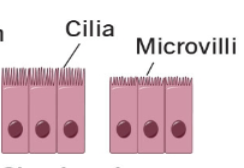
goblet cells
__ secrete a protective fluid called mucus on the free surface of the tissue and is known as a simple columnar tissue
microvilli
__ increased surface area of the cell membrane → cells that are specialized for absorption and is known as a simple columnar tissue
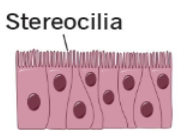
pseudostratified columnar epithelium tissue
when nuclei are at 2 or more levels and cells vary in shape, but all reach the basement membrane (often have cilia, goblet cells)
^^ protection from infections ^^ Lines respiratory passageways → mucus covered linings are sticky and trap dust → microorganisms and cillia wipe them away
lumen
Within simple cuboidal epithelium tissues, free layer faces the hollow channel or __
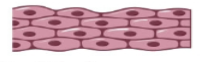
stratified squamous epithelial tissue
when tissues have many cell layers; thick —> protective; lines the oral cavity, vagina, and anal canal, and esophagus
keratinized
Within stratified squamous epithelial tissues, the epidermis is __
dry, tough, protective
keratinized allows for a __ material
stratified cuboidal epithelial tissue
have 2-3 layers of cube-shaped cells to form the lining of the lumen (more protection than 1 layer), line the ducts of mammary, sweat, and salivary glands, and the pancreas
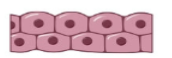
stratified columnar epithelial tissue
has several layers of cells, the top layer of elongated cells, cube-shaped cells in deeper layers, and lines part of the urethra (vas deferens) and parts of the pharynx
^^ protection, absorption, and secretion ^^
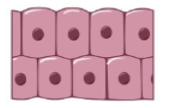
transitional epithelial tissue
has many cell layers; cube-shaped and elongated cells; changes shape and appearance with increased tension; lines the urinary bladder, ureters, and part of the urethra
^^ forms a barrier and lining that can be expanded ^^
glandular epithelial tissue
composed of cells that produce and secrete substances into ducts or boldly fluids → these cells are usually found in cuboidal or columnar epithelium
endocrine glands
__ secrete into the tissue fluid or blood
exocrine glands
__ secrete into ducts that open onto an internal or external surface
unicellular exocrine glands
composed of one epithelial cell, such as a goblet cell (secrete mucus)
multicellular exocrine glands
__ consisting of many cells; can be simple/compound (sweat&salivary)
simple exocrine glands
__ communicates with the surface by an unbranched duct, small and large intestine, and secretes mucus for digestion
compound exocrine glands
duct branches before it reaches the secretory portion, the parotid and salivary glands
tubular exocrine glands
consist of epithelial-lined tubes
alveolar exocrine glands
terminal portions form sac-like dilations, secrete into ducts, and milk from mammary glands
merocrine glandular secretion
secrete fluid products by exocytosis, salivary and sweat glands, pancreas (digestive juices into the duodenum)
apocrine glandular secretion
lose a small part of the cell during secretion; mammary and cerunious glands (earwax)
holocrine glandular secretion
releases entire cells filled with product, sebaceous glands
The Sebaceous Gland (holocrine)
secretes sebum, an oily substance on our skin, and is associated with a hair follicle. It is a simple-branched alveolar gland that secretes entire cells (overproduction can lead to acne)
connective tissues
what tissue is the most abundant tissue type by weight?
extracellular matrix
connective tissues contain abundant __ between cells, consisting of protein fibers and a ground substance
fibroblasts (fixed)
are the most common fixed cell and are large, star-shaped cells that produce fibers by secreting protein into the matrix
⬆Rapidly respond to injury by increasing in number → repair tissues that have limited abilities to regenerate
mast cells
are usually near blood vessels (immune system cells) that are derived from white blood cells; covered in granules; release heparin → prevents blood clotting; release histamine → stimulates inflammation and is a vasodilator
macrophages (wandering)
originate as white blood cells and are also known as histocytes; very numerous; usually attached to fibers, but can detach and wander; conduct phagocytosis and function as these scavenger cells that can remove foreign particles from tissues; defend against infection
fibroblasts
__ produce collagen, elastic, and reticular connective tissue fibers
collagen fibers
are grouped in long, parallel bundles; great tensile strength → can resist considerable pulling forces; flexible but only slightly elastic; found in ligaments (connect bone to bone) and tendons (muscles to bones)
elastic fibers
are composed of bundles of myofibrils embedded in elastin, a protein that branches, can stretch and return to its original shape, and is not as strong as collagen fibers. They are found in the vocal cords and the respiratory air passages
reticular fibers
are thin, branching fibers of collagen that form delicate, supporting networks found in the spleen and liver
areolar connective tissues
form thin, delicate membranes with cells being mainly fibroblasts, in a gel-like ground substance; in the subcutaneous layer; beneath most epithelia, where it nourishes nearby epithelial cells; binds skin to underlying organs, and fills the space between muscles
adipose fat tissue
is adipocytes that store fat droplets in cytoplasm; push their nuclei to one side; crowd out other cell types to become itself; cushions joints and some organs (kidneys), and lies just beneath the skin to insulate
white adipose tissue
store nutrients for nearby cells to use in the production of energy
brown adipose tissue
has cells that have many mitochondria to break down nutrients to generate heat to warm the body (babies have more of this)
rectiular connective tissues
is composed of a network of thin reticular fibers, like a filter; it supports the walls of internal organs, the walls of the liver and spleen (immune system)
dense regular connective tissues
consists of many closely packed, thick collagenous fibers, a fine network of elastic fibers, and fewer
dense irregular connective tissues
is thicker, with interwoven, more randomly organized fibers, which allow the tissue to sustain tension exerted from many different locations
^found in the dermis, periosteum (covers bone), perichodrium (covers cartilage), and encapsulated organs → nourishes and protects the other parts of the body
elastic connective tissues
consist of yellow elastic fibers in parallel strands or a branching network; collagenous fibers and fibroblasts between these fibers; attachments between vertebrae, within the walls of some internal hollow organs, such as large arteries, and some portions of the heart (aorta, and the larger airways)
cartilage
provides support, frameworks, attachments, and protection of underlying tissues, and forms structural models for many developing bones
hyaline cartilage
is the most common type; slippery and smooth so bones can move smoothly, fine collagen fibers in matrix, and ends of bones in joints, nose, respiratory passages, and between your ribs
elastic cartilage
is the most flexible, due to elastic fibers in the matrix, and is in the external ear (larynx)
fibrocartilage
is very tough due to many collagen fibers; a shock absorber; intervertebral discs, pads (menisci) of the knee, and the pelvic girdle
bone
is the most rigid connective tissue (mineral salts) that supports and protects vital structures (cranial and thoracic cavities), produces blood cells, and forms attachment sites for muscles; it forms the skeleton.
compact bone
(osteocytes + matrix + haversian) canal forms cylindrical units called osteons. Osteocytes send out processes into canaliculi and share the blood supply
spongy bone
makes up the interior part of bones, consists of bony plates containing osteocytes, with space between them for marrow; it is lighter in weight than compact bone
blood
is composed of cells (red or white) and cellular fragments called platelets suspended in plasma, and most are formed in hematopoietic tissues located in red marrow
integumentary system
The skin and its accessory structures make up the
weight
The integumentary system is the largest organ by __
skin
The__ is also called the cutaneous membrane
epidermis
the outer / superfiical layer of the skin
dermis
The innermost layer of the skin that binds epidermis to the underlying tissue; it supplies nutrients to the epidermis
subcutaneous
beneath the dermis; the insulated layer that is not considered part of the skin
nutrients
The subcutaneous layer provides
stratified squamous epithelium
epidermis is the outer layer that is known as __
avascular
The epidermis is __ which gets its blood supply from the dermis
keratinocytes
epidermis cells are __
epidermis protects against __
water loss, harmful chemicals, mechanical injury, and pathogens
stratum corneum
__ is a part of the epidermis and is fully keratinized with dead cells and a barrier that is further away from the dermis (5th or outer layer)
stratum lucidum
__ is a part of the epidermis and is only found in the thickened skin of the palms and soles (4th layer from the inside dermis)
stratum granulosum
__ is a part of the epidermis and is the granular layer where keratinization begins (3rd middle layer)
stratum spinosum
__ is a part of the epidermis and is the thick layer that cells form from junctions (2nd inner layer)
stratum basale
__ is a part of the epidermis and is the deepest (1st or base) layer that cells go through mitosis (very active layer), starting point
dendritic cells
(Langerhans cells) that are found in the stratum spinosum and have phagocytes that protect the skin and underlying tissues from infections
tactile cells
(Merkel cells) are found in the stratum basale and are along with sensory nerve endings, and act as sensory receptors for light touch
melanocytes
They are found in the stratum basale and produce pigment melanin
absorbs UV light from sunlight and provides skin color
cytocrine secretion
Melanin is distributed to keratinocytes via granules, to protect from UV radiation → __
DNA
genetic material that has molecules that store information in its sequence of nucleotides, which instruct a cell on how to synthesize certain proteins
proteins coded
enzymes, blood proteins, structural proteins of muscles and connective tissue, antibodies, and cell membrane components are __ in DNA function
red blood cells
do not have DNA because of how small it is and how well it binds to hemoglobin!
Gene
part of a DNA molecule that encodes the information to synthesize a protein; the unit of inheritance
chromosomes
Long molecules of DNA and its proteins are organized into __
genome
complete set of genetic instructions for an organism → all cells contain two copies of the genome (except sex cells because you get one from mom, then one from dad)
exome
a small portion (2%) of the genome that codes for proteins
gene expression
control of which proteins are produced in each cell type, in what amount, and when
nucleotides
the structure of DNA is __ known as building blocks of DNA
nucleotides, complementary strands, and hydrogen
DNA is a double stranded-molecule consisting of 2 chains of __ and resembles a ladder twisted into a spiral with bases of 2 __ that are linked together by __ bonds
adenine —> thymine
cytosine —> guanine
complementary base pairing can look lke:
purines
adenine and guanin are __
pyrimidines
cytosine and thymine
histones
The DNA double helix is wound around proteins called __
chromatin
a group of 8 histones —>
synthesize proteins
the configuration of chromatin influences which genes are being acessed to __ under certain conditons
DNA Replication
is a process in which an exact copy of the DNA molecule is made; it occurs during interphase (S Phase)
base pairs
During DNA Replication, hydrogen bonds break in between __
DNA helicase
During DNA Replication, strands unwind and seperate (via __)
DNA Polymerase
During DNA Replication, new nucleotides pair with exposed bases, under the direction of __
sugar-phosphate backbone
During DNA Replication, DNA polymerase connects new __ that provide a template for complementary RNA —> hydrogen bonds