Chapter 21: Genetics of complex traits
 Call Kai
 Learn
 Practice Test
 Spaced Repetition
 Match
 Flashcards
 Knowt Play
1/19

There's no tags or description
Looks like no tags are added yet.
20 Terms
complex genes are influenced by what factors?
multiple genes
allele interactions
variation in environment
interaction between alleles and environment
what is one of the most important parts of analyzing quantitative trait variation?
separating the genetic effects from the environmental effects
Example of quantitative trait variation in dandelions
found how either genetic factors impacted stem length or environmental factors impacted stem length at flowering. This required calculating the genetic and environmental variances, then adding up both to find to find total phenotypic variance (Vp = VG + VE, VG = genetic variance and VE = environmental variance)
heritability of a trait
the proportion of total phenotypic variance (VP) that is ascribable to genetic variation. There are two different types of variation: broad and narrow
broad sense variability
measured only when comparing identical twins to each other

Narrow sense variability
this is what we are more interested in. Heritability looks at the additive variance

Summary of equations
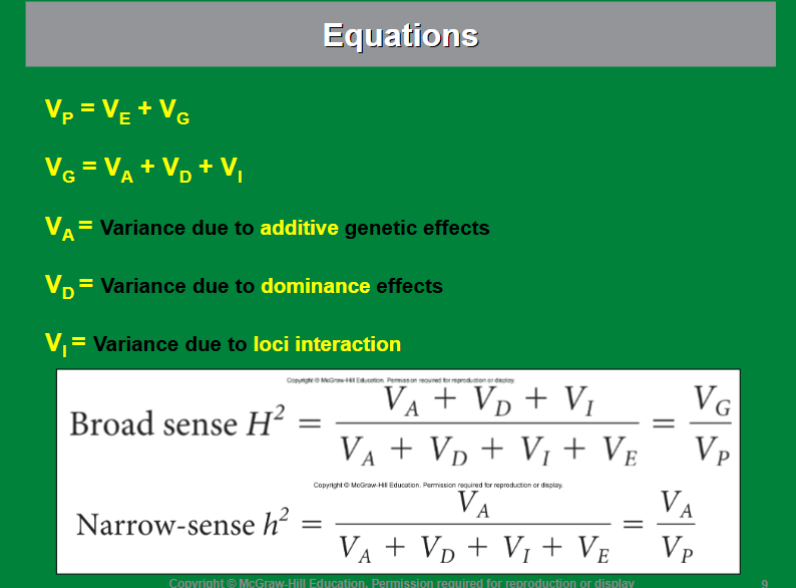
what would the heritability be if the environment had no effect?
1.0
what would the heritability be if there was no genetic contribution?
0 because it would all be dependent on environmental variation
concordance of a trait in two children raised in the same family but had no genetic heritability

concordance of a trait in two children raised in the same family but had different trait frequency due to genetic heritability

selection differential (S)
difference between value for this trait in the parents and value for this trait in the entire population (breeding and nonbreeding)
Response to selection (R)
the amount of change in the mean value of a trait that results from selection
how Selection differential (S), Response to selection (R), and heritability relate

quantitative trait loci (QTLs)
genes that contribute to complex traits
how to mapp QTLs
direct QTL mapping
Association mapping
direct QTL mapping
requires crosses between individuals that differ in the phenotype of interest. Looks for joint segregation of the phenotype and genetic markers. the steps are:
cross individuals showing two extremes of a phenotype
identify DNA markers (such as SNPs, insertions, deletions, or SSRs) that segregate with the phenotype
markers strongly correlated with phenotype are likely to be NEAR genes that influence the trait
association mapping
takes advantage of the history of a random breeding population
Example of rough mapping

Genome-Wide Association Studies (GWAS) identified what?
that genes only control a fraction of the total trait variation